

Listen to this podcast for free in the app: Download for free in the App Store
radio.net
Sleep timer
Save favourites
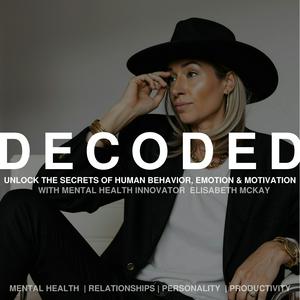
Decoded | Unlock The Secrets of Human Behavior, Emotion and Motivation
Elisabeth McKay | Mental Health Innovator and PredictiveMind Founder
Latest episode
58 episodes

Sex, Fantasy & Media Priming: Who Programmed Your Desire?
2026/09/17 | 1h 25 mins.What if your sexual desires aren't simply "who you are"?
What if fantasy, attraction, kink, pornography, and even the way you experience intimacy have been shaped by years of childhood exposure, media priming, repetition, brain patterning, and unresolved behavioral frameworks you didn't consciously choose?
In this episode of Decoded, Elisabeth McKay challenges the cultural narrative that sexual liberation automatically produces greater freedom, consciousness, or intimacy. Instead, she examines what happens when sexual desire is treated as an identity to continually explore rather than a behavioral pattern whose origins and consequences can be questioned.
Elisabeth traces the conversation back to childhood: what you saw, overheard, searched for, experienced, or were repeatedly exposed to before you had the cognitive framework to understand it. She explains how these early priming events and source belief patterns can influence intrusive thoughts, sexual fantasy, attraction, pornography consumption, power dynamics, and the way adults attempt to build intimate relationships.
The episode also examines the opposite extreme. Sexual repression and rigid attempts to completely shelter children can create their own pendulum swing. The objective isn't repression versus liberation. It's understanding what shaped your desires so you can determine whether repeatedly feeding them is actually creating the life and relationships you consciously want.
Elisabeth explores:
Childhood sexual priming and source belief patterns
How early media exposure can influence intrusive thoughts
Sexual fantasy through the lens of brain patterning
Pornography, repetition, novelty, and escalating stimulation
Fifty Shades of Grey and the mainstreaming of kink and BDSM
Sexual liberation and the pendulum swing from repression
Power dynamics, domination, submission, and role-play
Synaptic pruning and reinforcing versus starving behavioral pathways
Why fantasy can interfere with vulnerable intimacy
Hypersexualized media and changing beauty standards
Social media algorithms and repeated sexual imagery
Polyamory, commitment, and Elisabeth's perspective on relational transformation
Protecting childhood innocence without bubble-wrapping children
The difference between sexual connection and sexual impulse
The "weeds vs. flowers" framework for deciding what you're reinforcing
This isn't an argument for sexual repression.
It's an argument for examining the origin of what you desire before automatically deciding that desire deserves to be fed.
Because repetition matters. Priming matters. What you consume matters. And the patterns you continually reinforce can eventually compete directly with the marriage, family, intimacy, identity, and life you're consciously trying to build.
Watch the episode and ask yourself: Are you feeding the flowers—or reinforcing the weeds?
🔗 Find out your Brain Pattern Type: https://predictivemind.io/
🔗 Learn about Rapid Emotional Rewiring: https://breakmethod.com/
🔗 Grab a Copy of Your Brain is a Filthy Liar: https://www.amazon.com/YOUR-BRAIN-FILTHY-LIAR-Self-Deception/dp/1967424284/
🔗 My Peptide Supplier: https://elliemd.com/bizziegold
🔗 The Only Sauna I Recommend: https://www.healingsauna.com/bizzie?rfsn=8731070.5183d1 (Use CODE: BGHEAL for $200 OFF + Free Shipping)
Learn more about your ad choices. Visit megaphone.fm/adchoicesYour Diagnosis Isn't The Root Cause | Dr. Will Cole
2026/09/10 | 1h 18 mins.What if the anxiety, brain fog, fatigue, intrusive thoughts, or dysregulation you're experiencing isn't coming exclusively from your thoughts? And what if a physical symptom isn't exclusively physical either?
In this episode of Decoded, Elisabeth McKay sits down with functional medicine expert Dr. Will Cole to examine the intersection between mental health, cellular health, inflammation, hormones, environmental exposures, gut health, and behavioral patterns.
The central question is one that conventional conversations often separate into competing camps: Is the origin of a symptom physiological, psychological—or both?
Dr. Cole explains how functional medicine approaches that question through comprehensive lab testing, tighter functional ranges, health history, and bio-individuality. They discuss cellular aging, mitochondrial dysfunction, metabolic health, thyroid function, environmental toxins, mold, intrusive thoughts, trauma, peptides, IV therapy, and why receiving a diagnosis still doesn't necessarily explain the mechanism that produced it.
They also get into the philosophy behind longevity. Dr. Cole distinguishes extending healthspan from the pursuit of immortality and discusses the spiritual dimension of health explored in his new book with Dr. Josh Axe, Heal Yourselves: Reversing the Irreversible.
In this episode:
Mental health symptoms and cellular dysfunction
Why mental health and physical health aren't separate systems
Intrusive thoughts and neuro-immune-endocrine dysregulation
What functional medicine actually is
Optimal lab ranges vs. conventional reference ranges
Why the same diagnosis can have different underlying mechanisms
Autoimmunity, thyroid function, and metabolic health
Cellular aging and mitochondrial function
Mold, biotoxins, heavy metals, pesticides, PFAS, and microplastics
Stress, trauma, shame, and physiological dysregulation
Healthspan vs. the pursuit of immortality
The spiritual component of longevity
Biomarkers Dr. Cole looks at when evaluating cellular health
Why peptides are a tool—not a substitute for addressing underlying dysfunction
When IV therapy may be useful and when it may simply become an expensive bandage
The point isn't to decide that every psychological symptom is secretly physical—or that every physiological symptom can be changed through thought.
It's to stop forcing the human body into an either/or framework when the systems affecting your behavior, emotions, brain, immune function, hormones, and cellular health are constantly interacting.
Watch the full conversation and ask a better question: What is actually upstream of the symptom you're trying to change?
🔗 Find out your Brain Pattern Type: https://predictivemind.io/
🔗 Learn about Rapid Emotional Rewiring: https://breakmethod.com/
🔗 Grab a Copy of Heal Your Cells: Reversing The Irriversable:
https://www.amazon.com/s?k=heal+your+cells+by+dr+josh+axe&hvadid=810242586169&hvdev=c&hvexpln=67&hvlocphy=9029650&hvnetw=g&hvocijid=3115731636250114120--&hvqmt=e&hvrand=3115731636250114120&hvtargid=kwd-2486225119640&hydadcr=11928_13659523&mcid=07dbe94efda0309f9c54d23f4f7ebffd&tag=googhydr-20&ref=pd_sl_6w8kwzbyh6_e_p67🔗 My Peptide Supplier: https://elliemd.com/bizziegold
🔗 The Only Sauna I Recommend: https://www.healingsauna.com/bizzie?rfsn=8731070.5183d1 (Use CODE: BGHEAL for $200 OFF + Free Shipping)
Learn more about your ad choices. Visit megaphone.fm/adchoicesWhen Your Child Suddenly Develops OCD, Anxiety or Tics
2026/09/03 | 37 mins.What if your child seemed completely normal—and then, within days, became a completely different person?
Sudden OCD. Severe separation anxiety. Food restriction. Tics or unusual movements. Sleep disruption. Frequent urination. Explosive behavior. Developmental regression. Even symptoms that appear irrational, obsessive, or psychiatric.
In this episode of Decoded, Elisabeth McKay breaks down PANS and PANDAS—two controversial areas of pediatric neuropsychiatry that force us to ask a critical question: Are we mistaking psychiatric symptoms for the origin of the problem?
PANS stands for Pediatric Acute-Onset Neuropsychiatric Syndrome. PANDAS refers specifically to Pediatric Autoimmune Neuropsychiatric Disorders Associated with Streptococcal Infections. But understanding the labels is only the beginning.
Elisabeth examines how sudden behavioral deterioration can potentially emerge from multiple directions. In some cases, psychological and environmental inputs may be involved. In others, infection, immune activity, inflammation, mold toxicity, or another medical process may warrant investigation. And sometimes, multiple factors may be operating at once.
In this episode:
What PANS and PANDAS actually mean
The defining importance of sudden symptom onset
OCD, food restriction, anxiety, aggression, regression, tics, and sleep changes
The history of PANDAS and its association with Group A strep
Why PANS is broader than PANDAS
Basal ganglia circuitry and the proposed immune hypothesis
Why there is currently no single definitive PANS biomarker
What the American Academy of Pediatrics has said about PANS
PANS vs. autoimmune encephalitis
Why psychiatric symptoms don't automatically prove psychiatric origin
Psychological and environmental "perfect storm" events
Mold toxicity and other potential environmental factors discussed in the episode
How parental behavior during illness can affect a child's interpretation
Why parents should document patterns without catastrophizing
What information can make conversations with clinicians more productive
Why medical investigation and behavioral support don't necessarily have to be either/or
The goal isn't to diagnose your child from a podcast.
It's to stop confusing the description of an output with an explanation of its mechanism.
When a child's functioning changes rapidly, the question isn't simply, "What psychiatric label fits these symptoms?"
It's also: What changed—and where did this process actually begin?
Watch, observe carefully, document what you can, and work with qualified clinicians when medical evaluation is warranted.
🔗 Find out your Brain Pattern Type: https://predictivemind.io/
🔗 Learn about Rapid Emotional Rewiring: https://breakmethod.com/
🔗 Grab a Copy of Your Brain is a Filthy Liar: https://www.amazon.com/YOUR-BRAIN-FILTHY-LIAR-Self-Deception/dp/1967424284/ref=sr_1_1?crid=390FC0W304YNI&dib=eyJ2IjoiMSJ9.I8_kpD55nc-N5yNG8B9OPQ.Q7fi8mscYcCo01FBkOKtQgnXw7exKMp_Qus3pkQiQDw&dib_tag=se&keywords=your+brain+is+a+filthy+liar&qid=1767306891&sprefix=your+brain+is+a%2Caps%2C212&sr=8-1
🔗 My Peptide Supplier: https://elliemd.com/bizziegold
🔗 The Only Sauna I Recommend: https://www.healingsauna.com/bizzie?rfsn=8731070.5183d1 (Use CODE: BGHEAL for $200 OFF + Free Shipping)
Learn more about your ad choices. Visit megaphone.fm/adchoicesWhen Does a Thought Become a Delusion?
2026/08/27 | 55 mins.What separates an intrusive thought from a delusion? And at what point does your interpretation of reality become so rigid that contradictory evidence can no longer reach you?
In this episode of Decoded, Elisabeth McKay breaks down the difference between intrusive thoughts, delusion, and psychosis—and why understanding that distinction matters far beyond severe psychiatric illness.
Using the Lindsay Clancy trial as a starting point, Elisabeth examines how reality testing deteriorates, why emotionally driven interpretations can become self-sealing, and how persecutory, referential, grandiose, jealous, somatic, and nihilistic delusions actually function. She also explores the complicated intersection between spirituality and psychosis, gaslighting and coercive control, and the role agency and metacognition play in keeping you anchored to objective reality.
The episode also returns to new evidence discussed in the Lindsay Clancy trial, including searches allegedly made while Lindsay was away from the home, and the questions those details raise within Elisabeth’s stated hypothesis about Lindsay’s psychological deterioration. These are presented as questions and hypotheses—not established conclusions.
In this episode:
Intrusive thoughts vs. delusions vs. psychosis
What reality testing actually looks like
How to separate evidence from assumptions
Persecutory and referential delusions
Grandiose and spiritual delusions
Jealous, somatic, and nihilistic delusions
Why contradictory evidence can strengthen a delusion
How spirituality can become entangled with psychosis
Gaslighting, coercive control, and destabilized self-trust
New questions raised by the Lindsay Clancy trial
Why intrusive thoughts do not equal intention
Agency and metacognition
10 rules for protecting your grip on objective reality
The central question isn't whether you've ever had a disturbing, irrational, or emotionally charged thought.
It's whether you can still recognize that a thought is a thought, a feeling is not evidence, and your interpretation is not automatically reality.
Watch, reflect, and ask yourself: What do I actually know using only three-dimensional evidence?
🔗 Find out your Brain Pattern Type: https://predictivemind.io/
🔗 Learn about Rapid Emotional Rewiring: https://breakmethod.com/
🔗 Grab a Copy of Your Brain is a Filthy Liar: https://www.amazon.com/YOUR-BRAIN-FILTHY-LIAR-Self-Deception/dp/1967424284/
🔗 My Peptide Supplier: https://elliemd.com/bizziegold
🔗 The Only Sauna I Recommend: https://www.healingsauna.com/bizzie?rfsn=8731070.5183d1 (Use CODE: BGHEAL for $200 OFF + Free Shipping)
Learn more about your ad choices. Visit megaphone.fm/adchoicesThe Lindsay Clancy Trial: What Doesn't Add Up?
2026/08/20 | 59 mins.The Lindsay Clancy trial raises a question bigger than guilt or innocence: What happens when psychiatry, self-reporting, medication, human perception, and the judicial system collide?
In this episode of Decoded, Elisabeth McKay examines the Lindsay Clancy case—not as a true crime investigation, but through the psychological and systemic questions emerging from the trial.
The Commonwealth argues that Clancy intentionally murdered her three children. Her defense has argued that she was experiencing postpartum psychosis. But as Elisabeth examines the testimony and competing narratives surrounding the case, a much larger conversation emerges about psychiatric care, pharmacological intervention, self-reporting, perception, gaslighting, and the limitations of attempting to reconstruct objective reality through subjective human observation.
Elisabeth also examines an alternate theory circulating around the case: What if Lindsay Clancy didn't kill her children? She makes clear that this is a hypothesis—not an established fact—and discusses the details that caused her to question the dominant narrative.
This episode explores:
The Lindsay Clancy trial and postpartum psychosis defense
Questions surrounding Clancy's psychiatric treatment
The limitations of patient self-reporting
Why practitioner observation can also be distorted
Psychiatric medication and cascading pharmacological interventions
Concerns raised during testimony about suicidal ideation
The difference between symptoms and root causes
Questions surrounding Patrick Clancy's account
Why certain details of the night raise questions for Elisabeth
Gaslighting, self-trust, and distorted perception
How psychologically vulnerable people can lose confidence in their own reality
The limitations of traditional talk therapy
Why data-driven mental health assessment matters
The larger mental health failures exposed by this case
This is not an attempt to determine guilt from a podcast.
It is an examination of what happens when every layer of a system depends on human beings accurately reporting, observing, interpreting, and remembering reality.
And when those systems fail, the consequences aren't theoretical.
People's lives can be destroyed.
Watch the episode, examine the available evidence yourself, and draw your own conclusions.
🔗 Find out your Brain Pattern Type: https://predictivemind.io/
🔗 Learn about Rapid Emotional Rewiring: https://breakmethod.com/
🔗 Grab a Copy of Your Brain is a Filthy Liar: Amazon
Learn more about your ad choices. Visit megaphone.fm/adchoices
More Health & Wellness podcasts
 The School of GreatnessBusiness, Education, Entrepreneurship, Health & Wellness, Mental Health, Self-Improvement
 Huberman LabHealth & Wellness, Life Sciences, Science
 Feel Better, Live More with Dr Rangan ChatterjeeAlternative Health, Health & Wellness
 Maintenance PhaseEducation, Health & Wellness, History
 Get Sleepy: stories for sleepAlternative Health, Drama, Fiction, Health & Wellness, Kids & Family, Stories for Kids
 The Mindset MentorBusiness, Education, Health & Wellness
 Nothing much happens: bedtime stories to help you sleepFiction, Health & Wellness
 ZOE Science & NutritionEducation, Health & Wellness, Nutrition, Science
 Sleep Magic: Sleep Hypnosis & Meditation for Sleep PodcastAlternative Health, Education, Health & Wellness, Self-Improvement
 The Wellness ScoopHealth & Wellness, Mental Health, Society & Culture
Trending Health & Wellness podcasts
- Maintenance PhaseEducation, Health & Wellness, History
 Psychology UnpluggedHealth & Wellness, Medicine, Mental Health, Science, Social Sciences
 Sex With EmilyHealth & Wellness, Sexuality
 The Dr. Tyna ShowAlternative Health, Health & Wellness
 TransformHealth & Wellness, Mental Health, Society & Culture
 The Mandy Meyer PodcastHealth & Wellness
 TopMedTalkEducation, Health & Wellness, Medicine
 The Genius LifeHealth & Wellness
 Mindful In Minutes MeditationAlternative Health, Education, Health & Wellness, Self-Improvement
 Uniquely Human: The PodcastEducation, Health & Wellness, Mental Health
 Therapy for Black GirlsHealth & Wellness, Mental Health
 Do You F*cking Mind?Education, Health & Wellness, Mental Health, Self-Improvement
 Anaesthesia on AirEducation, Health & Wellness, Medicine, Science
 The Homecoming Podcast with Dr. ThemaHealth & Wellness
 Age Better with Liz EarleArts, Education, Fashion & Beauty, Health & Wellness, Self-Improvement
 The Dr. Lee Warren PodcastChristianity, Education, Health & Wellness, Life Sciences, Mental Health, Religion & Spirituality, Science, Self-Improvement
 We're All InsaneHealth & Wellness, Mental Health
 Sounds for Deep Sleep: White Noise, Ambience, Nature SoundsHealth & Wellness
About Decoded | Unlock The Secrets of Human Behavior, Emotion and Motivation
Unlock the Hidden Code Running Your Life—And Rewrite It for Good.
Your thoughts, relationships, addictions, and self-sabotaging behaviors aren’t random—they’re programmed patterns your brain has been running on autopilot.
Decoded breaks down the subconscious lies shaping your reality and gives you the tools to rewire them. Whether you're stuck in toxic cycles, battling destructive coping mechanisms, or just tired of feeling out of control, this podcast hands you the blueprint to disrupt the patterns, take back your mind, and start living with intention.
Podcast websiteListen to Decoded | Unlock The Secrets of Human Behavior, Emotion and Motivation, The School of Greatness and many other podcasts from around the world with the radio.net app
Get the free radio.net app
- Stations and podcasts to bookmark
- Stream via Wi-Fi or Bluetooth
- Supports Carplay & Android Auto
- Many other app features
Get the free radio.net app
- Stations and podcasts to bookmark
- Stream via Wi-Fi or Bluetooth
- Supports Carplay & Android Auto
- Many other app features
Decoded | Unlock The Secrets of Human Behavior, Emotion and Motivation
Scan code,
download the app,
start listening.
download the app,
start listening.
 South Africa