
Listen to this podcast for free in the app: Download for free in the App Store
radio.net
Sleep timer
Save favourites
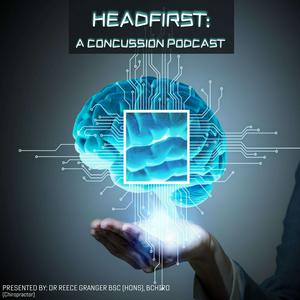
Headfirst: A Concussion Podcast
Dr Reece Granger BSc (Hons), BChiro
Latest episode
152 episodes
Heading for Trouble: Football’s Head Impact Crisis – And How We Save the Game with Dr Kevin Moore
2026/10/20 | 53 mins.Send us Fan Mail
Dr Moore is the founding Director of England’s National Football Museum, which he built from the ground up over more than twenty years, bringing together world-class collections, including the FIFA Collection. He opened the museum in Preston in 2001 before relocating it to Manchester in 2012, where it attracted over half a million visitors annually. He has advised sports museums internationally and written extensively on football history and museum culture.
His latest book, Heading for Trouble: Football’s Head Impact Crisis – And How We Save the Game, published by Bloomsbury Sport, draws on research and interviews with former players and neurological experts to explore the links between repetitive heading and brain disease, football’s slow response, and how the game can protect its players while preserving everything we love about it.
02:00 - Running a Sports Museum,
04:24 - Writing a Book on Football & Concussion?
08:00 - How Heading Became Part of the Game
15:45 – Concussion, CTE & Repetitive Heading Impacts
21:10 – Differences in Men, Women and Children
32:20 – Who Creates the Rules and Changes the Rules
36:40 – Ball Size, New vs Old
41:20 – Personal Views on Changing Rules for the Game
45:20- Favourite Sporting Moment and Piece of Memorabilia from a Museum
49:50 - Purchasing the Book and Supporting Dr Kevin Moore’s Work?
Dr Kevin Moore
https://doctorkevinmoore.org
https://www.bloomsbury.com/au/heading-for-trouble-9781399428248/
Audio Book on Spotify
https://open.spotify.com/show/1iA6Tpl5kqida5p0VJnZcN?si=32466a2f1b524e1d
Twitter: @first concussion
Facebook: Headfirst: A concussion podcast
Instagram: Headfirst_ Concussion
Email: headfirstconcussion@gmail.com
Subscribe, review and share for new episodes, which drop weekly
www.headfirstaconcussionpodcast.com
Twitter: @first concussion
Facebook: Headfirst: A concussion podcast
Instagram: Headfirst_ Concussion
Email: headfirstconcussion@gmail.comConcussions, Culture and The Sociology of Sport with Dr Jack Hardwicke
2026/10/13 | 59 mins.Send us Fan Mail
Dr Hardwicke is a Senior Lecturer in the Sociology of Sport at Nottingham Trent University and a leading UK voice on brain injury in sport. A former competitive cyclist who suffered a brain injury himself, he now works with colleagues on how to better care for former athletes living with neurodegeneration and their families. Through his research and his writing for the British Journal of Sports Medicine and The Conversation, he challenges sport to focus on preventing brain injuries rather than only managing them after they happen.
01:30 – Journey into Concussion and Sociology Research
09:30 - What is a Concussion in Sociology Research
13:00 - “Knowledge Doesn't Equal Safety" Paradox
20:00 - Brain Injury in Women’s Sport and Misconceptions
30:08 - Suspected CTE and Families Research
46:15 – Children and Brain Injury
54:53 - Where to Find Dr Jack Hardwicke
Dr Jack Hardwickie
https://www.ntu.ac.uk/staff-profiles/science-technology/jack-hardwicke
Google Scholar: https://scholar.google.com/citations?user=riOu_9AAAAAJ&hl=en
Subscribe, review and share for new episodes, which drop weekly
www.headfirstaconcussionpodcast.com
Twitter: @first concussion
Facebook: Headfirst: A concussion podcast
Instagram: Headfirst_ Concussion
Email: headfirstconcussion@gmail.comRepetitive Head Impacts, Chronic Traumatic Encephalopathy (CTE) and Traumatic Encephalopathy Syndrome with Dr Robert Stern (Re-Release)
2026/10/06 | 1h 10 mins.Send us Fan Mail
Professor Stern is a Professor of Neurology, Neurosurgery, and Anatomy & Neurobiology at the Boston University Chobanian & Avedisian School of Medicine. As co-founder of the BU CTE Center and former Director of Clinical Research, he has spent nearly two decades pioneering ways to detect and diagnose chronic traumatic encephalopathy (CTE) during life, while uncovering the long-term neurological impact of repetitive head trauma in former athletes. His ground-breaking work includes major projects such as the landmark DETECT and DIAGNOSE CTE studies, the Head Impact & Trauma Surveillance Study, and numerous investigations into biomarkers and diagnostic criteria for concussion and CTE. With more than 250 peer-reviewed publications, key advisory roles with the NFLPA and NCAA, and recognition such as the 2025 Leon Thal Prize for Research Excellence, Professor Stern is widely regarded as one of the foremost experts shaping modern concussion and CTE science.
06:50 - Dr Robert Stern’s Journey into Neurology, Neurodegenerative Disease and Repetitive Head Impacts
13:00 - What Does Boston University CTE Do?
15:55 – Repetitive Head Impacts
20:45 – Chronic Traumatic Encephalopathy
24:35 – Dementia
28:25 – Neurological Disease’s and Clinical Testing In vivo
32:24 – Biomarkers, Diagnosis Dementia and Growth in the Field
40:00 – Nocebo Effect and Understanding/ Misunderstanding of What is Known
45:35 - Traumatic Encephalopathy Syndrome and Diagnostic Criteria
01:02:00 – Summary of Traumatic Encephalopathy Syndrome
01:07:00 – How to Help and Support Dr Stern’s Work
Professor Robert Stern:
https://www.bu.edu/cte/
https://www.bu.edu/cte/profile/robert-stern/
https://scholar.google.com/citations?user=42mlewcAAAAJ&hl=en
Subscribe, review and share for new episodes which will drop weekly
Social media:
Twitter: @first concussion
Facebook: Headfirst: A concussion podcast
Instagram: Headfirst_ Concussion
Email: headfirstconcussion@gmail.com
Subscribe, review and share for new episodes, which drop weekly
www.headfirstaconcussionpodcast.com
Twitter: @first concussion
Facebook: Headfirst: A concussion podcast
Instagram: Headfirst_ Concussion
Email: headfirstconcussion@gmail.comPrevalence of Chronic Traumatic Encephalopathy at Death in National Football League Players: Retrospective Population-Based Cohort Study, 2008-21 with Dr Daniel Daneshvar
2026/09/29 | 33 mins.Send us Fan Mail
Dr Daneshvar is an associate professor at Harvard Medical School, Chair of physical medicine and Rehabilitation at Spaulding Rehabilitation, and Co-Director of Sports Concussion at Mass General Brigham, whilst also a long-time collaborator with the Boston University CTE Centre. Lastly, Dr Daneshvar earned the National Neurotrauma Society's 2024 Rising Star Award, whilst publishing more than 100 papers and being cited over 18,000 times by his academic peers. One of those articles is “Prevalence of chronic traumatic encephalopathy at death in National Football League players: retrospective population-based cohort study, 2008-21” The topic of today’s conversation.
01:15 - Journey into Neurosciences and Brain Injury
02:50 – What is and Difference Between Concussion and CTE
05:16 - “Prevalence of Chronic Traumatic Encephalopathy at Death in National Football League Players: Retrospective Population-Based Cohort Study, 2008-21” What are the major findings? How was it conducted…. Etc
09:10 – Extrapolation of CTE in Populations & Correlation Against Death Certificates
12:13 – Stage’s of CTE
15:10 - Accelerometer Data as a Predictor of CTE vs Career Length
18:10 - Significant Challenges in Conducting Studies Around CTE
23:10 – Risk Reduction
27:40 - How Can we Help Support Dr Daneshvar Research
Dr Daniel Daneshvar
Google Scholar: https://scholar.google.com/citations?user=YF2omqkAAAAJ&hl=en
Prevalence of chronic traumatic encephalopathy at death in National Football League players: retrospective population-based cohort study, 2008-21 : https://www.bmj.com/content/394/bmj-2026-100418
Subscribe, review and share for new episodes, which drop weekly
www.headfirstaconcussionpodcast.com
Twitter: @first concussion
Facebook: Headfirst: A concussion podcast
Instagram: Headfirst_ Concussion
Email: headfirstconcussion@gmail.comNeuropathology and Chronic Traumatic Encephalopathy (CTE) with Dr Michael Buckland
2026/09/22 | 26 mins.Send us Fan Mail
Dr Buckland is Head of the Department of Neuropathology at Royal Prince Alfred Hospital in Sydney and a Clinical Associate Professor at the University of Sydney. He founded and directs the Australian Sports Brain Bank, established in 2018, which has since become a leading centre for research into chronic traumatic encephalopathy (CTE). He is also a co-founder of Brainstorm, a brain cancer research initiative at RPA, and leads research across gliomas, neurodegenerative diseases and molecular neuropathology.
01:17 – Dr Buckland’s Journey Neuropathology and What is Neuropathology
04:25 - Concussion, repetitive head impact
07:50 – What is Chronic Traumatic Encephalopathy (CTE)
10:20 – How is Chronic Traumatic Encephalopathy (CTE) Diagnosed
13:00 – Separating Different Types of Neurodegenerative Disease
16:54 – Does Response Relationship
19:00 -Brain Donation and Difficulties in Approaching Donations
23:00 – Brainstorm and Cancer
Google Schoolar: https://scholar.google.com/citations?user=A4mEg3QAAAAJ&hl=en
Australian Sports Brain Bank: https://brainbank.org.au
BrainStorm: https://brainbenefit.org/causes/brainstorm-at-rpa/
Twitter: @first concussion
Facebook: Headfirst: A concussion podcast
Instagram: Headfirst_ Concussion
Email: headfirstconcussion@gmail.com
Subscribe, review and share for new episodes, which drop weekly
www.headfirstaconcussionpodcast.com
Twitter: @first concussion
Facebook: Headfirst: A concussion podcast
Instagram: Headfirst_ Concussion
Email: headfirstconcussion@gmail.com
More Health & Wellness podcasts


Trending Health & Wellness podcasts




About Headfirst: A Concussion Podcast
Headfirst: A Concussion Podcast, discusses all things concussion. From the physiology, effects, treatment and rehabilitation process. All with the aim of providing the tools and education to help patients. DISCLAIMER: All information discussed and provided is not a substitute for professional medical advice of doctors or healthcare practitioners. If a listener believes they are suffering from a similar injury to one discussed by the author, please seek medical care of your doctor or physician and do not rely on the author's advice.
Podcast websiteListen to Headfirst: A Concussion Podcast, On Purpose with Jay Shetty and many other podcasts from around the world with the radio.net app
Get the free radio.net app
- Stations and podcasts to bookmark
- Stream via Wi-Fi or Bluetooth
- Supports Carplay & Android Auto
- Many other app features
Get the free radio.net app
- Stations and podcasts to bookmark
- Stream via Wi-Fi or Bluetooth
- Supports Carplay & Android Auto
- Many other app features
Headfirst: A Concussion Podcast
Scan code,
download the app,
start listening.
download the app,
start listening.
 South Africa