

Listen to this podcast for free in the app: Download for free in the App Store
radio.net
Sleep timer
Save favourites
1557 episodes
#632 Neil: Grok 4.7 Challenges GPT And Claude With Coding Power
2026/09/22 | 17 mins.Grok 4.7 is here with stronger coding skills, competitive benchmarks, and lower pricing. See how xAI’s latest model compares with GPT and Claude, where it performs well, and why developers are paying attention to its real-world coding and knowledge work abilities. 🚀
We'll talk about:
Grok 4.7 Launch And Its Competition With Leading AI Models
Grok 4.7 Coding Benchmark Results
Grok 4.7 Pricing Advantages
Grok 4.7 Real World Coding Applications
Grok 4.7 Strengths And Limitations Compared With GPT And Claude
Keywords: Grok 4.7, AI Coding Model, AI Coding Model, AI Benchmarks, GPT Vs Claude, AI Coding Assistant, AI Model Comparison, AI Tools.
Links:
Newsletter: Sign up for our FREE daily newsletter.
Our Community: Get 3-level AI tutorials across industries.
Join AI Fire Academy: 500+ advanced AI workflows ($14,500+ Value)
Our Socials:
Facebook Group: Join 299K+ AI builders
X (Twitter): Follow us for daily AI drops
YouTube: Watch AI walkthroughs & tutorials#631 Neil: Make Money With AI Through 9 Business Models Today
2026/09/22 | 17 mins.Make Money With AI through 9 business models ranked from easy to advanced. Learn how AI coaching, content creation, consulting, automation, digital products, and AI software can help you build different income opportunities based on your skills and goals. 🚀
We'll talk about:
AI Coaching And AI Business Training
AI Content Creation And Faceless AI Videos
AI Consulting And AI Native Marketing Agencies
AI Automation Agencies And Digital Information Products
Building AI Products With Vibe Coding
Choosing The Right AI Business Model Based On Your Skills
Keywords: Make Money With AI, AI Business Models, AI Coaching, AI Content Creation, AI Consulting, AI Automation Agency, AI Tools.
Links:
Newsletter: Sign up for our FREE daily newsletter.
Our Community: Get 3-level AI tutorials across industries.
Join AI Fire Academy: 500+ advanced AI workflows ($14,500+ Value)
Our Socials:
Facebook Group: Join 299K+ AI builders
X (Twitter): Follow us for daily AI drops
YouTube: Watch AI walkthroughs & tutorials🎙️ EP 360: xAI Unveils Grok 4.7 Coding Model & Xiaomi Open-Sources MiMo-V2.5 Suite
2026/09/22 | 15 mins.xAI launched Grok 4.7, its latest reasoning model targeted at complex software engineering, long-horizon repo manipulation, and office tasks, while holding API pricing steady at $2 per million input tokens and $6 per million output tokens. Meanwhile, Xiaomi released MiMo-V2.5, an open-source model suite featuring a 1M context window and extensive reinforcement learning optimizations designed for agentic workflows.
We’ll talk about:
Upgraded base model scoring 46.3% on CursorBench 4.0 and 71.0% on DeepSWE v1.1 while maintaining developer API rates.
Release of MiMo-V2.5-Pro and general multimodal variants with full model weights, training reports, and agent evaluation frameworks.
Meta’s standalone AI application outpacing early adoption rates across North America despite Amazon access restrictions.
Internal math models breaking 100+ open problems, prompting formal academic oversight initiatives.
Keywords: Grok 4.7, MiMo-V2.5 Suite, Meta Muse, OpenAI math advisory group.
Links:
Newsletter: Sign up for our FREE daily newsletter.
Our Community: Get 3-level AI tutorials across industries.
Join AI Fire Academy: 700+ advanced AI workflows ($14,500+ Value)
Our Socials:
Facebook Group: Join 299K+ AI builders
X (Twitter): Follow us for daily AI drops
YouTube: Watch AI walkthroughs & tutorials#630 Neil: GPT-6 Astra Usage Tips To Save More Tokens Daily
2026/09/21 | 19 mins.GPT-6 Astra is powerful, but your workflow decides how efficiently you use it. Learn how to audit usage, adjust reasoning effort, manage context, and avoid common mistakes that waste credits. These practical tips help you get better results from complex tasks. 🚀
We'll Talk About:
How To Audit Your GPT-6 Astra Usage
Why Reasoning Effort Matters For Different Tasks
When To Use GPT-6 Astra For Complex Problems
How To Remove Context Waste And Keep Chats Focused
How To Protect Context Across Different Workflows
How To Avoid Common Usage Mistakes With Better Prompts
Keywords: GPT-6 Astra, GPT-6 Astra Usage, GPT-6 Astra Tips, AI Workflow Optimization, AI Usage Management, AI Tools.
Links:
Newsletter: Sign up for our FREE daily newsletter.
Our Community: Get 3-level AI tutorials across industries.
Join AI Fire Academy: 500+ advanced AI workflows ($14,500+ Value)
Our Socials:
Facebook Group: Join 299K+ AI builders
X (Twitter): Follow us for daily AI drops
YouTube: Watch AI walkthroughs & tutorials#112 Robin: Claude Code + Hermes Can Build an AI Agent That Keeps Learning
2026/09/21 | 18 mins.Most AI agents forget the useful stuff the moment a session ends. But when Claude Code and Hermes share the same memory layer, you can build something much more interesting: an AI system that keeps running, remembers corrections, learns from failures, and gets better over time.
In this episode, we break down the builder–operator setup behind a practical self-improving AI agent. Claude Code handles the heavy building and upgrades. Hermes keeps the workflows alive in the background. Shared AI memory connects both sides so context, decisions, and lessons don’t disappear between sessions.
We’ll talk about:
Claude Code Builds, Hermes Operates: Why Claude Code is better for creating and upgrading the system, while Hermes is better suited to running scheduled jobs, monitoring changes, and handling ongoing work after you step away.
The Shared Memory Layer: How tools like Mem0, Zep, Letta, and Supermemory can give Claude Code and Hermes access to the same context, so one agent can pick up where the other left off.
How the Agent Actually Improves Itself: When Hermes catches a failure, the correction can be saved into memory and reused next time instead of disappearing after one chat. Bigger problems get handed back to Claude Code for deeper system upgrades.
Real Business Use Cases: Website monitoring, video-retention analysis, client operations, and other workflows where Hermes can watch what happens after deployment and feed useful signals back into the system.
The Safety Rules Before You Let It Run Alone: Why self-checking, approval gates, cheaper models for repeat work, and clean handoffs matter if you want an autonomous agent that is useful instead of chaotic.
Keywords: Claude Code, Hermes AI, AI Agent Memory, Self-Improving AI Agent, Mem0, Zep, Letta, Supermemory, Autonomous AI Agents, Agentic Workflows, AI Automation, Persistent Memory, Claude Code Agents, AI Operators, Background Agents, Multi-Agent Systems.
Links:
Newsletter: Sign up for our FREE daily newsletter.
Our Community: Get 3-level AI tutorials across industries.
Join AI Fire Academy: 500+ advanced AI workflows ($14,500+ Value)
Our Socials:
Facebook Group: Join 297K+ AI builders
X (Twitter): Follow us for daily AI drops
YouTube: Watch AI walkthroughs & tutorials
More Business podcasts
 The Diary Of A CEO with Steven BartlettBusiness, Education, Society & Culture
 Aspire with Emma GredeBusiness, Entrepreneurship, Society & Culture
 BizNews RadioBusiness, Business News, Investing, News
 RSG Geldsake met MoneywebBusiness, Investing
 The Ramsey ShowBusiness, Education, Investing, Self-Improvement
 The Game with Alex HormoziBusiness, Education, Entrepreneurship, Tutorials
 The Money ShowBusiness, Business News, Investing, News
 FoundersBusiness, Entrepreneurship, History, Technology
 A Bit of OptimismBusiness, Careers, Education, Self-Improvement
 Money with CarlaBusiness, Investing
Trending Business podcasts
 The Official BNI PodcastBusiness, Education, Entrepreneurship, Marketing, Self-Improvement
 Morning Brew DailyBusiness, Business News, News
 High Performance BusinessBusiness, Entrepreneurship, Management, News, Sports News, Technology
 Andy Stanley Leadership PodcastBusiness
 Founder's Mentality: The CEO SessionsBusiness, Careers, Management
 Business &... with Natalie DawsonBusiness, Entrepreneurship
 CNBC's "Fast Money"Business, Investing, News
 Denzel Washington Motivational SpeechBusiness, Education, Entrepreneurship
About AI Fire Daily
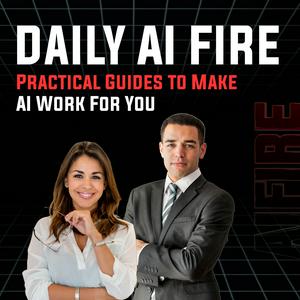
AI Fire – Master AI with practical guides. Your daily hub for AI-powered productivity. Join 72,000+ professionals from Google, Meta, Microsoft, Tesla, and more.AI Fire Podcast is your go-to resource for everything AI, from the latest trends to how AI can transform your career. Hosted by the AI Fire team and AI enthusiasts, we focus on providing you with practical tips to boost your productivity using AI tools and strategies.Our mission is to help you keep up with AI trends, master new skills, and get more done in less time. Whether you're looking to make money with AI, dive into prompt engineering, or explore automation and AI workflows, we've got you covered.Sign up for our FREE daily newsletter: https://www.aifire.co/subscribeGet 3-level AI tutorials across industries in our Community: https://community.aifire.co/Join AI Fire Academy: 500+ advanced AI workflows ($14,500+ Value): https://www.aifire.co/upgradeEmail us: services@aifire.coIn the AI Fire Podcast, we cover a wide range of topics such as:How to make money with AIAI Tools and AI JobsPrompt EngineeringAI Automations and AI WorkflowsAI Research and AI ReportsAI Case StudiesAI Startups and AI BooksAI Grants and DealsOur Socials:Facebook Group: Join 212K+ AI builders – https://www.facebook.com/groups/aifire.coX (Twitter): Follow us for daily AI drops – https://x.com/aifirecoYouTube: Watch AI walkthroughs & tutorials – https://www.youtube.com/@aifire.official
Podcast websiteListen to AI Fire Daily, The Diary Of A CEO with Steven Bartlett and many other podcasts from around the world with the radio.net app
Get the free radio.net app
- Stations and podcasts to bookmark
- Stream via Wi-Fi or Bluetooth
- Supports Carplay & Android Auto
- Many other app features
Get the free radio.net app
- Stations and podcasts to bookmark
- Stream via Wi-Fi or Bluetooth
- Supports Carplay & Android Auto
- Many other app features
AI Fire Daily
Scan code,
download the app,
start listening.
download the app,
start listening.
AI Fire Daily: Podcasts in Family
 South Africa