
Listen to this podcast for free in the app: Download for free in the App Store
radio.net
Sleep timer
Save favourites
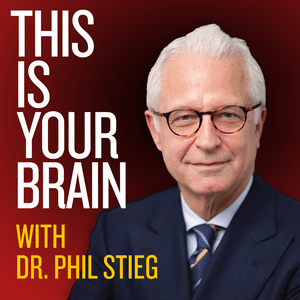
This Is Your Brain With Dr. Phil Stieg
Weill Cornell Medicine Neurological Surgery
Latest episode
198 episodes
The Power of Optimism: How to Overcome Helplessness
2026/10/16 | 29 mins.Why do some people bounce back from setbacks while others feel powerless to change their circumstances?
Dr. Martin Seligman, founder of positive psychology and author of Agency: The Psychological History of Human Progress, joins Dr. Phil Stieg to explore how optimism, resilience, and our belief in our ability to shape the future influence everything from mental health to human progress. He explains the neuroscience of learned helplessness, why positive thinking alone isn't enough, and how we can train our brains to overcome pessimism and regain a sense of control.
Discover practical strategies for breaking free from negative thought patterns, building resilience, and creating a more fulfilling life.May We Have Your Attention ... and Keep It?
2026/10/02 | 26 mins.Do you scroll on your phone for hours but then quit a meaty news story in 15 seconds? Maybe your attention span isn't the problem!
Dr. Ronald Yaros thinks the way to get people to pay attention is better content delivery that's designed to work with their busy lives.
Find out what actually captures and keeps our attention... and why.Is AI Making Us Dumber?
2026/09/18 | 28 mins.Every time AI answers for you, part of your brain may switch off. Theoretical neuroscientist Dr. Vivienne Ming explains why, including a striking claim about GPS use and Alzheimer's risk.
Dr. Ming shares her own fix for using AI. She calls it the nemesis prompt, a technique for turning AI into your harshest critic instead of your biggest fan.
Vivienne joins Dr. Stieg to unpack what it actually takes to come out of the AI age sharper, not dumber.Profiling The Criminal Mind - James Fitzgerald
2026/09/04 | 32 mins.For 17 years, the Unabomber skillfully eluded investigators, leaving behind no fingerprints, DNA, or usable forensic evidence but in the end it was his own words that gave him away.
Dr. Phil Stieg speaks with retired FBI criminal profiler James Fitzgerald, a pioneer of forensic linguistics whose analysis of Ted Kaczynski's writings helped crack one of the most notorious investigations in FBI history.
Fitzgerald reveals how investigators constructed a personality profile from the bomber's writings, identified the unusual turn of phrase that became a "linguistic smoking gun," and used patterns in language and behavior to identify this notoriously elusive criminal mind.
Plus, an exclusive glimpse into a family's traumatic moment when they discover their relative is a serial bomber.
###
Archival audio courtesy of Videos For Change Productions
Excerpt from documentary in progress "Life Or Death" featuring David Kaczynski and Linda Patrik, Producers Mike Camoin and John Carlson.A Memory Workout
2026/08/14 | 26 mins.Can't remember the fourth item on your grocery list? Nelson Dellis, a professional "memory athlete," can remember 100 things or more (though he still may forget the butter).
Hear how Dellis learned to memorize lists so long that he became a five-time USA Memory Champion, and how you can use some of his strategies to improve your own memory.
Dellis explains how he uses tricks like the "memory palace" and mnemonic devices to recall lengthy lists with perfect accuracy.
In an era when cell phones are making memory superfluous, you can regain some of those lost skills by using his techniques.
Plus… those rare folks who can never forget a day in their lives.
https://www.nelsondellis.com/
Click here for a transcript and further information on this episode.
More Health & Wellness podcasts







Trending Health & Wellness podcasts

















About This Is Your Brain With Dr. Phil Stieg
This Is Your Brain With Dr. Phil Stieg provides a fascinating look into the human brain, with each episode asking new questions — and finding new answers — about our most mysterious organ. Together with his expert guests, Dr. Stieg takes us on a journey that reveals unexpected secrets at every turn, and redefines what we know about ourselves and our place in the world.
The podcast explores the many fascinating aspects of neuroscience, ranging from how the brain is wired for both sudden bursts of violence and the pervasive inner calm of meditation. Where does confidence come from? How do we remember traumatic events – or do we? How do other animals experience consciousness? Does storytelling change our brains?
Take the journey with us as we explore the very foundation of what makes us human.
Podcast websiteListen to This Is Your Brain With Dr. Phil Stieg, Rain Sounds and many other podcasts from around the world with the radio.net app
Get the free radio.net app
- Stations and podcasts to bookmark
- Stream via Wi-Fi or Bluetooth
- Supports Carplay & Android Auto
- Many other app features
Get the free radio.net app
- Stations and podcasts to bookmark
- Stream via Wi-Fi or Bluetooth
- Supports Carplay & Android Auto
- Many other app features
This Is Your Brain With Dr. Phil Stieg
Scan code,
download the app,
start listening.
download the app,
start listening.
 South Africa