

Listen to this podcast for free in the app: Download for free in the App Store
radio.net
Sleep timer
Save favourites
396 episodes

Episode 387: Kate On: The Cornell Case, Male Violence, and the Limits of Empathy
2026/10/08 | 37 mins.Content warning: This episode covers the Cornell 7 case and includes discussion of sexual assault, drugging, and how survivors are failed by the systems meant to protect them.
"The conversation we should be having about the Cornell case isn't one about consent, it's one about entitlement."
I have been trying to figure out what I want to say about the Cornell case that hasn't already been said. I'm angry, obviously, but mostly I'm just so weary. We have watched women come forward, watched them be doubted and doxxed, and watched powerful men continue to be powerful. I don't want to record another episode explaining consent. That's 101. We know. And if knowing hasn't changed enough, then maybe knowledge isn't the problem. We've spent a really long time treating a power problem as an empathy problem, and it's not getting us anywhere.
Jane Doe alleges she was drugged and sexually assaulted by members of a Cornell fraternity in 2024, and one of the messages reportedly shared in the fraternity's Snapchat referred to her as "free pussy." In that phrase, she stops being a person and becomes something to be used.
This all points to a question feminism has been circling for as long as feminism has existed. Who gets access to women? Not only to our bodies, but to our time, our labor, our attention, and our care. I don't believe these frat guys didn't understand consent. I think they understood it perfectly well. What we're looking at is entitlement, and entitlement is about power.
In this solo episode, I talk about why women keep explaining our pain to people who already know, and why we keep selling women's freedom to men as something that's good for them too. Marriage is where so many of us see this play out most clearly. A woman spends years trying to get her husband to hear her, and the minute she asks for a divorce, he suddenly gets it. He always got it. What changed is that now it costs him something. And I think that's where feminism has to go next, from explaining to leveraging.
What you'll hear about in this episode
Why the Cornell case feels so wearying after Anita Hill, Kavanaugh, Epstein, and Me Too
What "free pussy" reveals about who is entitled to access women
Why entitlement is a power problem and education is a distraction from it
Zawn Villines on household labor and why the arrangement works perfectly well for him
Liz Plank on how the manosphere turned male loneliness into a grievance against women
Why women's freedom should be enough, without needing male buy-in
The difference between giving women tools and mistaking those tools for liberation
Resources & Links:
Unbreakable Retreat
Private Coaching
Focused Strategy Sessions with Kate
The Divorce Strategy Toolkit
Phoenix Rising: A Divorce Empowerment Collective
Kate Anthony's Complete Parenting Plan
Kate on Instagram
Kate on Facebook
Kate's Substack Newsletter: Divorce Coaching Dispatch
Episodes are also available YouTube!
Seven Step Mindset Reset for Divorce
Liz Plank
Zawn Villines
===================
DISCLAIMER: THE COMMENTARY AND OPINIONS AVAILABLE ON THIS PODCAST ARE FOR INFORMATIONAL AND ENTERTAINMENT PURPOSES ONLY AND NOT FOR THE PURPOSE OF PROVIDING LEGAL OR PSYCHOLOGICAL ADVICE. YOU SHOULD CONTACT AN ATTORNEY, COACH, OR THERAPIST IN YOUR STATE TO OBTAIN ADVICE WITH RESPECT TO ANY PARTICULAR ISSUE OR PROBLEM.
===================Episode 386: The Divorce Paperwork You Can't Afford to Forget with Marni Blank
2026/10/01 | 37 mins.Today we're having a conversation that so many of us need to have but don't want to have, and that's end-of-life planning in the middle of a divorce. Divorce already comes with so many choices, and most of them feel urgent, so the paperwork that comes with planning for the end tends to fall through the cracks. But updating healthcare proxies, beneficiaries, and wills needs a place on that list too.
My guest this week is here to help us feel a little more at ease and organized about all of it. Marni Blank is an End-of-Life & After-Loss Consultant and the founder of Begin With The End, a Brooklyn-based practice that helps people get their lives in order before a crisis forces the issue.
Together, Marni and I walk through what actually needs updating, even in the thick of decision fatigue, from healthcare proxies and living wills to powers of attorney and guardianship. We also talk about why a spouse may still be the one making medical decisions if the divorce isn't final, and why naming an executor without asking first is a big ask.
Doing this work now, while we're clear-headed, means we're not scrambling in the middle of grief or a crisis later.
What you'll hear about in this episode:
Where to start with updating paperwork after divorce, the documents and accounts beyond the obvious ones, and why it's never just paperwork (2:59)
The grief that comes with naming someone new as healthcare proxy after a spouse has held that role, and how to sit with that decision (3:57)
Beneficiaries, wills, trusts, and the other pieces worth revisiting while going through divorce, not just after it's final (8:06)
Why the people we choose for these roles need to be asked first, and what they're really signing up for (9:34)
How to think about our digital life and legacy, from legacy contacts to changing passwords (19:06)
Why so many newly divorced people don't want to think about the end when they're finally starting a new chapter, and why it's actually a good time to plan (23:23)
Learn more about Marni Blank:
Marni Blank is an End-of-Life & After-Loss Consultant and the founder of Begin With The End, a practice that helps people get their affairs, their digital lives, and their wishes in order so the people they love aren't left guessing.
A former attorney and trained mediator with training as an end-of-life doula and after-loss specialist, Marni came to this work after her parents' own health issues showed her how much most families haven't thought through, even the organized ones.
Her clients include solo agers, sandwich-generation caregivers, people newly divorced or widowed, and executors working through an estate. She regularly speaks on topics related to death, dying and grief.
Marni works virtually across the U.S. and in person around New York City. She writes The Hourglass, a weekly newsletter, and is the creator of the upcoming Plan Well Organizer, a guided system for getting your life documented in one place.
She firmly believes that in order to live well today, we must plan well for tomorrow.
She lives in Brooklyn with her labradoodle, Penny.
Resources & Links:
Kate Anthony's Complete Parenting Plan
Focused Strategy Sessions with Kate
The Divorce Strategy Toolkit
Phoenix Rising: A Divorce Empowerment Collective
Kate on Instagram
Kate on Facebook
Kate's Substack Newsletter: Divorce Coaching Dispatch
Episodes are also available YouTube!
Seven Step Mindset Reset for Divorce
Marni's website
Marni on LinkedIn
Marni on Instagram
Disclaimer:
The commentary and opinions available on this podcast are for informational and entertainment purposes only and not for the purpose of providing legal or psychological advice. You should contact an attorney, coach, or therapist in your state to obtain advice with respect to any particular issue or problem.Episode 385: Kate On: Why You Miss Him After You Leave
2026/09/24 | 38 mins."Why am I suddenly missing the person I worked so hard to leave?" A woman wrote to me recently with this question, and I know this is not an uncommon thing to feel. Many women know without a doubt they made the right decision. Yet, suddenly the desire to have the family back comes roaring back. In this episode, I'm unpacking why this happens, what might actually be driving it, and how to come back to the whole story when the heart is only showing part of it. Afterall, loneliness and grief are terrible historians.
Sometimes it's another layer of grief. Sometimes it's attachment after 20 or 30 years together. If the relationship ran on cycles of cruelty followed by tenderness, there may be a trauma bond at work. I break down intermittent reinforcement, why co-parenting makes a clean break so hard, and why 12 minutes of charm in a school parking lot shouldn't be used to reconsider 20 years of data. Missing someone is information about our emotional experience, not evidence that anything about the relationship has changed.
I hope this episode brings some perspective and clarity to a really confusing thing so many women feel. It's possible to build a life where pain doesn't have to be followed by reconciliation with the person who caused it. It's possible to miss someone and still choose yourself.
What you'll hear about in this episode:
How intermittent reinforcement works and why the nervous system becomes so accustomed to the cycle
Breaking the attachment when going no contact isn't possible because of co-parenting
Why patterns tell us more than moments, and how to start spotting them
What real change looks like when seriously considering reconciliation
The grief that can't be felt until after leaving, and why it doesn't mean go back
What to do when the romanticizing starts, from referencing data you placed in your notes app to creating a relationship reality document
Resources & Links:
Private Coaching
Unbreakable Retreat
Kate Anthony's Complete Parenting Plan
Focused Strategy Sessions with Kate
The Divorce Strategy Toolkit
Phoenix Rising: A Divorce Empowerment Collective
Kate on Instagram
Kate on Facebook
Kate's Substack Newsletter: Divorce Coaching Dispatch
Episodes are also available YouTube!
Seven Step Mindset Reset for Divorce
===================
DISCLAIMER: THE COMMENTARY AND OPINIONS AVAILABLE ON THIS PODCAST ARE FOR INFORMATIONAL AND ENTERTAINMENT PURPOSES ONLY AND NOT FOR THE PURPOSE OF PROVIDING LEGAL OR PSYCHOLOGICAL ADVICE. YOU SHOULD CONTACT AN ATTORNEY, COACH, OR THERAPIST IN YOUR STATE TO OBTAIN ADVICE WITH RESPECT TO ANY PARTICULAR ISSUE OR PROBLEM.
===================Episode 384: End Emotional Outsourcing with Beatriz Victoria Albina, NP
2026/09/17 | 49 mins.There was a stretch of my life where I could not be alone. Not because I loved being social so much, but because without someone else in the room, I did not know who I was. No plans for the night meant a full blown panic attack. What was I supposed to do with myself? More importantly, who even was I?
Turns out that is not just a me thing. It has a name, emotional outsourcing, and it is exactly what I dig into with my guest Beatriz (Béa) Victoria Albina, author of End Emotional Outsourcing: How to Overcome Your Codependent, Perfectionist, and People-Pleasing Habits. She also hosts the Feminist Wellness Podcast, and from the first minute we hit record, it was clear this was going to be one of those conversations we could have kept going all day.
We get into emotional outsourcing, the term Béa uses for the codependent, people-pleasing, and perfectionist habits so many of us learned as survival strategies. We also talk about how somatic work actually changes us, instead of just helping us understand our patterns intellectually. And if you are Gen X or a Xennial, this is your bonus round. Somewhere around the Mac LE2 and Saved by the Bell, we take a short detour into nostalgia.
What you'll hear about in this episode:
What emotional outsourcing actually is, and why Béa uses it as the catch-all term underneath codependency, people-pleasing, and perfectionism (5:19)
Using TV and movies as a mirror for healthy relating, and why even a show as savage as Veep can retrain your brain to recognize what it's missing (10:52)
How Béa defines the differences between codependency, people-pleasing, and perfectionism, and why they are survival habits, not character flaws (23:50)
Why knowing your patterns intellectually isn't the same as changing them, and how somatic experiencing helps your body believe a new story (20:24)
The reticular activating system and the default mode network, the two brain regions that keep us running the same old stories until we interrupt them (25:47)
Béa's "kitten steps" approach to rebuilding trust with yourself, starting as small as actually letting yourself pee when you have to pee (30:52)
Learn more about Beatriz (Béa) Victoria Albina, NP, MPH, SEP:
Beatriz (Béa) Victoria Albina, NP, MPH, SEP (she/her) is a UCSF-trained Family Nurse Practitioner, Somatic Experiencing Practitioner, Master Certified Somatic Life Coach, author of the bestselling "End Emotional Outsourcing: How to Overcoming Your Codependent, Perfectionist and People Pleasing Habits" and Breathwork Meditation Guide with a passion for helping humans socialized as women to reconnect with their bodies, regulate their nervous systems and rewire their minds, so they can break free from codependency, perfectionism and people pleasing and reclaim their joy.Encore Episode: When You Give Up the Authentic Fight
2026/09/10 | 23 mins.This week's episode is an encore episode. I'm away at my Unbreakable Retreat, so I'm revisiting one that felt right to bring back.
I asked a friend who is going through a divorce what I should talk about on this episode. He said I should talk about cravings. He explained it this way, "Given the shit happening in the world, we turn to safety, fantasy, and imagination to numb our true selves and we give up the authentic fight." How beautiful is that?
There is so much happening in the world right now.
And my friend is right, we numb out as a way to escape. We numb with food, drinking, or shopping. When it comes to relationships, we numb out by fantasizing about other people, hoping they are the cure for a troubled marriage. Turning to other people, places, or things will not lead you to true fulfillment. Doing so simply covers up the pain, momentarily.
Succumbing to cravings is giving up the authentic fight.
What happens if you just sit still with all of the shit that is happening in your life? What if you gazed into all of your own holes and examined them for what they are? What if?
What might be possible for your relationship, for your marriage, or most importantly, for you? That's what this episode is about. I hope you tune in.
What You'll Hear About In This Episode:
Why a marriage is not responsible for fulfilling you 100%
Discernment work is so complex, but necessary
The importance of recognizing your own 'made-up' stories and changing the narrative
Links and Resources:
Unbreakable Retreat
Kate Anthony's Complete Parenting Plan
Focused Strategy Sessions with Kate
The Divorce Strategy Toolkit
Phoenix Rising: A Divorce Empowerment Collective
Kate on Instagram
Kate on Facebook
Kate's Substack Newsletter: Divorce Coaching Dispatch
Episodes are also available YouTube!
Seven Step Mindset Reset for Divorce
Disclaimer:
The commentary and opinions available on this podcast are for informational and entertainment purposes only and not for the purpose of providing legal or psychological advice. You should contact an attorney, coach, or therapist in your state to obtain advice with respect to any particular issue or problem.
More Education podcasts
 The Mel Robbins PodcastEducation, Health & Wellness, Mental Health, Relationships, Self-Improvement, Society & Culture
 Jim Rohn Motivation DailyBusiness, Education, Self-Improvement
 Begin Again with Davina McCallEducation, Health & Wellness, Mental Health, Self-Improvement, Society & Culture
 IMO with Michelle Obama and Craig RobinsonEducation, Self-Improvement, Society & Culture
 The Jordan B. Peterson PodcastEducation, Science, Society & Culture
 The Jefferson Fisher PodcastEducation, Relationships, Self-Improvement, Society & Culture
 SOLVED with Mark MansonEducation, Self-Improvement
 Motivation Daily by MotiversityEducation, Health & Wellness, Self-Improvement
 anything goes with emma chamberlainEducation, Personal Journals, Self-Improvement, Society & Culture
 How to Be a Better HumanEducation, Self-Improvement
Trending Education podcasts
 'n Ma & 'n MikrofoonEducation, Kids & Family, Parenting, Relationships, Self-Improvement, Society & Culture
 No Dumb QuestionsEducation, Society & Culture
 Trauma RewiredEducation, Life Sciences, Science, Self-Improvement
 Dry Creek Wrangler PodcastEducation, Self-Improvement, Society & Culture
 The 20 Questions Podcast Trivia QuizEducation, Games, Leisure
 Stoic LessonsBusiness, Education, Entrepreneurship
 Charlotte Mason's VolumesEducation
 Achieve Your Goals with Hal ElrodBusiness, Education, Self-Improvement
 What In The 20’s?Education, Self-Improvement
 The Other Side NDE (Near Death Experiences)Education, Religion & Spirituality
 Aware and AggravatedEducation, Health & Wellness, Mental Health, Self-Improvement
 Finding Freedom with Peter CroneEducation, Health & Wellness, Mental Health, Religion & Spirituality, Self-Improvement, Spirituality
 Deep Dive: CFA® Level I Prep 2026Courses, Education
 Motivational daily by I am worthy clubEducation, Tutorials
 Certified: The ISACA CISA Audio CourseCourses, Education, Technology
 Habits of A GoddessEducation, Self-Improvement
 Side Hustle IdeasEducation, Tutorials
 The Sabrina Zohar ShowEducation, Health & Wellness, Mental Health, Relationships, Self-Improvement, Society & Culture
 The Woman & Finance PodcastBusiness, Education, Investing, Self-Improvement
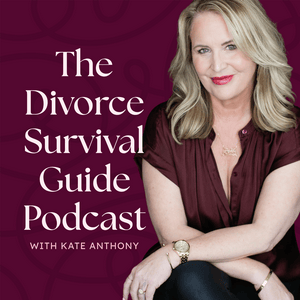
About The Divorce Survival Guide Podcast
On the Divorce Survival Guide Podcast we have open and honest conversations about co-parenting, separation, divorce, and the hardest question of all, should you stay or should you go?
Hosted by Kate Anthony, your Divorce Survival Guide.
Podcast websiteListen to The Divorce Survival Guide Podcast, The Mel Robbins Podcast and many other podcasts from around the world with the radio.net app
Get the free radio.net app
- Stations and podcasts to bookmark
- Stream via Wi-Fi or Bluetooth
- Supports Carplay & Android Auto
- Many other app features
Get the free radio.net app
- Stations and podcasts to bookmark
- Stream via Wi-Fi or Bluetooth
- Supports Carplay & Android Auto
- Many other app features

The Divorce Survival Guide Podcast
Scan code,
download the app,
start listening.
download the app,
start listening.
 South Africa