PodcastsEducationSpoken Ancient Greek - The Companion's Companion

Spoken Ancient Greek - The Companion's Companion

Matthew Duffy
Spoken Ancient Greek - The Companion's Companion
Latest episode

6 episodes

  • Spoken Ancient Greek - The Companion's Companion

    Lesson Three - Part One (Greek)

    2025/12/16 | 17 mins.
    This week, Matthew and Luke continue their journey through Mark Jeong's text, tackling Lesson 3 (τὸ τρίτον δίδαγμα). In this immersive Ancient Greek conversation, they discuss a narrative featuring Prisca (Priscilla), Saul (Saul), and Barnabas. The central conflict revolves around the nature of Jesus' Kingdom (βασιλεία). While Prisca asserts that the kingdom exists in the heart, Saul and Barnabas remain skeptical, arguing that because they cannot see a physical kingdom on earth, they cannot believe in it. The hosts explore the tension between empirical sight and spiritual faith, culminating in the lesson's motto: "It is time to believe" (ὥρα ἐστὶν πιστεύειν).

    Topics discussed:

    Reading and comprehension of Lesson 3: The theological debate between Prisca, Saul, and Barnabas.

    Key verbs: πιστεύει (believes), βλέπει (sees), and γινώσκει (knows).

    The contrasting definitions of the βασιλεία (kingdom): Is it of the earth (τῆς γῆς) or of the heart (τῆς καρδίας)?

    Saul and Barnabas's skepticism: The inability to believe what one cannot physically see.

    Jesus’ identification with the ἀλήθεια (truth).

    Links mentioned in this episode:

    A Greek Reader: Companion to A Primer of Biblical Greek by Mark Jeong

    A Primer of Biblical Greek by N. Clayton Croy

    This podcast is hosted by ZenCast.fm

  • Spoken Ancient Greek - The Companion's Companion

    Lesson Two - Part Two (Greek)

    2025/12/07 | 12 mins.
    This week, Matthew and Luke continue their journey through Mark Jeong's text, tackling Lesson 2 (τὸ δεύτερον δίδαγμα). In this immersive Ancient Greek conversation, they discuss a humorous narrative involving Jacob, Mary, and David. While Jacob and Mary attempt to write a Bible, David interrupts the process by "loosing" (destroying) the book. The hosts break down the absurdity of David's defense—that he destroyed the book because he wanted to "teach"—and discuss the vocabulary of writing, wanting, and destroying.

    Topics discussed:

    Reading and comprehension of Lesson 2: The story of Jacob, Mary, and David.

    Key verbs: γράφειν (to write), διδάσκειν (to teach), θέλειν (to want), and λύειν (to loose/destroy).

    The specific meaning of λύειν when applied to a book (untying the scroll/destroying the work).

    The concept of ἄτοπον (strange/absurd/out of place) regarding David's logic.

    Grammatical agreement: Plural subjects (Jacob and Mary) taking plural verbs (γράφουσιν).

    Links mentioned in this episode:

    A Greek Reader: Companion to A Primer of Biblical Greek by Mark Jeong

    A Primer of Biblical Greek by N. Clayton Croy

    This podcast is hosted by ZenCast.fm
  • Spoken Ancient Greek - The Companion's Companion

    Lesson Two (Greek)

    2025/12/07 | 16 mins.
    This week, Matthew and Luke continue their journey through Mark Jeong's text, tackling Lesson 2 (τὸ δεύτερον δίδαγμα). In this immersive Ancient Greek conversation, they explore a narrative involving Jacob, Maria, David, and Mark. While Jacob and Maria attempt to write a Bible, David—claiming a desire to "teach"—decides to destroy their work. The hosts break down the vocabulary of writing, emotional reactions, and destruction, while humorously debating the validity of David’s aggressive pedagogical methods.

    Topics discussed:

    Reading and comprehension of Lesson 2: The story of Jacob, Maria, and David.

    Key verbs: γράφει (writes), λύει (looses/destroys), διδάσκει (teaches), and κλαίει (cries).

    The use of λύειν (to loose/untie) in the context of destroying a scroll or book.

    David’s circular logic: destroying a book to teach that he does not want to write.

    Mark’s judgment of the situation and the distinction between a "good teacher" (διδάσκαλος καλός) and a "bad teacher" (διδάσκαλος κακός).

    Links mentioned in this episode:

    A Greek Reader: Companion to A Primer of Biblical Greek by Mark Jeong

    A Primer of Biblical Greek by N. Clayton Croy

    This podcast is hosted by ZenCast.fm
  • Spoken Ancient Greek - The Companion's Companion

    Lesson One - Part Two (Greek)

    2025/12/02 | 8 mins.
    In this short conclusion to Lesson 1, Matthew and Luke wrap up their immersive spoken Greek session. Matthew tests Luke’s comprehension of the narrative, focusing on the specific relationships between the characters and the logic of who recognizes whom in the story. They clarify the identity of the "Teacher" and confirm the names of all four participants in the text.

    Topics discussed:

    A summary of the four characters present: Jacob, David, Mary, and Mark.

    The logic of recognition (ἐπιγινώσκω): Clarifying that Mark knows everyone, but the students do not all know each other.

    The revelation of the Teacher's name (τὸ ὄνομα).

    Final comprehension checks regarding the narrative flow.

    Links mentioned in this episode:

    A Greek Reader: Companion to A Primer of Biblical Greek by Mark Jeong

    A Primer of Biblical Greek by N. Clayton Croy

    Reformed Theological Seminary

    Trinity Evangelical Divinity School

    This podcast is hosted by ZenCast.fm
  • Spoken Ancient Greek - The Companion's Companion

    Lesson One - Part One (Greek)

    2025/12/02 | 20 mins.
    This week, Matthew and Luke dive into Lesson 1, conducting the entire episode in spoken Ancient Greek. They guide listeners through a narrative dialogue involving introductions and identity, featuring characters named Jacob, David, Mary, and a teacher named Mark. Matthew reads the text and asks Luke comprehension questions to enforce listening skills and vocabulary retention.

    Topics discussed:

    Basic greetings (Χαῖρε) and self-identifications (Ἐγώ εἰμι).

    The meeting of Jacob (Ἰάκωβος) and David (Δαυίδ).

    Mary's (Μαρία) arrival and her recognition of David but not Jacob.

    The entrance of Mark (Μᾶρκος), who identifies himself as the teacher (διδάσκαλος), and the group's reaction.

    Links mentioned in this episode:

    A Greek Reader: Companion to A Primer of Biblical Greek by Mark Jeong

    A Primer of Biblical Greek by N. Clayton Croy

    Reformed Theological Seminary

    Trinity Evangelical Divinity School

    This podcast is hosted by ZenCast.fm
More Education podcasts

About Spoken Ancient Greek - The Companion's Companion

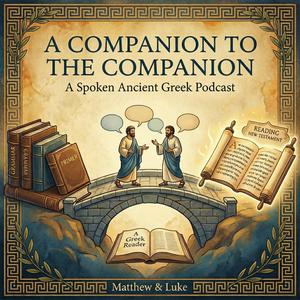
This podcast employs the circling technique (in the form of a dialogue about a grader reader) to provide comprehensible input for those acquiring Biblical and Classic Greek.
Podcast website

Listen to Spoken Ancient Greek - The Companion's Companion, The Jordan B. Peterson Podcast and many other podcasts from around the world with the radio.net app

Get the free radio.net app

  • Stations and podcasts to bookmark
  • Stream via Wi-Fi or Bluetooth
  • Supports Carplay & Android Auto
  • Many other app features
Social
v8.7.2 | © 2007-2026 radio.de GmbH
Generated: 3/12/2026 - 11:50:19 PM