
Listen to this podcast for free in the app: Download for free in the App Store
radio.net
Sleep timer
Save favourites
1295 episodes
How a Chicago Restaurant Has Stayed Open For Nearly Three Decades
2026/10/24 | 48 mins.Richard Mott's first foray into hospitality was in the 1980s at the University of Chicago, where he started running a coffee shop in the basement of the business school when he was a grad student. By the time he graduated, he helped grow that single coffee shop into four locations across campus. He's a longtime Chicago-based restaurateur and his farm-to-table restaurant North Pond has been around since the late 1990s. Lately, he's expanded his business to include Spark Shared Kitchen, a catering facility and incubator for food entrepreneurs. He knows a lot about the practical economics of restaurants and hospitality at large, and in his decades-long career in the Chicago scene he's seen about everything. On our recent trip to Chicago, we sat down with Mott to talk about the ever-increasing price of food and labor, why diners are drinking less, and the expected and unexpected reasons that restaurants so often fail.
Read more:Chicago Seeks to Borrow for Police Settlements, Revive Head TaxChipotle’s Softening Sales Force Analyst to Throw in the Towel
Only http://Bloomberg.com subscribers can get the Odd Lots newsletter in their inbox each week, plus unlimited access to the site and app. Subscribe at bloomberg.com/subscriptions/oddlots
Subscribe to the Odd Lots NewsletterJoin the conversation: discord.gg/oddlots
See omnystudio.com/listener for privacy information.The Forgotten Godmother of Economic Literature
2026/10/23 | 43 mins.In 1776, the field of economics was born with the publication of Adam Smith's The Wealth of Nations. And among the book's earliest readers, and most ardent advocates, was a Regency-era novelist named Maria Edgeworth. In her time, Edgeworth was one of the most famous literary figures in England, and she smuggled into her stories economic concepts and debates around rent seeking, the idea of productive labor, and so on. These works were enormously influential and they helped expose a generation to practical applications of Smith's new theories. Yet when you read about the history of economics, Edgeworth's name is hardly ever mentioned. Jeanna Smialek, a veteran reporter and the Brussels bureau chief at The New York Times, thinks Edgeworth's name needs to be placed back in the pantheon of economic history. On this episode, we speak with Smialek about her biography, The Invisible Hand of Maria Edgeworth, and we discuss Edgeworth's friendly debates with the likes of Thomas Malthus and David Ricardo, how the Irish potato famine reshaped economic thought, and how Edgeworth used the novel form to educate the masses on the value of economics.
Only Bloomberg.com subscribers can get the Odd Lots newsletter in their inbox, plus unlimited access to the site and app. Sign up at bloomberg.com/subscriptions/oddlots
See omnystudio.com/listener for privacy information.Bhaskar Sunkara Thinks the Market Has a Place Under Socialism
2026/10/22 | 53 mins.In September, Gallup released a poll that showed that 43% percent of Americans viewed socialism positively, the highest approval since Gallup began the poll back in 2010. Since Zohran Mamdani won the NYC mayoral election, the left has made a number of gains across national politics. Still, the majority of Americans view socialism negatively, according to Gallup. As a longtime DSA member and veteran of leftist media, Bhaskar Sunkara is one of socialism's leading advocates, and he's spent much of his career charting what a socialist economy in America might look like. Unlike some other leftists, he believes the market has a place. In fact, he thinks markets and entrepreneurs are an objective good in society. He proposes a vision of so-called "market socialism" in his recent co-authored book The Blueprint, and he lays out this system for us in today's episode. We talk about how many features of capitalism — from small businesses to monetary policy — might be remade under socialist principles.
Read more:
Ocasio-Cortez Boosts El-Sayed and 2028 Talk With $1 Million Check
An Economist Makes the Case for Mamdani-Style Populism
Only Bloomberg - Business News, Stock Markets, Finance, Breaking & World News subscribers can get the Odd Lots newsletter in their inbox each week, plus unlimited access to the site and app. Subscribe at bloomberg.com/subscriptions/oddlots
Subscribe to the Odd Lots Newsletter
Join the conversation: discord.gg/oddlots
See omnystudio.com/listener for privacy information.James Robinson on What It Looks Like When a State is Failing
2026/10/21 | 37 mins.The third and last episode from our Chicago live show is with James Robinson, a professor at the University of Chicago and a recipient of the 2024 Nobel Prize in economics (which he shared with Daron Acemoglu and Simon Johnson). His most famous work is 2012's Why Nations Fail, and in that book he and his co-author Acemoglu document the institutional factors — whether it is reliably run elections or open markets that help facilitate innovation — that determine why some states thrive and others don't. So we ask Robinson the big question: What would have to happen for the US to be considered a failed state?
Read More: ‘Middle Powers’ Grapple With New Survival Strategies Under Trump
Only Bloomberg.com subscribers can get the Odd Lots newsletter in their inbox, plus unlimited access to the site and app. bloomberg.com/subscriptions/oddlots
See omnystudio.com/listener for privacy information.CME's Terry Duffy on the Disconcerting State of Finance Regulation
2026/10/20 | 29 mins.The Commodity Futures Trading Commission was practically brand new when Terry Duffy started working at CME Gropu almost five decades ago, and over the course of his career at the exchange, this legend of the trading world has seen an enormous amount of change when it comes to finance regulation, including the rise of prediction markets, 24/7 trading and perpetual futures. Duffy is set to transition out of his current position as CEO next year, and this conversation, recorded live at City Winery in Chicago, is a sort of exit interview. He tells us how regulation has evolved since the start of his time at the CME. We also talk about why he is against perps, the credibility issues prediction markets face, his definition of spreads versus futures, and what he wishes he knew at the start of his career, now that he is nearing retirement.
See omnystudio.com/listener for privacy information.
More Business podcasts

Trending Business podcasts










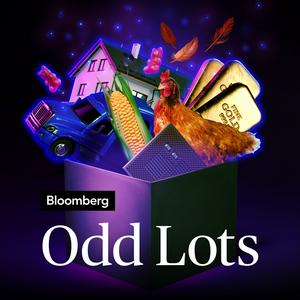
About Odd Lots
Bloomberg's Joe Weisenthal and Tracy Alloway explore the most interesting topics in finance, markets and economics. Join the conversation every Monday, Thursday, and Friday
Podcast websiteListen to Odd Lots, The Money Show and many other podcasts from around the world with the radio.net app
Get the free radio.net app
- Stations and podcasts to bookmark
- Stream via Wi-Fi or Bluetooth
- Supports Carplay & Android Auto
- Many other app features
Get the free radio.net app
- Stations and podcasts to bookmark
- Stream via Wi-Fi or Bluetooth
- Supports Carplay & Android Auto
- Many other app features

Odd Lots
Scan code,
download the app,
start listening.
download the app,
start listening.
Odd Lots: Podcasts in Family
 South Africa