
Listen to this podcast for free in the app: Download for free in the App Store
radio.net
Sleep timer
Save favourites
97 episodes
S12 Ep3: Growing Up Digital: Exploring the Risks and Benefits of Social Media with Octavia Field Reid
2026/11/11 | 32 mins.In recent years, growing concern and media attention have focused on the potential negative effects of social media and smartphone use on the mental health and wellbeing of teenagers and young people worldwide. There has been a growing political push to restrict young people’s access to social media. Australia led the way by introducing a ban for under 16s, with the UK following suit this summer. These measures aim to protect young people from the potentially harmful effects of social media.
In this episode of We Society with Will Hutton, Will speaks to Octavia Field Reid, Associate Director at the Ada Lovelace Institute, about her latest research, conducted in partnership with the Nuffield Foundation, ‘I Love It, but I Hate It’. Part of the Nuffield Foundation's Grown up? Journeys to adulthood programme, the research project explores how young people aged 14–24 experience and feel about growing up with digital technology, particularly social media and AI. Joining at the start of the conversation are Holly and Elise, two young people who took part in the research, who share their mixed feelings about the social media ban and their own experiences of growing up in the digital age.
Octavia talks to Will Hutton about her scepticism over the ban being the only effective way of dealing with the issue of young people being exposed to online harms. She also argues that simply removing children from social media will not address the wider issues like the lack of offline opportunities to build friendships, develop independence in safe and youth-friendly spaces.
And while a social media ban may help protect children in the short term, it does little to address the long-term underlying problem, that technology companies are still failing to build sufficient safeguards into the design of their platforms. Rather than placing the burden solely on young people to stay away, greater responsibility must be placed on the companies themselves to make their platforms safer by design.
This episode is ideal for listeners interested in topical issues, the debate around the under 16s social media ban, the realities of growing up in the digital age, and how we can rethink children’s relationship with digital technology.
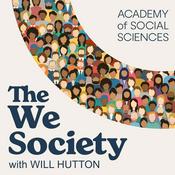
In the We Society, join acclaimed journalist and Academy of Social Sciences president Will Hutton, as he invites guests from the world of social science to explore the stories behind the news and hear their solutions to society’s most pressing problems. In this series social science calls on aspects of business, education, economics, geopolitics, healthcare, human geography and more, exploring their impact on society and the social policy they can inspire. The We Society is for those interested in how social science impacts their world, and how evidence backed research can improve it.
Don’t want to miss an episode? Follow the show on your favourite podcast platform and you can email us on wesociety@acss.org.uk and tell us who we should be speaking to.S12 Ep2: The New Space Age: The future of humanity in space with Professor Andrew Futter
2026/11/04 | 32 mins.Human activity in outer space has surged dramatically in recent years, in what some are calling the dawn of a new space age. And there’s big money to be made, with some estimates suggesting that the global space industry could generate revenues of more than $1tn within the next two decades. But as our activities in space ramp up, big questions over who gets to control, and benefit from space and how we prevent today’s space race from reproducing the inequalities and conflicts on our planet are urgently needed.
In this episode of the We Society podcast, Professor Andrew Futter, Director of the University of Leicester’s newly opened Leverhulme Centre for Humanity and Space, joins host Will Hutton to discuss the centre’s ambitious research programme and its vision, as the first centre of its kind to look at space through a social sciences lens.
They discuss the urgent need to address the challenges and opportunities of this new global chapter, including whether we are asking the necessary social, political and ethical questions quickly enough.
Andrew Futter is Professor of International Politics at the University of Leicester. His new book, ‘The Third Nuclear Age’, examines another frontier shaped by extraordinary technological change, the nuclear age and the increasingly complex relationship between technology, geopolitics, security and society.
This episode is ideal for listeners interested in topical issues, outer space, nuclear technologies, and how the social sciences can help shape humanity’s next chapter in space.
In the We Society, join acclaimed journalist and Academy of Social Sciences president Will Hutton, as he invites guests from the world of social science to explore the stories behind the news and hear their solutions to society’s most pressing problems. In this series social science calls on aspects of business, education, economics, geopolitics, healthcare, human geography and more, exploring their impact on society and the social policy they can inspire. The We Society is for those interested in how social science impacts their world, and how evidence backed research can improve it.
Don’t want to miss an episode? Follow the show on your favourite podcast platform and you can email us on wesociety@acss.org.uk and tell us who we should be speaking to.
The We Society podcast is brought to you by the Academy of Social Sciences in association with the Nuffield Foundation and the Leverhulme Trust.S12 Ep1: Why we need each other, not our devices: The science of social connection with Professor Nick Epley
2026/10/28 | 30 mins.Around the world, we are experiencing an epidemic of loneliness, and it’s increasing, particularly among the millennial generation and younger. Our devices and modern living have made it easier to avoid talking with the people around us and it’s become increasingly easy to spend large amounts of time alone. In a world that many people see as divided, with distrust and political differences driving people apart, building social connections could also play an important role in tackling wider social problems.
In this episode of the We Society with Will Hutton, Will speaks to Nick Epley, the John Templeton Keller Distinguished Service Professor of Behavioural Science at the University of Chicago. After an encounter with a stranger on his commute into work one morning, he became fascinated with the paradox that on the one hand we know that social interaction is vitally important for our wellbeing yet we often avoid it. With more than a decade’s worth of research, involving over 30,000 people and around 130 experiments, his aim was to uncover the reasons why we shy away from social interactions. And reassuringly, his results repeatedly found that people generally enjoy social interactions more than they expected to/expect.
He talks to Will Hutton about his latest book published this year, ‘A Little More Social: How Small Choices Create Unexpected Happiness, Health, And Connection’ (2026), in which he examines why it matters for our wellbeing and for the societies we live in to be a little more social. He explains that building social connections starts with the choices we make and that small actions, such as talking to a stranger or choosing to call rather than text, can have a positive impact on both ourselves and others. He also discusses how making these actions a regular habit can help us develop stronger connections over time.
This episode is ideal for listeners interested in topical issues, behavioural science, wellbeing, and how we can address the problems surrounding loneliness and loss of connection.
In the We Society, join acclaimed journalist and Academy of Social Sciences president Will Hutton, as he invites guests from the world of social science to explore the stories behind the news and hear their solutions to society’s most pressing problems. In this series social science calls on aspects of business, education, economics, geopolitics, healthcare, human geography and more, exploring their impact on society and the social policy they can inspire. The We Society is for those interested in how social science impacts their world, and how evidence backed research can improve it.
Don’t want to miss an episode? Follow the show on your favourite podcast platform and you can email us on wesociety@acss.org.uk and tell us who we should be speaking to.
The We Society podcast is brought to you by the Academy of Social Sciences in association with the Nuffield Foundation and the Leverhulme Trust.S11 Ep9: Season 12 of the We Society Launches Wednesday 28th!
2026/10/23 | 2 mins.The We Society returns for its 12th season on Wednesday, so join acclaimed journalist and Academy of Social Sciences president Will Hutton, as he invites guests from the world of social science to explore the stories behind the news and hear their solutions to society’s most pressing problems.
In this series social science calls on aspects of business, education, economics, geopolitics, healthcare, human geography and more, exploring their impact on society and the social policy they can inspire. The We Society is for those interested in how social science impacts their world, and how evidence backed research can improve it.S11 Ep8: Searching for a good life: Data analysis and Google with Simon Rogers
2026/09/01 | 36 mins.Google processes billions of searches every day, and the data behind the searches say a lot about us. The data analysis presents fascinating insights not just for social science, but for every person using search engines to navigate modern life.
In the final episode of Season 11 of the We Society with Will Hutton, join Simon Rogers, Data Editor at Google, and author of What We Ask Google, as he talks about the two decades of data from the world’s biggest search engine that reveal our inner desires, moods and secrets. The data analysis findings are uplifting, with less division and cynicism than you'd expect, and a lot more curiosity, confusion, and kindness.
This episode is ideal for listeners interested in topical issues, social science, data analysis, and internet history.
In the We Society, join acclaimed journalist and Academy of Social Sciences president Will Hutton, as he invites guests from the world of social science to explore the stories behind the news and hear their solutions to society’s most pressing problems. In this series social science calls on aspects of business, education, economics, geopolitics, healthcare, human geography and more, exploring their impact on society and the social policy they can inspire. The We Society is for those interested in how social science impacts their world, and how evidence backed research can improve it.
Don't want to miss an episode? Follow the show on your favourite podcast platform and you can email us at wesociety@acss.org.uk to tell us who we should be speaking to.
The We Society podcast is brought to you by the Academy of Social Sciences in association with the Nuffield Foundation and the Leverhulme Trust.
Producer: Emily Uchida Finch
Assistant Producer: Emily Gilbert
A Whistledown Production for the Academy of Social Sciences
More Education podcasts



Trending Education podcasts




















About The We Society with Will Hutton
Will Hutton and guests explore the big ideas in Social Science that can change the way
we live.
Beyond the politics, beyond our geography are the intangible connections that hold us
together – The We Society.
Brought to you by the Academy of Social Sciences in association with the Nuffield
Foundation and the Leverhulme Trust, The We Society explores the thousands of ways
Social Science can help us understand and enhance this complicated and fascinating
human network.
From social policy to human geography, misinformation to healthcare and AI to the war
in Ukraine, leading experts, academics and public figures share the knowledge that
matters.
So if you’re ready for research-led insights and engaging conversations, why not make
The We Society your next listen?
Podcast websiteListen to The We Society with Will Hutton, IMO with Michelle Obama and Craig Robinson and many other podcasts from around the world with the radio.net app
Get the free radio.net app
- Stations and podcasts to bookmark
- Stream via Wi-Fi or Bluetooth
- Supports Carplay & Android Auto
- Many other app features

 South Africa

