
Listen to this podcast for free in the app: Download for free in the App Store
radio.net
Sleep timer
Save favourites
191 episodes
Amor Fati: The Stoic Practice Of Loving Your Fate
2026/10/20 | 25 mins.What would it mean to work with the life you have, even when it takes a turn you would never have chosen?
This recorded talk explores amor fati, the practice of loving your fate, and the difference between active acceptance and passive resignation. I connect the idea with three everyday practices: looking for a useful response to adversity, separating what is up to you from what is not, and noticing what you can still appreciate.
Bring one current frustration to mind and use it as the starting point for the exercises.
Free 7-Day Stoic Challenge: stoicchallenge.co
The Stoic Vault: stoicvault.comJon Friedland: Jiu-Jitsu, Fear and the Practice of Stoicism
2026/10/15 | 1h 6 mins.Your first jiu-jitsu class can expose how little your toughness helps. Going back takes a different kind of courage.
Jon Friedland joins me to explore what training can teach us about Stoicism. We discuss competition nerves, judging a performance without clinging to the result, and why a black belt can leave someone's ego bigger than before. Jon explains how he keeps learning after nearly thirty years on the mats.
One question from the conversation stayed with me: what advice would you give someone else in your position? Jon uses it when he's stuck under pressure and struggling to see an option.
Jon is the founder and head instructor of Neutral Ground Academy and the author of Jiujitsu Stoic.
Jon’s Instagram: https://www.instagram.com/jon_friedland/
Neutral Ground Academy: https://www.ngmke.com/about-us/jon-friedland/
Jon’s book: https://jiujitsustoic.com/
Jiujitsu Stoic on Amazon: https://www.amazon.com/dp/B0HKLX73Y5
Free 7-Day Stoic Challenge: stoicchallenge.co
The Stoic Vault: stoicvault.comDifficult People: A Stoic Masterclass
2026/10/13 | 35 mins.How do you stay yourself around someone who keeps drawing you into conflict?
In this recorded Stoic masterclass, I work through five practical moves: expect difficulty, notice the hook, drop the rope, make your boundary a behaviour, and look honestly at your own patterns. We also map the inner citadel: what belongs to you, and what was never yours to control.
The session distinguishes everyday friction from harmful and dangerous relationships, then offers exercises you can use before, during and after a difficult interaction.
Free 7-Day Stoic Challenge: stoicchallenge.co
The Stoic Vault: stoicvault.comStoic Joy: Six Habits For A Calmer Life
2026/10/06 | 31 mins.You can get better at handling difficulty and still forget to enjoy your life.
This half-hour Stoic talk explores six habits for practising joy, including the seven-second control check, the View from Above and the Joy of Enough. It also covers a 24-hour virtue experiment, obstacle training and a morning-and-evening routine.
Choose one habit from the session and give it a place in your day. There's no need to turn all six into another list of things you're failing to do.
Free 7-Day Stoic Challenge: stoicchallenge.co
The Stoic Vault: stoicvault.comThe Reset: How to Come Back Quickly When You've Lost It
2026/10/05 | 3 mins.Marcus Aurelius expected to be knocked off balance. His advice was to come back quickly and treat every return as training. This short Stoic practice is for the moment after you’ve snapped or started spiralling.
The Reset uses SPQR as a modern memory aid: Stop, Pause, Question, Reframe. Take one breath, check the story you’re telling yourself, and look at what’s actually here and what your part is. Try one Reset today and record whether you came back.
This is episode two of One Passage. Passage: Marcus Aurelius, Meditations 6.11, translated by George Long.
Free 7-Day Stoic Challenge: stoicchallenge.co
The Stoic Vault: stoicvault.com
More Education podcasts








Trending Education podcasts
























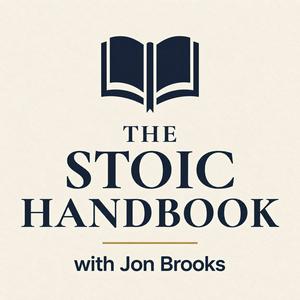
About The Stoic Handbook with Jon Brooks
You've read the books. You know what Marcus Aurelius would do. But when life gets hard, the philosophy disappears. This podcast is for people who want to close the gap between knowing Stoicism and actually living it. New episodes weekly. Start with the free 7-Day Stoic Challenge: https://www.stoicchallenge.co/?utm_source=podcast&utm_medium=show-description&utm_content=global
Podcast websiteListen to The Stoic Handbook with Jon Brooks, IMO with Michelle Obama and Craig Robinson and many other podcasts from around the world with the radio.net app
Get the free radio.net app
- Stations and podcasts to bookmark
- Stream via Wi-Fi or Bluetooth
- Supports Carplay & Android Auto
- Many other app features
Get the free radio.net app
- Stations and podcasts to bookmark
- Stream via Wi-Fi or Bluetooth
- Supports Carplay & Android Auto
- Many other app features
The Stoic Handbook with Jon Brooks
Scan code,
download the app,
start listening.
download the app,
start listening.
The Stoic Handbook with Jon Brooks: Podcasts in Family
 South Africa