
Listen to this podcast for free in the app: Download for free in the App Store
radio.net
Sleep timer
Save favourites
234 episodes
234: OpenAI's Dots Are Cute. What They Do With Your Data Is Not.
2026/10/02 | 14 mins.OpenAI's new agents, dots, are fuzzy balls with eyes that you name and dress. They also sign into websites with your saved passwords and read the email you connect. I went through OpenAI's pages to see what the face is covering. What a dot reads can train the model unless you find the switch, and websites are told nothing. I would not give one my logins or my card.
Chapters
00:00 Sam Altman's pitch, and what a dot is
01:42 Do you need one?
02:36 Where the face came from
04:33 Launch day, and why now
07:05 Under the costume: your data
08:37 A model that looks for another way
10:06 What the cute is for
11:09 What websites are told
12:39 Through the web, or over it
14:01 The verdict
Key Takeaways
The face is how it gets sold. OpenAI had characters on the side in April. Meta made the character the product, and three weeks later OpenAI did too.
What a dot reads can train the model by default. The setting is "Improve the model for everyone", and it covers the apps you connect, email included.
OpenAI publishes no way for a website to recognise a dot. Its instructions tell the user to try their computer when a website blocks one.
What to Do
In ChatGPT, open Settings, then Data controls, and uncheck "Improve the model for everyone".
Before you give any agent your logins or a card, ask what it does that you needed.
If you run a website, send it to me at nohacks.co/ai-accuracy. I'll put one question your customers ask to the AI assistants and send you what they said. It's free.
The newsletter is at nohacks.co/subscribe.
Sources & Links
From OpenAI
Introducing dots
Dots privacy FAQ
Dots, computers and apps
OpenAI's crawlers
GPT-6 Astra test results
Mentioned in the episode
Thomas Germain, BBC, on Meta's Muse
The Tech Report, with Ed Zitron
Better Offline
FTC on Joe Camel, 1997
No Hacks runs no sponsorships and is funded by advisory and audit work.
If your website needs to work for machines as well as people, start with a fixed-scope Machine-First Architecture audit: https://nohacks.co/audit233: Muse Is Why Meta Has No Business Building The Agentic Web
2026/09/26 | 18 mins.Mark Zuckerberg says Meta's AI agent, Muse, needs to be discreet. The same month, some of the calls it made to businesses were placed by people in a call center. I went through what he told Joanna Stern and Alex Heath about Muse's privacy and security and sorted every claim by tense. What exists today, only Meta has checked. The protection from Meta itself is promised for later this year. My verdict: stay away from this. After the sign-off, the show moves to Saturday mornings.
Chapters
00:00 - Discreet AI, and calls made by people
00:59 - What Muse is, and the agentic web
02:33 - Joanna Stern's question
03:57 - Present tense: the virtual machine and the ads
05:45 - Passwords, Sentinel, Amazon and the Mac app
07:05 - Future tense: the locked version and discretion
10:10 - Who is asking: an ad company with a privacy record
11:40 - From the browser wars to the agent wars
14:42 - Two documents, 1993 and 2026
16:00 - After the episode: moving to Saturdays
Key Numbers
500,000+ people tried Muse in its first week, as reported by The Information
97.6% of Meta's 2025 revenue came from ads
$5 billion: the FTC's 2019 privacy penalty on Facebook
87 million people's data reached Cambridge Analytica
1993: CERN put the web's code in the public domain
"Later this year": when Meta says the version it cannot see inside arrives
Key Takeaways
Listen for the tense. What Muse does today is described only by Meta, and nobody outside Meta has published a check of it. The version Meta itself cannot see inside is promised for later.
Meta's plan for Muse is a small cut of every transaction. Zuckerberg said the cut will come from the businesses. If you run a store, that is you.
The early web worked because it was given away and ran on your own computer. This time the companies want to be in the middle from day one. It is the browser wars again, fought over the agent.
What to Do
Before you connect your email, passwords or card to any agent, ask how it works today, in the present tense.
If you run a store on Shopify, check Sales channels, then Agentic. Meta's agent and Google's AI may be on by default.
Watch the full Joanna Stern interview.
The No Hacks newsletter is at nohacks.co/subscribe.
Sources & Links
The interviews
Joanna Stern, New Things with Joanna Stern
Alex Heath, Sources podcast
Meta's own words
Introducing Muse
Meta's 2025 annual report
The record
FTC, $5 billion penalty
CERN, 30 years of a free and open web
No Hacks runs no sponsorships and is funded by advisory and audit work.
If your website needs to work for machines as well as people, start with a fixed-scope Machine-First Architecture audit: https://nohacks.co/audit232: The Agentic Web Is Still A Single-Player Game
2026/09/16 | 18 mins.A hundred and seventy-two companies have put their name to A2A, the standard for AI agents at different companies to find each other and talk. I took the web address the project lists next to each name and asked 135 of them the question the standard is built around. Four answered. The reason is not technical: MCP needs one person to say yes, A2A needs two organisations.
Chapters
00:00 - AWS, Microsoft, Salesforce, SAP, and four answers
00:54 - What I was actually sold, and what I went looking for
01:31 - What counts as another party, and what does not
03:08 - Single-player, and why the reason is not technical
04:07 - MCP, November 2024: one person has to agree
06:56 - A2A, April 2025: two organisations have to agree
11:04 - What the agent card is, and why not having one is fine
12:56 - Who is actually at your server
15:35 - Forget the logos, watch your own logs
16:24 - After the episode: the race to the bottom
Key Numbers
172 companies listed on the A2A partners page
135 of them checked, both well-known paths, 270 requests
4 served an agent card. 131 served nothing
1 served it at the path the specification registers
14 returned HTTP 200 at that path. 12 were the homepage
MCP: 1 person has to agree. A2A: 2 organisations
Key Takeaways
The visitor at your server is one person's assistant, not another company's agent. It fetches one thing, cannot ask a follow-up, and has no patience for a slow page. That is a smaller job than the one being described to you, and a different one.
A protocol that pays off alone spreads. One that needs a counterparty waits. MCP works the afternoon you wire it up. You can implement A2A perfectly and get nothing until somebody you do not control has done the same work.
Not having an agent card is not a failure. It is not a test, nothing scores you on it, and if no agent runs on your server there is nothing to publish.
What to Do
Watch your own logs rather than the partner lists. The day something arrives that was clearly sent by another company's system, not a person, is the day this changed.
Treat a 200 as nothing. Twelve of the fourteen I found were a homepage answering to any address.
Answer clearly and quickly, and be honest about what you do not have. Most websites say yes to everything.
The No Hacks newsletter is at nohacks.co/subscribe.
Sources & Links
The standard
A2A specification, section 8.2 discovery
A2A partners list
IANA well-known URI registry
The other protocol
Model Context Protocol specification
Announcing A2A, Google, April 2025
No Hacks runs no sponsorships and is funded by advisory and audit work.
If your website needs to work for machines as well as people, start with a fixed-scope Machine-First Architecture audit: https://nohacks.co/audit231: A Paywall Stopped ChatGPT From Reading The Article. It Confidently Summarised It For Me Anyway.
2026/09/10 | 23 mins.A magazine put a paywall in front of its journalism to stop AI reading it. I tested what that paywall actually checks. It reads one line of your request, the name you type in yourself, and compares it against a list. Say who you are and you get a bill. Make something up and you walk straight in. Then I asked two assistants to read the article anyway. Both got charged, both answered, and neither had read a word of it. It keeps going after the sign-off, about where this podcast is headed.
Chapters
00:00 - A story, and a bill instead of a page
02:19 - What a 402 is, and who sells it
04:02 - What the wall checks, and the name I made up
06:46 - robots.txt says one thing, the server does another
08:08 - Googlebot walks in free while Penske sues Google
10:08 - Is anybody actually paying
12:13 - I asked Claude and ChatGPT to read it
15:22 - Being read or being cited
17:42 - Ask your chatbot where it got the facts
19:17 - After the episode: where this is headed
Key Numbers
402 Payment Required has been in the web standards since 1992 and almost nothing ever used it
robots.txt has been a convention since 1994, and nothing makes a robot obey it
6,000 or 8,000 or 9,500 websites, depending which of TollBit's own pages you read
25 robots named in Variety's robots.txt, 24 of them blocked
3 crawlers get charged that the file never names at all
0 AI companies named on TollBit's page aimed at AI companies
1 paying customer ever named publicly, a news reader app
Key Takeaways
The paywall checks a name, not a robot. Every crawler that identified itself honestly got a bill. A name I invented, belonging to no company on earth, got the whole page one second later.
Your server sets your policy and your robots.txt only describes it. Variety's two disagree right now, and three crawlers the file permits are charged anyway.
Blocking the machine does not block the answer. It decides who gets credited when the machine repeats you. Two assistants credited a search engine and a podcast directory.
What to Do
Request a page from your own website with a crawler name in the user agent, then with a name you invent, and compare
Read your robots.txt beside what your server actually returns, line by line
Check what Google-Extended covers before you rely on it, because it has never covered AI Overviews
Ask your assistant whether it read the page or searched around it
Every link and every check I ran is in the newsletter, nohacks.co/subscribe
Sources & Links
No Hacks website
Variety's robots.txt
The article
No Hacks runs no sponsorships and is funded by advisory and audit work.
If your website needs to work for machines as well as people, start with a fixed-scope Machine-First Architecture audit: https://nohacks.co/audit230: A Shoe Company And A Cookie Company Now Say The Exact Same Thing To AI Agents
2026/08/12 | 17 mins.On August 5 Shopify switched on a second way into every store on its platform, built for AI agents instead of people. Nothing to install, no merchant asked. I opened three unrelated stores, Allbirds, Brooklinen and Partake Foods, and asked each what it could do for a machine. All three answered with the same roughly 800 words, identical character for character, and no merchant wrote a syllable of it. What those words say, and what it costs a brand when the visitor has no eyes.
Chapters
00:40 Thirty years of every shop trying to sound different
02:13 What Shopify switched on, overnight, on every store
03:19 Three stores, one identical answer
05:06 The tools are stage direction for a machine
08:13 Nobody is using any of it yet
13:45 Your voice does not transmit, your data does
Key Numbers
Three unrelated stores returned the same ~800 words of tool text, identical character for character
The adapter file is version 0.1.0
Etsy put AI agent platform traffic under 1% of its total in Q2 earnings
Shopify reports AI-referred orders tripled, which is referred traffic, not agents buying
Shopify reports over a million merchants on the platform
Three Takeaways
Shopify wrote what your store says to machines, and every other store says it too. These are instructions, not descriptions. The checkout tool tells the agent to "follow it." Another tells it not to ask the shopper about missing options when it decides they only want to look. Someone chose when the customer gets consulted, and it was not the customer or the merchant.
This is the right way to build it, which is separate from whether anyone noticed. The tools read the same database as the storefront people see, so the two cannot drift apart. One good default beats a million bad ones. It is still worth knowing a default was set for you.
If the machine is the visitor, your voice does not transmit and your data is what is left. The photography, the badges, the reviews, the copy someone agonised over: none of it survives the call. Back comes a title, a price, a size run, availability. What is left to compete on is whether your prices are right and your stock is accurate. That work pays off whether or not the agents arrive.
Mentioned
My WebMCP reference guide: https://nohacks.co/blog/what-is-webmcp
What I found on day one: https://nohacks.co/blog/shopify-gave-every-store-an-agent-api
Shopify's docs for building the buyers: https://shopify.dev/docs/agents
Talia Wolf and the Emotional Targeting Framework
Episode 229, llms.txt against 137,000 domains
Newsletter, one a week: https://nohacks.co/subscribe
Say hello: hi@nohacks.co
No Hacks runs no sponsorships and is funded by advisory and audit work.
If your website needs to work for machines as well as people, start with a fixed-scope Machine-First Architecture audit: https://nohacks.co/audit
More Business podcasts









Trending Business podcasts



















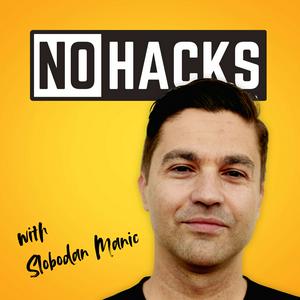
About No Hacks with Slobodan Manic
AI is changing the internet, and nobody asked us if we wanted it changed. So every week I go and look at one thing it did: a website that started charging robots to read it, an assistant that got turned away at the door and answered anyway, a company that promised something a year ago and can't show a receipt. Then I tell you whether it's good, bad, or pointless, and what to do about it, whether you use the web or build it. Around fifteen minutes per episode, usually me on my own, with occasional guests. Hosted by Slobodan Manic, a CXL-certified conversion specialist, WordPress Core Contributor, and the creator of Machine-First Architecture, the framework for building websites for the agentic web.
Podcast websiteListen to No Hacks with Slobodan Manic, The Money Show and many other podcasts from around the world with the radio.net app
Get the free radio.net app
- Stations and podcasts to bookmark
- Stream via Wi-Fi or Bluetooth
- Supports Carplay & Android Auto
- Many other app features
Get the free radio.net app
- Stations and podcasts to bookmark
- Stream via Wi-Fi or Bluetooth
- Supports Carplay & Android Auto
- Many other app features
No Hacks with Slobodan Manic
Scan code,
download the app,
start listening.
download the app,
start listening.
 South Africa

