

Listen to this podcast for free in the app: Download for free in the App Store
radio.net
Sleep timer
Save favourites
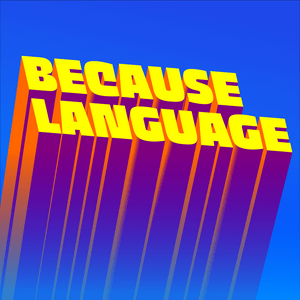
Because Language - a podcast about linguistics, the science of language.
Daniel Midgley, Ben Ainslie, and Hedvig Skirgård
Latest episode
129 episodes
148: On the Mark (with Florence Hazrat)
2026/10/11 | 2h 18 mins.Commas, em dashes, apostrophes, and interrobangs. We use them for timing, for grammar, and even for social purposes. But these little marks didn't just arise overnight. Dr Florence Hazrat fills us in on the history and meaning of these symbols. Florence is the author of On the Mark: From Periods to Interrobangs, How Punctuation Remade the World.
Timestamps
00:00 Start
01:48 Intros and hot punctuation takes
(5:21) On the Mark: From Periods to Interrobangs, How Punctuation Remade the World
06:13 Patreon plug: It's OnlyFans for your brain
11:37 News: Irish citizenship test
17:35 News: Bonobo compositionality maybe not a thing
22:36 Side note: How does disconfirmation feel?
26:26 News: Analogies increase fidelity in language transmission
36:34 News: The Internet Archive is saving news footage
39:30 Related or Not: Theme from Camden
40:14 Related or Not 1: stick
44:32 Related or Not 2: vacation, vaccine, vacuum
46:10 Related or Not 3: Spot the pair
52:57 Interview with Florence Hazrat, author of On the Mark
55:09 Getting into punctuation
56:44 Punctuation is about prosody and…?
01:02:26 Misconceptions and playfulness in punctuation
01:04:45 Who were the heavy hitters in punctuation?
01:08:36 Punctuation as a democratising force
01:11:38 Hyphens and identity
01:14:59 English puts hyphens and spaces everywhere
01:20:14 How is digital communication changing punctuation?
01:23:57 Of dashes both em and en
01:30:33 Which punctuation marks have disappeared?
01:35:48 What punctuation should we be using, but don't?
01:38:15 Does punctuation help reading comprehension?
01:46:11 Conscious punctuation
01:49:19 Word of the Week: parachute
01:54:34 Word of the Week: Lake America
01:56:09 Word of the Week: doom trolling
02:05:44 Word of the Week: Naoero
02:06:46 Comment from Scott: Soo-ey! and Shakespeare
02:08:42 The Reads
Show notes
Why does French have circumflex letters?
https://thelanguagecloset.com/2022/05/21/french-circumflex-circonflexe/
Citizenship rules to be tightened with longer residency and language test
https://www.thejournal.ie/irish-citizenship-residency-changes-7154915-Sep2026/
White Australia policy | National Museum Australia
https://www.nma.gov.au/defining-moments/resources/white-australia-policy
Dictation test passages used in 1925 | National Archives of Australia
https://www.naa.gov.au/students-and-teachers/learning-resources/learning-resource-themes/society-and-culture/migration-and-multiculturalism/dictation-test-passages-used-1925
[PDF] Aspects of Racism in the Australian Context: Issues of Definition and Action
Minister for External Affairs Atlee Hunt, in a 1903 memo to his staff: "It is not desirable that [coloured] persons should be allowed to pass the test . . . and before putting it to anyone the Officer should be satisfied that he will fail. If he is considered likely to pass the test if put in English, it should be applied in some other language of which he is ignorant."
https://www7.austlii.edu.au/au/journals/AUJlHRights/1994/9.pdf
Structure without semantics: no evidence for bonobo compositionality in Berthet et al. (2025)
https://peerj.com/articles/21651/
Holding, Thomas, Paul E. Smaldino, and Charlotte O. Brand. "Analogies Evolve by Increasing Transmission Fidelity in the Communication of Complex Information." Evolutionary Human Sciences 8 (2026): e32.
https://doi.org/10.1017/ehs.2026.10063.
TV News Search & Borrow | Internet Archive
https://archive.org/details/tv
Jethro Tull - Aqualung (Instrumental)
https://www.youtube.com/watch?v=uVcsLJ3mixQ
Catherine the Great was inoculated against smallpox in a risky experiment. It changed Russia's history
https://www.abc.net.au/news/2022-09-22/catherine-the-great-russian-empress-inoculation-thomas-dinsdale/101405692
On the Mark: From Periods to Interrobangs, How Punctuation Remade the World, by Florence Hazrat
https://www.hachettebookgroup.com/titles/florence-hazrat/on-the-mark/9781541606494/?lens=basic-books
(01:39:46) All over me
On the Mark: Apple Books link
https://books.apple.com/us/book/on-the-mark/id6755950089
Richard Artschwager, Exclamation Point (Yellow), 2001
http://www.dreamideamachine.com/?p=81116
Broken Swedish words (split by accidental spaces) breaking translations
https://forum.readlang.com/t/broken-swedish-words-split-by-accidental-spaces-breaking-translations/5256
Tear Drops and Roses: Persian Punctuation by Florence Hazrat
https://mindthegap1.substack.com/p/tear-drops-and-roses-persian-punctuation
Irony punctuation | Wikipedia
https://en.wikipedia.org/wiki/Irony_punctuation
Mind the Gap | Florence Hazrat on Sunstack
https://mindthegap1.substack.com
Florence Hazrat on Instagram (@thepunctuationlady)
https://www.instagram.com/thepunctuationlady/
Labor's Secret Harbour by-election loss is ominous
https://redflag.org.au/article/labors-secret-harbour-by-election-loss-is-ominous/
Political Parties, book by Duverger | Brittanica
https://www.britannica.com/topic/Political-Parties
Political parties : their organization and activity in the modern state, by Duverger, Maurice, 1917- | Internet Archive
https://archive.org/details/politicalparties0000duve/page/n9/mode/2up?q=parachuting
History of a concept: 'Parachute' candidates, an old electoral practice of politics taking precedence over roots
https://www.lemonde.fr/en/history/article/2022/06/17/history-of-a-concept-parachute-candidates-an-old-electoral-practice-of-politics-priming-over-roots_5987200_157.html
Parachute candidate | Wikipedia
https://en.wikipedia.org/wiki/Parachute_candidate
Trump signs order to rename Lake Ontario 'Lake America' amid Canada trade war
https://www.cnbc.com/2026/08/27/trump-canada-lake-america-ontario.html
Coxon tweet
https://x.com/hilbertspaess/status/2097476196791709843
Google engineer claims AI technology LaMDA is sentient
https://www.abc.net.au/news/2022-06-13/google-ai-lamda-sentient-engineer-blake-lemoine-says/101147222
OpenAI IPO will not happen in 2026 amid AI safety fears, Sam Altman says
https://www.theguardian.com/us-news/2026/sep/12/openai-delays-ipo-sam-altman-ai-safety-concerns
Timnit Gebru tweet
https://x.com/timnitGebru/status/2098289939217846660
Dear AI Companies: Stop the "Doom Trolling"
https://calnewport.com/dear-ai-companies-stop-the-doom-trolling/
Cal Newport: Dear AI Companies: Stop the "Doom Trolling"
https://youtu.be/aHxwZEXHwps?si=7K5dLhu34NIRPRqm
The Thrill of Wanting AI to Destroy the World
https://www.theatlantic.com/ideas/2026/09/ai-destroy-world-apocalypse/688575/
Nauru officially changes its name to Naoero
https://www.theguardian.com/world/2026/aug/03/nauru-officially-changes-its-name-to-naoero
Shakespeare in the Bush
Bohannon, Laura (1971), from Conformity and Conflict: Readings in Cultural Anthropology, eds. James P. Spradley and David W. McCurdy Boston: Little Brown and Company.
https://web.archive.org/web/20060613143803/http://www-static.cc.gatech.edu/~idris/Essays/Shakes_in_Bush.htm
List of typographical symbols and punctuation marks | Wikipedia
https://en.wikipedia.org/wiki/List_of_typographical_symbols_and_punctuation_marks147: The Language Beat (with Michael Erard)
2026/09/23 | 58 mins.Michael Erard has been covering language in major publications for a good long while. What has he learned, and what can linguistic communication take from his work? Michael sits down for a chat with Daniel and Hedvig to talk about his new book The Language Beat: Essays and Reporting on Language and Life.
Timestamps
00:00 Start
01:21 Getting the book together: Save your contracts!
04:22 Getting into lingcomm
06:38 Popular things v things you're interested in
10:48 Getting the Spidey sense
19:30 Public reactions and book tour insights
23:22 Lingcomm involves a little bit of pastoral care
26:55 How has the lingcomm landscape changed?
34:05 Persistent misunderstandings
39:48 Are we seeing a lingcomm explosion?
47:37 Are we doing any good?
57:07 Thanks and closing146: Beyond Words (with Karen Stollznow)
2026/09/17 | 2h 1 mins.How do children learn language, and why can't other animals? Why are false friends between languages always naughty? And how is public perception of language changing? Dr Karen Stollznow is taking us through a tour of psycholinguistics, taboo language, and linguistic skepticism with her new book Beyond Words: How We Learn, Use, and Lose Language. We're also taking a look at Bitch: The Journey of a Word.
Timestamps
00:00 Start
00:32 Intros: Do you use Y'ALL?
06:46 New patron shoutout
08:07 News: Strathfield Council trying to control shop signage
17:37 News: Claude introduces watermarking
25:43 News: Welsh joins the Star Wars club
29:30 Related or Not: Theme from Hugh
30:25 Related or Not 1: cute and acute
34:48 Related or Not 2: skip
42:22 Related or Not 3: tribe, tribute, & tributary
46:51 Karen Stollznow on psycholinguistics
50:36 Language and animal communication
53:37 Skepticism in linguistics
59:48 Getting a book done
01:02:09 The attraction of taboo words
01:08:18 Daddy diaries and child language acquisition
01:15:00 False friends
01:19:09 Best way to learn a language?
01:22:05 Public awareness of linguistics
01:26:58 Word of the Week: forever war
01:29:56 Word of the Week: aegyo
01:31:20 Word of the Week: meat proxy
01:33:46 Word of the Week: Cyberno de Bergerac
01:37:31 Comment: vague v ambiguous
01:39:24 Comment: Okay if languages die?
01:41:59 Comment: Sudoku pronunciation in Japanese
01:43:20 The Reads
01:56:02 Outtake: Hedvig watches an eclipse
02:00:18 Outtake: Glottle145: Face With Tears of Joy (live with Keith Houston and friends)
2026/09/03 | 1h 33 mins.Emoji, once regarded as some kind of frivolous nonsense, have become an important way we communicate online. But how did these little pictures come to our devices? What is the Unicode Consortium, and how did they get involved? And who is the Levitating Suit Guy? Fear not; author Keith Houston is here to give us the whole story in front of a live audience. Keith is the author of Face With Tears of Joy: A Natural History of Emoji.
Timestamps
00:00 Start
02:21 Introducing Keith Houston, author of Face With Tears of Joy
03:28 Put your top five emoji in chat
08:03 What's the state of emoji now?
10:11 How did the Unicode Consortium get involved?
22:30 The strange history of Levitating Suit Guy
27:37 The latest emoji in v17.0
30:12 Changes to some emoji
38:22 What gives an emoji staying power?
47:12 Related or Not: Theme by David
48:10 Related or Not 1: orchard and hoard
52:46 Related or Not 2: belle, bell, ball, & ball
59:01 Related or Not 3: Italian aceto (vinegar) & Spanish aceite (oil)
01:03:45 Why don't they use emoji on Reddit?
01:05:26 Are emoji now more acceptable in serious contexts?
01:08:34 Do speakers of some languages use emoji more?
01:13:00 Any languages where they just don't use emoji?
01:13:59 Does everyone call them "emoji"?
01:16:13 Sociolinguistic trends in emoji?
01:22:12 The reads: Which emoji is closest to your name?
01:33:06 Afterparty144: Sociophonetics Deep Dive (with Jennifer Nycz, Lauren Hall-Lew, and Kelly Wright)
2026/08/22 | 1h 8 mins.Why don't we all sound the same? Are some accents easier to learn? And are there reasons for the differences in how people sound and sign, or is it just random?
We use sound and sign to encode information about our age, place, gender, sexuality, and so much more. Sometimes we're not even aware of how we do it. But we're fixing that on this episode with Jennifer Nycz and Lauren Hall-Lew, editors of Sociophonetics: Implications for Phonological and Phonetic Theory.
Timestamps
00:00 Start: Introducing Jennifer Nycz and Lauren-Hall Lew
01:57 What is sociophonetics?
03:01 What's in our own sociophonetic background?
10:10 Why is it always vowels, vowels, vowels?
13:03 Why don't we all just sound the same?
15:09 You can hallucinate accents by seeing a photo
16:00 Sound encodes gender and sexuality
20:57 Chronolects, Boomerlects, and GenX-lects
22:04 Tweens to teens: What to expect sociophonetically?
27:33 Are there reasons for sound variation and change?
34:16 Why does a community change faster than an individual?
38:37 Does media have an influence on accent?
42:17 How much are we consciously aware of?
44:52 Are some accents easier?
48:39 What are the sociophonetic hot spots?
50:54 Are American women more nasal?
52:09 Persistent misconceptions
54:49 Fight linguistic discrimination, or teach marginalised people to "pass"?
01:03:03 The sociophonetics of signed languages
More Education podcasts


Trending Education podcasts





About Because Language - a podcast about linguistics, the science of language.
A podcast about linguistics, the science of language.
Podcast websiteListen to Because Language - a podcast about linguistics, the science of language., Motivation Daily by Motiversity and many other podcasts from around the world with the radio.net app
Get the free radio.net app
- Stations and podcasts to bookmark
- Stream via Wi-Fi or Bluetooth
- Supports Carplay & Android Auto
- Many other app features
Get the free radio.net app
- Stations and podcasts to bookmark
- Stream via Wi-Fi or Bluetooth
- Supports Carplay & Android Auto
- Many other app features

Because Language - a podcast about linguistics, the science of language.
Scan code,
download the app,
start listening.
download the app,
start listening.
 South Africa