

Listen to this podcast for free in the app: Download for free in the App Store
radio.net
Sleep timer
Save favourites
173 episodes
How to Help Your Toddler Listen and Understand More Ep 173
2026/10/13 | 25 mins.Does your toddler understand what you're saying? And how can you help him become a better listener - even before he's talking in sentences?
Between 12 and 24 months, your toddler is developing important listening and understanding skills. But these skills don't develop simply by memorizing words, colors, or numbers.
Real understanding grows through everyday experiences, meaningful interactions, and opportunities to participate in family life.
In this episode of Talking Toddlers, Erin Hyer, speech-language pathologist with more than 35 years of clinical experience, walks you through key developmental building blocks of receptive language - your child's ability to listen, understand, and make sense of spoken language.
You'll discover:
How toddlers learn to understand and follow simple directions.
Why learning what objects do is just as important as learning their names.
How familiar activities build listening, memory, and the ability to distinguish between words.
Why playing with toys and sharing picture books help children practice what they've learned in real life.
Why memorizing letters, colors, and numbers doesn't necessarily mean your toddler understands everyday language.
The best part? You don't need flashcards, fancy toys, or formal lessons.
Your toddler's everyday experiences—getting dressed, helping with chores, sharing books, and playing alongside you—offer wonderful opportunities to strengthen understanding.
Because before your toddler can use language confidently, he needs opportunities to understand what those words mean.
Listen in and learn what to watch for, what to practice, and how to make everyday moments count.
🎁 FREE COMPANION GUIDE
FREE Companion Guide CLICK HERE: Helps you remember these key listening skills so everyone wins.
===================
If you have a specific situation with your toddler that you keep replaying, Erin offers free 20-minute Clarity Calls to help you look more closely at what may be happening underneath the behavior.
🔗 Click here for CLARITY CALL HERE
Helpful links:
▶ Watch Talking Toddlers on YouTube: Click HERE
📘 Download Erin’s free guide: 10 Essential Skills Before Talking
🌿 Visit Hyer Learning:
www.HyerLearning.com
Educational and coaching information only. This episode is not a substitute for an individual speech-language, developmental, behavioral, or medical evaluation.Should My Toddler Be Talking More? Ep 172
2026/10/06 | 45 mins.Should my toddler be talking more?
It’s an understandable question, but word count alone does not tell you how well your child is communicating.
In this episode, I explain the developmental skills sitting underneath talking — including initiation, shared attention, turn-taking, and the different jobs language begins to do in everyday life.
You’ll also learn what to watch for instead of only counting words, why too many questions can sometimes make toddlers quieter, and one simple way to create more opportunities for your child to communicate during routines you are already doing.
And if you are genuinely concerned about your toddler’s speech, hearing, or overall development, I’ll also explain when I believe it is important to seek an evaluation rather than simply wait and see.
The goal is not more pressure or more practice. It is learning to see your child more clearly — and knowing what to do next.
👉🏻 Click here for this week's GUIDE: Should My Toddler Be Talking More?
🌟 Word List Guide - Click Here: Building Vocabulary
===================
If you have a specific situation with your toddler that you keep replaying, Erin offers free 20-minute Clarity Calls to help you look more closely at what may be happening underneath the behavior.
🔗 Click here for CLARITY CALL HERE
Helpful links:
▶ Watch Talking Toddlers on YouTube: Click HERE
📘 Download Erin’s free guide: 10 Essential Skills Before Talking
🌿 Visit Hyer Learning:
www.HyerLearning.com
Educational and coaching information only. This episode is not a substitute for an individual speech-language, developmental, behavioral, or medical evaluation.Does Your Toddler Focus on THIS — But Not on You? Ep 171
2026/09/29 | 24 mins.Does your toddler seem able to focus deeply on a screen, but struggle to stay with a book, sit through a meal, play independently, or listen when you need him to?
In this episode, Erin looks beyond the surface and explains what attention actually asks of a developing child. A screen may be very effective at holding attention, but real-world attention is built through movement, participation, repetition, curiosity, problem-solving, connection, and everyday life.
You’ll also hear why sleep, nutrition, routines, background noise, movement, and the overall pace of the day matter so much. Toddler development does not happen in separate categories. Language, motor skills, regulation, feeding, attention, and behavior are constantly developing together.
Erin also explores why simple play is often more valuable than it looks, why boredom can create room for imagination and curiosity, and why screens are never developmentally neutral for very young children.
Most importantly, this episode will help you stop asking only, “Why won’t my toddler focus?” and start looking more carefully at the environment and experiences shaping his attention every day.
Because attention is not simply something your toddler either has or doesn’t have.
It develops through experience.
===================
If you have a specific situation with your toddler that you keep replaying, Erin offers free 20-minute Clarity Calls to help you look more closely at what may be happening underneath the behavior.
🔗 Click here for CLARITY CALL HERE
Helpful links:
▶ Watch Talking Toddlers on YouTube: Click HERE
📘 Download Erin’s free guide: 10 Essential Skills Before Talking
🌿 Visit Hyer Learning:
www.HyerLearning.com
Educational and coaching information only. This episode is not a substitute for an individual speech-language, developmental, behavioral, or medical evaluation.Why Everything Becomes a Battle With Your Toddler Ep 170
2026/09/22 | 31 mins.When every little thing starts feeling like a battle, the problem may not be the cup, the shoes, the bath, or leaving the park. The final trigger is often only one part of a much bigger developmental picture.
In this episode, I’m helping you widen the lens.
We’ll talk about why toddler skills are still emerging, why having a skill is not the same as being able to access it under every condition, and why a child who handled something beautifully yesterday may struggle with it today.
We’ll also look at:
• Why the trigger and the whole cause are not necessarily the same thing
• What executive function actually means in a two- or three-year-old
• Why “he knows better” may not tell you the whole story
• How sleep, food, movement, language, transitions, and the environment affect behavior
• Why normal frustration does not always mean “dysregulation”
• How repeated everyday experiences shape the developing brain
• Why two- and three-year-olds can look surprisingly different as memory, language, and persistence grow
• How to begin noticing patterns instead of reacting only to the final behavior
Your toddler’s brain is developing in real time.
And so is your ability to understand what you’re seeing.
My goal is not to give you another parenting script to memorize. It is to help you become more observant, more discerning, and more confident in knowing what your child actually needs from you.
Because the little years are the big years.
— Erin Hyer, M.A., CCC-SLP
Early Childhood Development Specialist & Speech-Language Pathologist
===================
If you have a specific situation with your toddler that you keep replaying, Erin offers free 20-minute Clarity Calls to help you look more closely at what may be happening underneath the behavior.
🔗 Click here for CLARITY CALL HERE
Helpful links:
▶ Watch Talking Toddlers on YouTube: Click HERE
📘 Download Erin’s free guide: 10 Essential Skills Before Talking
🌿 Visit Hyer Learning:
www.HyerLearning.com
Educational and coaching information only. This episode is not a substitute for an individual speech-language, developmental, behavioral, or medical evaluation.Your Toddler Understands You. So Why Won’t He Listen? Ep 169
2026/09/15 | 28 mins.“I know he understands me. So why isn’t he listening?”
If you’ve ever thought that about your toddler, this episode will help you look at the moment a little differently.
Understanding your words and being able to follow through are not the same developmental skill.
Before your toddler can respond, he may need to register your voice, shift his attention away from what he is doing, process what you said, organize what comes next, and tolerate the interruption or transition.
And sometimes, he understands perfectly well and simply does not want to do it.
That matters, too.
In this episode, Erin looks at what may be happening between understanding and doing — and why the answer is not always more words, more reminders, or another parenting script.
You’ll hear how deep play, attention shifting, inhibition, sequencing, routines, and everyday participation all contribute to your toddler’s ability to follow through.
Most importantly, this episode is about helping you become more confident in what you are seeing.
Is your child still developing the skill?
Does he need help getting started?
Or does he simply need you to calmly and confidently lead?
Your toddler is learning how to move from understanding into action.
And you are learning how to recognize what is getting in the way.
If you have a specific situation with your toddler that you keep replaying, Erin offers free 20-minute Clarity Calls to help you look more closely at what may be happening underneath the behavior.
🔗 Click here for CLARITY CALL HERE
------------------------------
Helpful links:
▶ Watch Talking Toddlers on YouTube: Click HERE
📘 Download Erin’s free guide: 10 Essential Skills Before Talking
💬 Learn about parent coaching or schedule a Clarity Call:
CLICK HERE TO CONNECT
🌿 Visit Hyer Learning:
www.HyerLearning.com
Educational and coaching information only. This episode is not a substitute for an individual speech-language, developmental, behavioral, or medical evaluation.
More Kids & Family podcasts




Trending Kids & Family podcasts












About Talking Toddlers
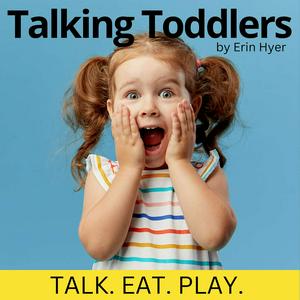
Calm, developmentally grounded guidance for moms of babies and toddlers.As a mom of a baby or toddler, it can feel like everyone has an opinion - and very few answers that actually make things clearer. The noise is loud. The pressure is real. And the uncertainty can be exhausting.Talking Toddlers is a podcast for moms who want calm, trustworthy, developmentally grounded guidance - without fear, guilt, or unrealistic expectations.I’m Erin Hyer, a licensed speech-language pathologist with nearly 35 years of experience supporting young children and their families. I’ve spent my career on the floor with toddlers, partnering with parents, consulting with early educators, and training graduate students to understand how children truly grow, learn, and communicate - through relationships, everyday routines, and meaningful language experiences.This podcast breaks down how the young brain learns, why certain behaviors or challenges show up, and how parents can gently support development before small concerns become bigger ones. I believe parents are in a powerful position — not to do more, but to understand more.Each episode offers:Practical, real-life strategies you can use during everyday routinesGentle explanations of the why behind toddler behavior and developmentSupportive conversations that help you feel less alone and more confidentMy goal is simple: to help moms feel empowered and toddlers feel supported - so learning, communication, and connection can grow naturally at home.New episodes of Talking Toddlers are released weekly. This is a space for clarity, connection, and courage - where moms come to slow down, trust themselves, and support their child’s development with confidence.
Podcast websiteListen to Talking Toddlers, Grimm, Grimmer, Grimmest and many other podcasts from around the world with the radio.net app
Get the free radio.net app
- Stations and podcasts to bookmark
- Stream via Wi-Fi or Bluetooth
- Supports Carplay & Android Auto
- Many other app features
Get the free radio.net app
- Stations and podcasts to bookmark
- Stream via Wi-Fi or Bluetooth
- Supports Carplay & Android Auto
- Many other app features
Talking Toddlers
Scan code,
download the app,
start listening.
download the app,
start listening.
 South Africa