
Listen to this podcast for free in the app: Download for free in the App Store
radio.net
Sleep timer
Save favourites
230 episodes
Iñárritu's Digger
2026/10/20 | 1h 11 mins.REUPLOAD BECAUSE HALF THE EPISODE WAS MISSING:
In this early release episode, Ryan and Todd discuss Alejandro González Iñárritu's recent film Digger. Widely panned upon its release a couple of weeks ago--though seemingly embraced by audiences and some contemporary revisions of initial reactions--Ryan and Todd extol the film's virtues. Chief among them being the film's insistence that we look at our contemporary situation regarding the climate from the position of retroactivity. The hosts bring to Freud's Future of an Illusion to bear on the film as well, tying it in to recent conversations. Try to see this movie before it leaves theaters forever, if you can.
Bonus: Here's Calgary Flames goalie Devin Cooley espousing Why Theory's take on the unconscious dimension of sporting excellence.Future of an Illusion
2026/10/11 | 1h 11 mins.On this episode, Ryan and Todd discuss Freud's Future of an Illusion, a text that would become overshadowed by his subsequent publication, Civilization and Its Discontents. The hosts discuss the relationship between the two texts--paying close attention to how the drive becomes figured and then reconfigured in the latter text--but are careful to stamp out where Illusion departs in focus and in substance from one Freud's most well-known works. The hosts also work through Freud’s thoughts on religion in Illusion and compare it against his later thoughts in Moses and Monotheism and more recent work on psychoanalysis and religion (specifically when compared to Rick Boothby’s Embracing the Void).Neo Noir
2026/09/27 | 1h 18 mins.On this episode, Ryan and Todd return to their film genre series to discuss the neo noir. As opposed to the classic noir period, which is named retroactively by French film critics (1941-1958), neo noir films were aware of how they fit into a specialized genre. Does this mean the Neo noir is more of a genre than the class noir? Less of one? Is it just a style? What unique affordances hold the genre together now that these films are made post-Code? This episode discusses these questions and more with extended reference to: The Long Goodbye, Body Heat, One False Move, and The Last Seduction among many other films.
Also referenced in this episode and available to watch on YouTube is Pretty PoisonDivine Violence
2026/09/13 | 1h 10 mins.On this episode, Ryan and Todd discuss the notion of divine violence. The conversation draws principally on an encounter staged between the term's evocation in Walter Benjamin's 1921 essay, "Toward a Critique of Violence" and the term's later deployment by Slavoj Žižek in his book On Violence. The conversation also touches on Giorgio Agamben's use of "bare life" (a phrase used, though translated slightly differently, by Benjamin in his essay) and how recent podcast conversations on Frantz Fanon overlap or depart from the concerns of divine violence.
The Vader SessionsWretched of the Earth
2026/08/30 | 1h 12 mins.On this episode, Ryan and Todd complete their Frantz Fanon duology by talking about his final completed work, Wretched of the Earth. The episode focuses on Fanon's "stretching" of both Marxism and psychoanalysis to ground his unique decolonial intervention.
More TV & Film podcasts





Trending TV & Film podcasts
















About Why Theory
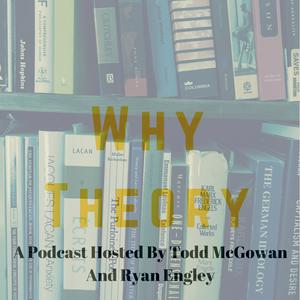
Why Theory brings continental philosophy and psychoanalytic theory together to examine cultural phenomena.
Podcast websiteListen to Why Theory, WHAT WENT WRONG and many other podcasts from around the world with the radio.net app
Get the free radio.net app
- Stations and podcasts to bookmark
- Stream via Wi-Fi or Bluetooth
- Supports Carplay & Android Auto
- Many other app features
Get the free radio.net app
- Stations and podcasts to bookmark
- Stream via Wi-Fi or Bluetooth
- Supports Carplay & Android Auto
- Many other app features

Why Theory
Scan code,
download the app,
start listening.
download the app,
start listening.
Why Theory: Podcasts in Family
 South Africa
