

Listen to this podcast for free in the app: Download for free in the App Store
radio.net
Sleep timer
Save favourites
86 episodes
84. Gioele Zisa: The plant world
2026/06/19 | 45 mins.Gioele talks about the PlANET Project (Plants in the Ancient Near East Texts). How do texts and archaeobotanical evidence combine to explain the economic and functional roles of plants? And what symbolic values did they have? To what extent did they play active roles?
3:27 the PlANET project
5:23 what do we know about plants?
7:57 combining sources
11:13 project goals
13:35 attitudes to environmental change
15:18 interdisciplinary
17:30 identifying plants
21:07 environmental humanities
26:15 plants as actors
29:06 gender studies in plant studies
32:59 BioANE project and PlANET project
33:49 analogical thinking
37:43 current research
40:59 favourite plant
PlANET at La Sapienza
Music by Ruba Hillawi
Website: http://wedgepod.org
YouTube: https://www.youtube.com/channel/UCSM7ZlAAgOXv4fbTDRyrWgw
Email: wedgepod@gmail.com
Patreon: http://Patreon.com/WedgePod83. David Kertai: The palaces of Assyria
2026/04/11 | 37 mins.David Kertai explains all about Neo-Assyrian palaces. What, and who, would we find there? How did they function? What do their design and decoration tell us about how they were used? How visible was the king?
David's museum page
Music by Ruba Hillawi
Website: http://wedgepod.org
YouTube: https://www.youtube.com/channel/UCSM7ZlAAgOXv4fbTDRyrWgw
Email: wedgepod@gmail.com
Patreon: http://Patreon.com/WedgePod82. IAA prize winners 2025
2026/01/28 | 35 mins.International Association for Assyriology awards prizes to early career scholars annually. The for 2025 awards went to:
Best PhD dissertation in the field of Assyriology and Mesopotamian Archaeology: Adeline Reynaud, for “Les diagrammes mathématiques paléo-babyloniens : catalogue, propriétés matérielles, rôles dans les raisonnements”
Best article in Assyriology and Mesopotamian Archaeology:
Laureate: Jon Beltz, for “Everyday Magic? Four Sumerian zi…pa₃ Incantations on Amulets,” in Journal of Cuneiform Studies 77: 97-121.
Runner-up: Andrew Pottorf, for “un-il₂ (“Menials”) as a Serflike Social Stratum during the Ur III Period,” Journal of Ancient Near Eastern History 12/1: 83-113.
Jon and Andrew join us to talk about their prize-winning research.
2:00 What is a zipa incantation?
2:54 amulets and tablets
3:55 practical magic
5:27 main argument
6:29 structures
8:13 place in research
9:10 what's next
11:42 status groups in Ur III
15:52 state of research
20:52 the "people"
22:30 how to become UN.IL2
26:59 social security?
28:50 place in research
30:43 what's next
Music by Ruba Hillawi
Website: http://wedgepod.org
YouTube: https://www.youtube.com/channel/UCSM7ZlAAgOXv4fbTDRyrWgw
Email: wedgepod@gmail.com
Patreon: http://Patreon.com/WedgePod81. Lisa Wilhelmi: Bronze Age Diplomacy
2025/12/03 | 33 mins.Lisa Wilhelmi discusses the international system in the ancient Middlle East. The 14th century BC tablets from Amarna in Egypt, and tablets from the royal archives in Hattusa (Türkiye), reveal diplomatic exchanges between the great powers that ruled the region. What did they want from each other? Who and what moved around, and why?
2:00 what does "international" mean?
3:09 what sources our sources say?
5:22 were the letters preserved or did they just survive?
6:50 what language do they use?
8:37 were they equal partners?
10:34 do resources buy membership of the great powers club?
12:15 how did they talk to each other?
14:35 what messages are they sending each other?
16:38 political theatre?
18:32 how princesses were chosen
19:40 did princesses take part in the correspondence?
20:13 why was cuneiform the method of communication?
23:51 cultural exchange
26:52 lost in translation?
Lisa's university page
Music by Ruba Hillawi
Website: http://wedgepod.org
YouTube: https://www.youtube.com/channel/UCSM7ZlAAgOXv4fbTDRyrWgw
Email: wedgepod@gmail.com
Patreon: http://Patreon.com/WedgePod80. Ea-nasir: everyone's favourite copper merchant
2025/11/04 | 59 mins.Gina Konstantopoulos, Andrew Deloucas, Gabriel Moshenska, and Steven Garfinkle discuss internet favourite, Ea-nasir. What do we know about the Dilmun traders and their role in the supply of copper to the kingdoms of Babylonia? Who were his customers and what did they want his copper for? How did he become famous in the 21st century, and what jokes do people make about him? What possibilities does this offer assyriology?
Andrew Deloucas's university page
Gina Konstantopoulos's university page
Gabriel Moshenska's university page
Steven Garfinkle's university page
Music by Ruba Hillawi
Website: http://wedgepod.org
YouTube: https://www.youtube.com/channel/UCSM7ZlAAgOXv4fbTDRyrWgw
Email: wedgepod@gmail.com
Patreon: http://Patreon.com/WedgePod
More Arts podcasts
 Artwork SoundsArts
 Rich Dad Poor Dad In EnglishArts, Books
 MiddagvervolgverhaalArts
 THEMOVEArts, Sports
 The psychology of Money in EnglishArts, Books
 Kabza de Small & DJ Maphorisa - eMcimbini feat. Samthing Soweto, Aymos, Mas Musiq & Myztro x Suzy Eises Saxophone Cover - Shera The DJ mix.Arts, Performing Arts
 Things Bakers Know: The King Arthur Baking PodcastArts, Food, Hobbies, Leisure
 Team No SleepArts, Performing Arts
Trending Arts podcasts
 Comentando sobre o podcast Comentando sobre podcast robotizados pelo wha robotizados pelo WhatsAppArts, Books
 Sentimental GarbageArts, Books, Society & Culture
 House of SpadesArts, Performing Arts
 Kendrick Lamar's - Not Like UsArts, Music, Music Commentary
 The Podcast With A Thousand FacesArts, Religion & Spirituality, Society & Culture
 The Greatest True Crime Stories Ever ToldArts, Books, True Crime
 Beauty and the BeastsArts
 Articles of InterestArts, Fashion & Beauty
 Crime Classics | Old Time RadioArts
 Down These Mean Streets (Old Time Radio Detectives)Arts, Performing Arts, TV & Film
 RISK!Arts, Comedy, Performing Arts, Personal Journals, Society & Culture
 Breaking Beauty PodcastArts, Fashion & Beauty, Society & Culture
 Choice Classic Radio Detectives | Old Time RadioArts, Drama, Fiction, Performing Arts
 Sherlock Holmes Bedtime StoriesArts, Books
 Ruthie's Table 4Arts, Food
About Thin End of the Wedge
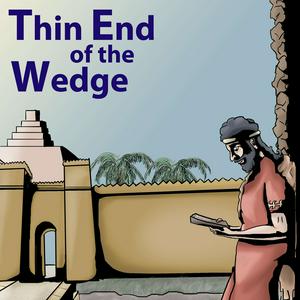
Thin End of the Wedge explores life in the ancient Middle East. There are many wonderful stories we can tell about those people, their communities, the gritty reality of their lives, their hopes, fears and beliefs. We can do that through the objects they left behind and the cities where they once lived. Our focus is on the cultures that used cuneiform (“wedge-shaped”) writing, so mostly on ancient Iraq and nearby regions from about 3000 BC to about 100 AD. Thin End of the Wedge brings you expert insights and the latest research in clear and simple language. What do we know? How do we know anything? And why is what we know always changing? Why is any of this important today? We won’t talk to you like you’re stupid. But you won’t need any special training to understand what we’re talking about. This is an independent production by me as an individual. It is not supported by my employer or any other organisation I am involved with, and the views expressed here do not necessarily reflect theirs.
Podcast websiteListen to Thin End of the Wedge, Artwork Sounds and many other podcasts from around the world with the radio.net app
Get the free radio.net app
- Stations and podcasts to bookmark
- Stream via Wi-Fi or Bluetooth
- Supports Carplay & Android Auto
- Many other app features
Get the free radio.net app
- Stations and podcasts to bookmark
- Stream via Wi-Fi or Bluetooth
- Supports Carplay & Android Auto
- Many other app features
Thin End of the Wedge
Scan code,
download the app,
start listening.
download the app,
start listening.
Thin End of the Wedge: Podcasts in Family
 South Africa