
Listen to this podcast for free in the app: Download for free in the App Store
radio.net
Sleep timer
Save favourites
25 episodes

Ep. 25 | When Your Child Is Dysregulated with Stacy Nation
2026/09/23 | 56 mins.What happens when your child is dysregulated - and suddenly you are, too?
In this episode of the PDA Parenting Podcast, Amy talks with therapist, author, and educator Stacy Nation about what’s happening beneath challenging behavior, why co-regulation matters, and how our own childhood experiences and nervous-system patterns can shape the way we respond to our kids.
They explore co-regulation, empathy, parent triggers, school struggles, and why connection is so important when parenting PDA and neurodivergent children.
In this episode:
Why behavior is often a stress response
How to recognize nervous system overload
Co-regulation and empathy during meltdowns
How our own childhood patterns affect parenting
Why connection matters more than compliance
A compassionate conversation about helping our kids regulate - while learning to understand and regulate ourselves.
Looking for more PDA parenting support?
Learn more about Amy’s approach and ways to work with her: amykcoach.com.
Connect with Stacy Nation:
Learn more about Stacy, her book What Really Happens in Therapy: Behind Closed Doors: A Guided Journey to Healing, courses, and other resources at gobeyou.org.PDA Parenting: When Compliance Thinking Hides in Neuro-affirming Parenting
2026/09/03 | 31 mins.Even when we understand PDA, autonomy, nervous system safety, and the difference between “can’t” and “won’t,” old compliance-based parenting patterns can still sneak in.
In this episode, Amy explores how even compassionate, PDA-friendly strategies can quietly become focused on getting our child to comply - and what changes when we replace “How do I get my child to do this?” with “What might I not understand yet?”
Through personal stories about parenting her daughter, Amy talks about fluctuating capacity, invisible disability, scaffolding independence, family-of-origin messages, parental nervous system activation, and the fear that we may be “doing too much.”
The goal isn’t perfect neuroaffirming parenting. It’s noticing when fear and urgency take over, getting curious about what’s happening - for our child and for ourselves - and finding our way back to connection.
Because maybe the opposite of compliance isn’t permissiveness.
Maybe it’s curiosity.
If this episode resonated with you and you’re looking for more compassionate, practical support for parenting a PDA or neurodivergent child, visit AmyKCoach.com to explore resources, coaching, and ways to work with me.
You don’t have to have all the answers. Sometimes the next step is simply understanding what’s happening a little differently.Autistic Meltdowns: Why They Begin Long Before the Meltdown
2026/07/16 | 23 mins.Why do autistic meltdowns seem to happen over something so small? In this episode of The PDA Parenting Podcast, parent coach Amy Kotha explores why the visible trigger is rarely the true cause of a meltdown.
Through the fictional story of Emma, Amy illustrates how sensory challenges, masking, unexpected changes, and accumulated stress can overwhelm a child's nervous system long before a meltdown occurs. Listeners will gain a deeper understanding of why meltdowns aren't manipulative or intentional - they're often the result of a nervous system that has simply reached its limit.
In this episode, you'll learn:
Why the final trigger usually isn't the real cause of a meltdown
How stress and sensory overload build throughout the day
Why many children hold it together at school and melt down at home
How meltdowns can change as children grow into teens and adults
A compassionate question that can transform the way parents respond to challenging behaviors
Looking for additional support?
Amy's 16-week Raising Kids with Big, Baffling Behaviors course + coaching program helps parents better understand their child's nervous system, reduce conflict, and build stronger family connections using brain-based strategies adapted specifically for PDA families.
The course was developed by Robyn Gobbel and is facilitated by Amy. Each week includes a live discussion/coaching session to help you integrate the concepts and apply - in real time - to your specific family.
👉 Learn more here: PDA Parent Course DetailsHolding Grief (And Each Other)
2026/06/29 | 30 mins.Grief isn't only about death.
Sometimes it's saying goodbye to a season of parenting. Sometimes it's watching your child grow up. Sometimes it's the end of a coaching group, a move, a beloved pet, or simply the realization that life is changing.
In this deeply personal episode, Amy shares a week filled with endings - including the unexpected loss of her family's beloved dog, Keira - and the powerful lessons it taught her about grief, nervous systems, parenting, and love.
If you're raising a PDA or neurodivergent child, you'll also hear why grief doesn't always look like sadness. It may show up as increased anxiety, control, demand avoidance, irritability, shutdowns, or emotional overwhelm. Most importantly, you'll learn why your job isn't to fix your child's grief - but to help them feel safe enough to move through it.
In this episode, you'll discover:
• Why grief is often disguised as stress, burnout, or overwhelm
• How PDA and neurodivergent children may express grief differently
• Why co-regulation matters more than having the "right" words
• How to support highly empathetic children through loss
• The importance of allowing different family members to grieve in different ways
• Why your nervous system isn't looking for perfection—it is looking for connection and "enough"
• How to hold gratitude and grief at the same time
Whether you're navigating the loss of a loved one, parenting through big life transitions, or simply feeling emotionally exhausted, this episode offers gentle permission to slow down, honor your emotions, and remember that grief is evidence of love.
If this episode touched your heart, I'd love for you to share it with another parent who may need this reminder today. And if you're looking for compassionate support as you navigate life with your PDA or neurodivergent child, I'd love to welcome you into one of my coaching programs. www.amykcoach.com/parentcourse
You don't have to do this alone.What If PDA Isn't A Behavior Problem?
2026/06/19 | 17 mins.What if PDA isn't a behavior problem at all?
In this episode, Amy explores a powerful shift in perspective that can change how parents understand PDA. Instead of viewing avoidance, refusal, aggression, or meltdowns as the problem, what if these behaviors are actually signals from a nervous system working hard to stay safe?
Drawing on the work of Robyn Gobbel, Mona Delahooke, Bruce Perry, and emerging PDA research, Amy discusses the connection between autonomy, anxiety, nervous system states, and protective behaviors. She explains why traditional behavior-focused approaches often fall short and offers a compassionate framework for understanding what may be happening beneath the surface.
If you've ever wondered why your child can desperately want something one moment and refuse it the next, this episode will help you see those struggles through a new lens - one rooted in connection, curiosity, and nervous system safety.
In this episode you'll learn:
• Why PDA may be better understood as a nervous system difference rather than a behavior problem
• The difference between connection states and protection states
• How autonomy and safety are deeply connected
• Why avoidance may be information rather than defiance
• Questions to ask when behavior escalates
• How shifting your perspective can reduce conflict and increase understanding
Want support implementing these strategies in your own family?
Amy's small-group, 4-month coaching program helps parents understand PDA through a nervous-system lens while receiving personalized coaching, education, and community support.
Enrollment is currently open with limited spots available!
Learn more at www.amykcoach.com/parentcourse.
More Kids & Family podcasts










Trending Kids & Family podcasts





















About The PDA Parenting Podcast
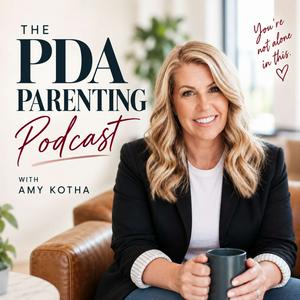
A podcast for parents raising PDA autistic kids and teens. Real talk, personal stories, and practical tools to move from chaos to connection - hosted by parent coach Amy Kotha.
Podcast websiteListen to The PDA Parenting Podcast, Circle Round and many other podcasts from around the world with the radio.net app
Get the free radio.net app
- Stations and podcasts to bookmark
- Stream via Wi-Fi or Bluetooth
- Supports Carplay & Android Auto
- Many other app features
Get the free radio.net app
- Stations and podcasts to bookmark
- Stream via Wi-Fi or Bluetooth
- Supports Carplay & Android Auto
- Many other app features

The PDA Parenting Podcast
Scan code,
download the app,
start listening.
download the app,
start listening.
 South Africa

