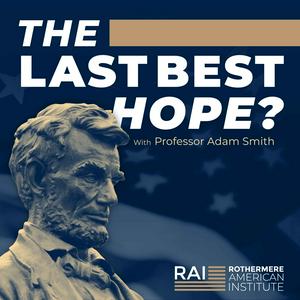
As the US gears up for the 250th anniversary celebrations of the Declaration of Independence on 4 July, the RAI’s podcast, The Last Best Hope?, returns for our 16th series on 13 May. As always, each episode uses history to explore what makes America different
“The must-listen US podcast” Nick Bryant, former BBC Correspondent in New York
The Last Best Hope? is a podcast of the Rothermere American Institute at the University of Oxford and is kindly supported by Tom Amraoui. For details of our programming, go to rai.ox.ac.uk
If you would like to support us by making a donation go to https://www.rai.ox.ac.uk/giving
Producer: Emily Williams. Presenter: Adam Smith Hosted on Acast. See acast.com/privacy for more information.
Why the Declaration of Independence said what it did, Episode 2
2026/03/04 | 42 mins.
To its principal author, Thomas Jefferson, it was “an expression of the American mind”; to the English philosopher Jeremy Bentham, it was "absurd and visionary". The Declaration of Independence, written 250 years ago, is so layered in myth, so foundational to the idea of America as the last best hope of earth, that it is a challenge, now, to put it into its gritty historical context -- a document that served to justify an act of rebellion, to garner support for it by listing grievances, but which also embedded, perhaps inintentionally, some powerful emancipatory claims. In this two-part episode of The Last Best Hope, Adam asks why the Declaration of Independence said what it did and why it mattered.
Contributors: Professor Lige Gould (University of New Hampshire), author of Among the Powers of the Earth: The American Revolution and the Making of a New World Empire; Professor Steven Sarson (Jean Moulin University Lyon 3) author of The Course of Human Events: The Declaration of Independence and the Historical Origins of the United States; the intellectual historian, biographer of James Harrington, Professor Rachel Hammersley (Newcastle University); Dr Grace Mallon (University of Oxford), Clive Holmes Fellow in History at Lady Margaret Hall; and Bradford Skow, Laurance S. Rockefeller Professor of Philosophy at MIT, author of American Independence in Verse.
The Last Best Hope? is a podcast of the Rothermere American Institute at the University of Oxford and is kindly supported by Tom Amraoui. For details of our programming, go to rai.ox.ac.uk
If you would like to support us by making a donation go to https://www.rai.ox.ac.uk/giving
Producer: Emily Williams. Presenter: Adam Smith Hosted on Acast. See acast.com/privacy for more information.
Why the Declaration of Independence said what it did, Episode 1
2026/02/26 | 46 mins.
To its principal author, Thomas Jefferson, it was “an expression of the American mind”; to the English philosopher Jeremy Bentham, it was "absurd and visionary". The Declaration of Independence, written 250 years ago, is so layered in myth, so foundational to the idea of America as the last best hope of earth, that it is a challenge, now, to put it into its gritty historical context -- a document that served to justify an act of rebellion, to garner support for it by listing grievances, but which also embedded, perhaps inintentionally, some powerful emancipatory claims. In this two-part episode of The Last Best Hope, Adam asks why the Declaration of Independence said what it did and why it mattered.
Contributors: Professor Lige Gould (University of New Hampshire), author of Among the Powers of the Earth: The American Revolution and the Making of a New World Empire; Professor Steven Sarson (Jean Moulin University Lyon 3) author of The Course of Human Events: The Declaration of Independence and the Historical Origins of the United States; the intellectual historian, biographer of James Harrington, Professor Rachel Hammersley (Newcastle University); Dr Grace Mallon (University of Oxford), Clive Holmes Fellow in History at Lady Margaret Hall; and Bradford Skow, Laurance S. Rockefeller Professor of Philosophy at MIT, author of American Independence in Verse.
The Last Best Hope? is a podcast of the Rothermere American Institute at the University of Oxford and is kindly supported by Tom Amraoui. For details of our programming, go to rai.ox.ac.uk Hosted on Acast. See acast.com/privacy for more information.
Why the Declaration of Independence said what it did, Episode 1
2026/02/25 | 46 mins.
To its principal author, Thomas Jefferson, it was “an expression of the American mind”; to the English philosopher Jeremy Bentham, it was "absurd and visionary". The Declaration of Independence, written 250 years ago, is so layered in myth, so foundational to the idea of America as the last best hope of earth, that it is a challenge, now, to put it into its gritty historical context -- a document that served to justify an act of rebellion, to garner support for it by listing grievances, but which also embedded, perhaps inintentionally, some powerful emancipatory claims. In this two-part episode of The Last Best Hope, Adam asks why the Declaration of Independence said what it did and why it mattered.
Contributors: Professor Lige Gould (University of New Hampshire), author of Among the Powers of the Earth: The American Revolution and the Making of a New World Empire; Professor Steven Sarson (Jean Moulin University Lyon 3) author of The Course of Human Events: The Declaration of Independence and the Historical Origins of the United States; the intellectual historian, biographer of James Harrington, Professor Rachel Hammersley (Newcastle University); Dr Grace Mallon (University of Oxford), Clive Holmes Fellow in History at Lady Margaret Hall; and Bradford Skow, Laurance S. Rockefeller Professor of Philosophy at MIT, author of American Independence in Verse.
The Last Best Hope? is a podcast of the Rothermere American Institute at the University of Oxford and is kindly supported by Tom Amraoui. For details of our programming, go to rai.ox.ac.uk
If you would like to support us by making a donation go to https://www.rai.ox.ac.uk/giving
Producer: Emily Williams. Presenter: Adam Smith Hosted on Acast. See acast.com/privacy for more information.
Can federalism save American liberalism?
2026/02/18 | 40 mins.
For much of the twentieth century, progressives in America wanted to expand the Federal Government. They created regulation, bureaucracy, and agencies capable of managing a complex industrial society. And often state governments were the obstacles they had to flatten – that was most obviously true of the movement for racial equality: the Civil Rights Act of 1964 and the Voting Rights Act of 1965 empowered the Federal government to step in and override the racist laws and practices that state governments implemented or failed to prevent. The working assumption of liberal politicians was that rights should be equally protected everywhere – from women’s access to abortion, to criminal justice, to the right to vote – and that idea even justified Federal government action in areas like education, which were otherwise clearly the preserve of the states. But today, things look different. The right is in control in Washington; maybe the states and state courts provide alternative pathways for liberals, in the way that they once were for conservatives? Can states not only resist federal power but also pioneer new forms of governance? Adam is joined by Emily Zackin, Associate Professor in the Political Science Department at Johns Hopkins and currently the Winant Professor of American Government at Oxford. And by Judge Daniel Korobkin, who sits on the Michigan Court of Appeals.
The Last Best Hope? is a podcast of the Rothermere American Institute at the University of Oxford and is kindly supported by Tom Amraoui. For details of our programming, go to rai.ox.ac.uk
If you would like to support us by making a donation go to https://www.rai.ox.ac.uk/giving
Producer: Emily Williams. Presenter: Adam Smith Hosted on Acast. See acast.com/privacy for more information.
Abraham Lincoln called the United States “the last best hope of Earth.” In this podcast, we ask whether that claim still holds — and whether it ever did. Each episode takes a figure, idea, or moment in American political history and asks what it tells us about the country’s understanding of itself, always with an eye to how America looks from the outside in. The Last Best Hope? takes ideas seriously: America as a creed, the arguments of the people who built and remade it, and what America has meant to the rest of the world. We take our subjects from history, not the news — though the present is rarely far away.Hosted by Adam Smith, Orsborn Professor of American Political History and Director of the Rothermere American Institute at Oxford, The Last Best Hope? brings him into conversation with leading scholars and public figures, including Hillary Clinton, Annette Gordon-Reed, Eric Foner, David Frum, Heather Cox Richardson, Stacy Schiff, Jonathan Freedland, James Morone, Michael Kazin, Kevin Kruse, Julian Zelizer, Bruce Schulman, Ty Seidule, Liz Varon, Eric Rauchway, Phil Tinline, Emily Bazelon, Richard Carwardine, Rachel Shelden, Richard Blackett, Devin Fergus, and Dan Jackson.“Adam Smith is one of the UK’s foremost historians of America, and communicates his expertise with zest, wit and unforced passion. The Last Best Hope? brings him together with fellow scholars to provide a unique insight we can’t do without.” — Phil Tinline, BBC radio documentary-maker and author“The Last Best Hope is an absolutely brilliant podcast. Thoughtful, clever, engaging and accessible, Adam Smith always gets the best out of his guests, and I’ve learned an enormous amount from every episode. I love it.” — Dominic Sandbrook, historian and co-host of The Rest is History“The must-listen US podcast.” — Nick Bryant, former BBC Correspondent in New YorkProduced by the Rothermere American Institute, University of Oxford. https://www.rai.ox.ac.uk/home Hosted on Acast. See acast.com/privacy for more information.











 South Africa