

Listen to this podcast for free in the app: Download for free in the App Store
radio.net
Sleep timer
Save favourites
54 episodes
E50: Prediction Markets in Roblox Replacement Theory? Did Malthus Really Lie?
2026/08/10 | 1h 9 mins.Roblox's generational numbers will change the face of gaming forever, but no one seems to give a shit. [Phillip Black]( / phillip-black-economist , [Christopher Kaczmarczyk-Smith]( / chris-economics , and [Eric Guan]( / eric-guan-6b122875 ) sketch the Malthusian arithmetic behind Roblox replacement theory and what it all means.We turn Polymarket into a one-dollar group game and compare the economics of $40 rhythm games and Elden Ring DLC.Plus:
Polymarket as a game: 60-second decisions, and why tiny stakes can make distant events worth following
The Game Economist Cast prediction portfolio, from geopolitical deadlines and GTA 6 to House of the Dragon word counts
Betting as suspense design: stakes make otherwise meaningless moments feel consequential
Rhythm Heaven's $40 one-button joy and Phillip's inability to care without competition
Elden Ring, downloadable content, and how $500 in lifetime franchise spending compares with mobile-game LTV
Roblox replacement theory: unprecedented youth acquisition followed by a stacking cohort of adult gamers
The Malthusian arithmetic behind two in five Americans playing games by 2055, and the 80% carry-through assumption supporting it
Whether Roblox players migrate into legacy platforms or carry Roblox-native genres, language, and business models into adulthood
Why growth in gaming GDP does not guarantee survival for today's studios, publishers, and platforms.E49: The Economic Game Theory of All Games
2026/04/28 | 1h 18 mins.The entire theory of games is underpinned by this one theory, but how far can it's explanitory power be pushed? Phillip Black, Christopher Kaczmarczyk-Smith, and Eric Guan talk cozy Pokemon habitats, merge-game economics multipliers, AI labor-market irony, and Edward Castronova's foundational work on virtual worlds.
We talk:
Pokopia as the Pokemon cozy game:
Multipliers as the key merge-game innovation:
Narrative as reward subsidy or tax:
AI and the game-industry labor market:
Castronova's virtual-world economics:
The player contract:GEC BONUS EP: What's up at GDC 2026?
2026/03/18 | 38 mins.Takes so hot that they were recorded late at night after a long day on the GDC floor, and couple whiskeys. Phil, Eric and Chris crew unpack what actually mattered at GDC 2026, and what didn’t.
We discuss:
A sharper critique of industry thinking
Too many taxonomy talks, not enough opinions
Why game talks should behave more like economics seminars
AI’s role on the show floor and conference
Shift from generative art hype to code generation and workflows
Why survey data understates actual usage and masks revealed preferences
AI present but muted, Web3 effectively gone
Novelty hardware, indie creativity, and a clear tech pullback
The collapse of production costs and what replaces them
Near-zero fixed costs leading to infinite content supply
Discovery, marketing, and CAC as the new binding constraints
Why incumbents may strengthen, not weaken
Ad spend and distribution advantages widening the moat
Counterpoint: new channels still create pockets of disruption
Hardware, interfaces, and “convergent evolution”
Why controllers standardized and what that says about optimal design
Failed alternatives and the persistent friction of interactionE48: Ozempic, 2XKO and ARPDAU For Wild Takes
2026/02/15 | 1h 1 mins.If the majority of mobile casuals' target audience takes Ozempic, what effect does that have on games? No one's asking these questions, so welcome to the Game Economist Cast.
Weight loss drugs, AI copilots, and gambling apps dominated the most expensive media real estate on earth, and games were barely in the frame. In this episode, we unpack what that signal means for interactive entertainment, Eric uncovers Riot’s 2XKO downsizing to Google’s Genie 3, and the future of engines. Phil previews his GDC talk on the economics of a billion-dollar cosmetic economy, Chris breaks down his attempt to design and publish a trading board game, and we ask a harder question: in a world of Ozempic and infinite AI supply, what actually happens to gaming demand?
We discuss:
The 2XKO reset and the economics of niche within niche genres
Team size, burn rate, and why a 160-person fighting game team changes the break-even math
Free to play cosmetics versus box price DLC in a capped DAU genre
Why betting apps can out-monetize most games on ARPDAU
How appetite suppression might reallocate time, spending, and loop sensitivity
Genie 3 and the cost curve of game production
Engines as rule governance layers in a probabilistic content world
Cosmetic economies as foundational theory
Scarcity, signaling, and equilibrium pricing in digital status markets
Price discovery, private information, and turning trade into tabletop playE47: Iterated Prisoner’s Dilemma, Social Norms Go Astray, and Why Game Economy Needs Math
2026/01/26 | 1h 11 mins.Chuck E. Cheese is still alive, and so is the analytics-to-product pipeline. @Amanda Cesario analytics lead turned product leader, joins @Phillip Black, Eric, and @Christopher Kaczmarczyk-Smith argue for embedded analytics, sharper language, and game systems that actually produce cooperation instead of a cosplay community.
We discuss:
• The missing vocabulary for economy design in live service, and how it's harmed the entire industry
• Why office ball pits best start-up ping pong tables
• The analyst’s real job: explaining “why,” then realizing the only way to fix it is to own the lever
• Embedded analytics vs centralized service orgs; who beats who
• Roblox as a laboratory: aspirational visibility, server “neighborhoods,” and system norms that communicate more than art
• Iterated Prisoner’s Dilemma, Axelrod’s tournaments, and why tit-for-tat is a design principle
• Monopoly Go partner events as rare, genuine, cooperation-through-repeated-interaction design
• Why Discovery Zone died, but Chuck E. Cheese prints money anyway
More Business podcasts






Trending Business podcasts



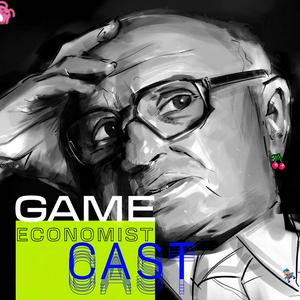
About Game Economist Cast
What does the new wave of open economies mean for monetization? Will negative externalities overcome cosmetic economies in the long run? What exactly does a game economist do?
Game Economist Cast is a roundtable discussion of the latest developments in mobile, HD, and crypto games, through a bunch of people figuring it out using the economic toolkit.
Podcast websiteListen to Game Economist Cast, The Money Show and many other podcasts from around the world with the radio.net app
Get the free radio.net app
- Stations and podcasts to bookmark
- Stream via Wi-Fi or Bluetooth
- Supports Carplay & Android Auto
- Many other app features
Get the free radio.net app
- Stations and podcasts to bookmark
- Stream via Wi-Fi or Bluetooth
- Supports Carplay & Android Auto
- Many other app features

Game Economist Cast
Scan code,
download the app,
start listening.
download the app,
start listening.
Game Economist Cast: Podcasts in Family
 South Africa