

Listen to this podcast for free in the app: Download for free in the App Store
radio.net
Sleep timer
Save favourites
76 episodes
Nobel Prize in Chemistry 2026 Explained: Mirror Molecules (EP 63)
2026/10/07 | 1h 20 mins.Why does life favor one molecular mirror image? The 2026 Nobel Prize in Chemistry honors Henri B. Kagan and Kenso Soai for nonlinear effects and autocatalysis in asymmetric organic synthesis.
Lester Nare and Krishna Choudhary unpack the science from first principles: chirality, Pasteur's crystals, enantiomeric excess, and how a tiny imbalance can grow into an overwhelming preference for one molecular hand.
We connect Kagan's catalyst discoveries and the Soai reaction to medicines, the origins of biological handedness, and the serious concerns around hypothetical mirror life. Plus: symmetry in physics, Frances Oldham Kelsey and thalidomide, and our interpretation of a Nobel illustration.
CHAPTERS
00:00 Why life has a molecular handedness
01:33 Hello Internet
02:49 The 2026 Chemistry laureates
06:24 Chirality and mirror-image molecules
12:10 Pasteur and the history of handedness
19:36 Why is life's chemistry one-handed?
24:35 Frank and the origin-of-life puzzle
29:14 Enantiomeric excess explained
30:30 Kagan and nonlinear effects
38:58 FFP and symmetry in physics
42:20 Soai and asymmetric autocatalysis
51:28 Why chirality matters for medicine
58:21 What this does and does not explain about life
1:00:25 Mirror life and biological risk
1:10:37 Examining the Nobel illustration
1:14:10 Recap and Nobel week reflections
RESEARCH & FURTHER READING
Original papers and supporting context:
Frank's model (1953): https://doi.org/10.1016/0006-3002(53)90082-1
Puchot, Kagan et al. (1986): https://doi.org/10.1021/ja00269a036
Soai et al. (1995): https://doi.org/10.1038/378767a0
Sato et al., amplification (2003): https://doi.org/10.1002/anie.200390105
Mirror-life risks (2024): https://doi.org/10.1126/science.ads9158
Nobel announcement: https://www.nobelprize.org/prizes/chemistry/2026/press-release/
EDITORIAL NOTES
Intro: the 50:50 example describes an unbiased synthesis, not all chemistry. The Soai reaction is a clue to amplification, not proof of how life began.
On-screen clarifications:
04:38 B-DNA is right-handed; Z-DNA can form a left-handed helix.
13:56 Pasteur separated sodium ammonium tartrate crystals.
18:48 L/D configuration does not specify optical rotation.
19:10 Proteins mainly use L-amino acids; DNA/RNA use D-sugars.
22:55 Mentos mainly triggers CO2 bubble nucleation.
27:18 Asymmetric catalysis and autocatalysis are distinct.
34:07 0.25 × 0.25 = 0.0625 = 6.25%.
36:31 Inactive mixed catalyst pairs are a simplified model.
37:55 The normalized product-ratio curve need not be parabolic.
42:04 Wu: preferential emission opposite spin; antineutrinos also emitted.
45:30 5-pyrimidyl alkanol; an alkanol is an alcohol.
47:10 The tiny-imbalance result is Sato et al. (2003), cited above.
47:40 A demonstration of symmetry breaking by asymmetric autocatalysis.
49:09 Above 99.5% ee means above 99.75% majority form, not exactly 100%.
49:57 0.00005% excess is 1 part in 2,000,000.
52:44 Thalidomide enantiomers interconvert in the body.
53:36 Merrell applied in the U.S.; Kelsey withheld approval. Trial exposure occurred.
1:02:09 Mirror-life catastrophe is a serious risk, not an observed outcome.
1:03:28 Antibodies are adaptive immunity, not innate immunity.
1:03:53 Impaired recognition does not mean proven total immune invisibility.
1:04:27 Some treatments might work; ecosystem protection is very difficult.
1:04:56 No reproducing mirror organism has been reported.
1:09:19 Chimeras and genetic modification are not interchangeable.
1:10:37 The Nobel-diagram critique is our interpretation, not an official correction.
1:11:51 Solid wedge: toward; hashed wedge: away; ordinary line: neither.
WATCH & FOLLOW
Full video: https://youtu.be/Wdapv1hFT4w
Episode notes: https://ffppod.com/episodes/ep63
Follow @FFPPod on Instagram, TikTok, X and Facebook.
Breaking down science news so it makes sense to curious people everywhere.Nobel Prize in Physics 2026 Explained: IceCube & Neutrinos
2026/10/06 | 1h 2 mins.Why build a telescope inside a billion tons of Antarctic ice? The 2026 Nobel Prize in Physics recognizes Francis Halzen's work on IceCube and the discovery of high-energy neutrinos from the cosmos.
In Episode 62 of From First Principles, Lester Nare and Krishna Choudhary explain neutrinos from the ground up: why these elusive particles make powerful cosmic messengers, how faint flashes of Cherenkov light reveal their interactions, and why detecting them requires an observatory buried deep beneath the South Pole.
We follow the path from beta decay and the first neutrino experiments to AMANDA, IceCube's construction, the 2013 astrophysical breakthrough, a distant blazar, and a neutrino map of the Milky Way. Along the way: cosmic rays, the Oh-My-God particle, tracks versus cascades, and the international collaboration behind the discovery.
CHAPTERS
00:00 Hunting ghost particles beneath Antarctica
01:16 Hello Internet and Nobel Prize
05:30 What are neutrinos?
10:00 Neutrinos as cosmic messengers
15:02 The Oh-My-God particle
16:21 Cosmic-ray energies
19:07 Cosmic particle accelerators
22:28 Why look for neutrinos?
25:52 How to detect a neutrino
29:23 Cherenkov light
33:13 Building a neutrino observatory
37:17 From Antarctic ice to AMANDA
42:21 Building IceCube
44:59 Reading tracks and cascades
49:30 Backgrounds and the 2013 discovery
52:46 Tracing cosmic neutrino sources
54:16 Mapping the Milky Way
58:23 IceCube collaboration and Gen2
1:01:05 Closing and Nobel week
RESEARCH & FURTHER READING
AMANDA in Antarctic ice (2001): https://doi.org/10.1038/35068509
IceCube detector and instrumentation (2017): https://doi.org/10.1088/1748-0221/12/03/P03012
First PeV neutrinos (2013): https://doi.org/10.1103/PhysRevLett.111.021103
Astrophysical neutrino evidence (2013): https://doi.org/10.1126/science.1242856
Blazar TXS 0506+056 (2018): https://doi.org/10.1126/science.aat1378
Archival blazar neutrino emission (2018): https://doi.org/10.1126/science.aat2890
Milky Way neutrino map (2023): https://doi.org/10.1126/science.adc9818
Gamma-ray burst constraints (2012): https://doi.org/10.1038/nature11068
IceCube overview: https://icecube.wisc.edu/science/icecube/
EDITORIAL NOTES
Intro: the 2013 breakthrough was high-energy astrophysical neutrinos. Lower-energy supernova neutrinos were detected in 1987.
On-screen clarifications:
06:45 Beta-minus decay produces a proton, electron and electron antineutrino.
11:10 Davis studied solar neutrinos; Koshiba's team detected SN 1987A neutrinos.
17:50 The cosmic-ray knee and ankle are not fixed distance boundaries.
19:38 Required accelerator size depends on magnetic-field strength.
24:18 Ground-based telescopes also detect gamma rays through air showers.
27:48 W interactions produce charged leptons; Z scattering preserves neutrino flavor.
34:06 The underwater concept dates to 1960; DUMAND developed in the 1970s.
36:09 Baikal holds about one-fifth of unfrozen surface freshwater.
38:53 Earth filters muons but also absorbs many very-high-energy neutrinos.
41:26 Pressure converts air bubbles into clathrates, reducing light scattering.
42:28 Construction finished in December 2010; full operations began in May 2011.
44:27 Sensors are DOMs; DeepCore is a densely instrumented detector region.
45:47 Timing gives direction; light yield and pattern help estimate energy.
49:44 Upgoing events can still be atmospheric neutrinos.
53:12 TXS 0506+056 is about 3.7 billion light-years away.
56:38 Long GRBs often involve collapsing stars; short GRBs often involve mergers.
WATCH & FOLLOW
Full video: https://youtu.be/eMahxeBj5k0
Episode notes: https://ffppod.com/episodes/ep62
Medicine Nobel explained: https://youtu.be/PKAYqhy8xf8
Follow @FFPPod on Instagram, TikTok, X and Facebook.
From First Principles: Breaking down science news so it makes sense to curious people everywhere.Nobel Prize in Medicine 2026 Explained: Optogenetics (EP 61)
2026/10/05 | 1h 11 mins.How do you prove what a brain cell actually does? The 2026 Nobel Prize in Medicine celebrates a remarkable answer: give cells a light-sensitive protein, then switch their activity on or off with light.
In Episode 61 of From First Principles, Lester Nare and Krishna Choudhary explain optogenetics from the ground up and trace the discoveries of Peter Hegemann, Georg Nagel and Karl Deisseroth. We follow the story from algae swimming toward light to channelrhodopsins, precisely controlled neurons, and experiments probing memory, reward and behavior. Then we explore heart-brain connections, early attempts to restore vision, and what these experiments can and cannot tell us.
CHAPTERS
00:00 The discovery that put brain cells under light control
02:34 Hello Internet
03:28 2026 Medicine Nobel and optogenetics
05:38 Understanding the brain
08:42 From correlation to causation
18:13 Controlling neurons with light
21:25 Early optogenetics and the chARGe system
24:17 Light-sensitive microbial proteins
26:26 Algae and phototaxis
31:42 Discovering channelrhodopsins
34:42 Nagel and light-gated ion channels
40:55 Controlling mammalian neurons
50:19 Expanding the optogenetic toolkit
56:10 Neural circuits and behavior
59:02 Memory, reward and reinforcement
1:02:53 Heart rhythm and emotion
1:04:02 Beyond the brain and toward medical treatments
1:06:56 Implications and limits
1:09:10 Closing and Nobel week
RESEARCH & FURTHER READING
Full paper list: https://ffppod.com/episodes/ep61
Nobel Prize announcement and background:
https://www.nobelprize.org/prizes/medicine/2026/summary/
Optical control of neurons: https://doi.org/10.1038/nn1525
Memory recall in mice: https://doi.org/10.1038/nature11028
Partial visual recovery: https://doi.org/10.1038/s41591-021-01351-4
EDITORIAL NOTES
On-screen clarifications are included at these timestamps:
13:46 The Jennifer Aniston neuron was recorded in human patients. Selective firing alone did not establish that it causes recognition.
30:34 Vertebrate rhodopsin is a GPCR. In rods and cones, light closes cGMP-gated channels and causes hyperpolarization.
35:12 Xenopus oocytes are immature frog egg cells, not embryos.
39:52 Calcium entry triggers neurotransmitter release; neurotransmitters carry the signal across the synapse. ChR2 conducts several positive ions, not just calcium.
52:17 Halorhodopsin is a light-driven chloride pump, not a channel.
1:03:18 The heart-pacing study expressed ChRmine in mouse heart muscle cells, not neurons.
Animal studies and early clinical results are distinguished from established treatments.
WATCH & LISTEN
Watch this episode: https://youtu.be/PKAYqhy8xf8
Our Nobel predictions: https://open.spotify.com/episode/4xuoH7WhM5svq8vEJPL3Ce
Support: https://ffppod.com/donate
Contact: https://ffppod.com/contact
Follow @FFPPod.
Breaking down science news so it makes sense to curious people everywhere.2026 Nobel Prize Predictions: Medicine, Physics & Chemistry (EP 60)
2026/10/03 | 40 mins.Who could win the 2026 Nobel Prizes? From the science behind Ozempic to quantum interference and droplets inside living cells, Lester Nare and Krishna Choudhary make their picks for Medicine, Physics and Chemistry, and explain the discoveries behind them.
In Episode 60 of From First Principles, we explore seven research areas with a case for Nobel recognition: GLP-1, optogenetics, optical coherence tomography, the Aharonov–Bohm effect, atomic force microscopy, biomolecular condensates and Buchwald–Hartwig coupling. We also discuss Michael Berry’s geometric phase and the awkward question of how a prize limited to three people recognizes discoveries built by larger teams.
These are our predictions, recorded before the 2026 announcements. Medicine, Physics and Chemistry will be announced October 5–7. Which discovery, and which researchers, would you pick? Tell us in the comments, then join us for our Nobel week breakdowns.
CHAPTERS
00:00 The science that could win a Nobel Prize
00:57 Hello Internet: our 2026 predictions
02:03 Medicine: GLP-1 and the science behind Ozempic
07:41 Medicine: optogenetics and controlling neurons with light
13:16 Medicine: optical coherence tomography
16:28 Golden Goose Awards and FFP updates
18:39 Physics: the Aharonov–Bohm effect and geometric phase
27:37 Physics: atomic force microscopy
32:04 Chemistry: biomolecular condensates
36:36 Chemistry: Buchwald–Hartwig coupling
38:42 Your predictions and our Nobel week plans
RESEARCH & FURTHER READING
Foundational papers and background for the discoveries discussed:
GLP-1: Mojsov, Weir & Habener (1987)
https://doi.org/10.1172/JCI112855
Optogenetics: Boyden et al. (2005)
https://doi.org/10.1038/nn1525
Optical coherence tomography: Huang et al. (1991)
https://doi.org/10.1126/science.1957169
Aharonov–Bohm effect (1959)
https://doi.org/10.1103/PhysRev.115.485
Berry’s geometric phase (1984)
https://doi.org/10.1098/rspa.1984.0023
Atomic force microscopy: Binnig, Quate & Gerber (1986)
https://doi.org/10.1103/PhysRevLett.56.930
Biomolecular condensates: Brangwynne et al. (2009); Li et al. (2012)
https://doi.org/10.1126/science.1172046
https://doi.org/10.1038/nature10879
Buchwald–Hartwig coupling: Paul et al. (1994); Guram et al. (1995)
https://doi.org/10.1021/ja00092a058
https://doi.org/10.1002/anie.199513481
Official Nobel announcement schedule:
https://www.nobelprize.org/prizes/about/prize-announcement-dates/
EDITORIAL NOTES
19:30 David Bohm later held a professorship at Birkbeck, University of London (1961–1987); he did not spend the rest of his career in Brazil.
33:23 The ribosome-producing compartment discussed is the nucleolus, not the nucleosome. These corrections also appear on screen.
WATCH & EXPLORE
YouTube: https://youtu.be/MgOpbh5VUGE
Episode page and research library: https://ffppod.com/episodes/ep60
Support: https://ffppod.com/donate
Follow @FFPPod on X / Instagram / TikTok / Facebook
Breaking down science news so it makes sense to curious people everywhere.Golden Goose Awards 2026: The Science Behind the Winners (Part 1) (EP 59)
2026/09/29 | 2h 7 mins.What connects a noise complaint, holiday lights seen from space, and the physics of a coffee stain? Three unexpected paths from basic research to discoveries with real-world impact.
Krishna Choudhary and Lester Nare explore the science behind the 2026 Golden Goose Awards: Zhen Xu's work on histotripsy, NASA's Black Marble nighttime satellite data, and Sidney Nagel's discoveries in soft matter physics.
We start with focused ultrasound and the tiny bubbles that can break apart targeted tissue, tracing the journey from early laboratory experiments to clinical research on liver tumors. Then we look at how Earth's nighttime lights reveal power outages, disaster recovery, and changing human activity. Finally, falling drops, coffee stains, and jammed grains open up a world of robotic grippers and materials that can be trained and retrained.
The thread connecting all three stories is the unexpected value of federally funded basic research. Part 2 will feature conversations with the award-winning researchers and AAAS CEO Sudip Parikh.
CHAPTERS
00:00 Golden Goose Awards trailer
01:19 Introducing our Golden Goose special
02:42 Zhen Xu: From a noise complaint to histotripsy
05:57 The early ultrasound experiments
13:42 Controlling cavitation with microtripsy
20:29 Tumor destruction and the immune response
28:33 Histotripsy through the skull
37:23 The HOPE4LIVER clinical trial
43:55 Why basic research needs time
47:17 FFP updates and supporting the show
49:20 NASA Black Marble: Holiday lights from space
55:29 Turning night lights into reliable data
1:01:36 Hurricane Maria and unequal recovery
1:08:12 COVID-19 and changing nighttime activity
1:10:16 Mapping access to electricity
1:15:20 Where Earth is brightening and dimming
1:32:57 Sidney Nagel and the physics of everyday life
1:37:07 The science of a falling drop
1:46:02 Why coffee leaves a ring
1:51:04 Jamming: When grains become rigid
1:53:35 A robotic gripper filled with grains
1:55:39 Why air pressure changes a splash
1:58:55 Materials that can be trained and retrained
2:03:26 The payoff from curiosity
2:05:29 Coming in Part 2
2:07:06 Outro
FEATURED RESEARCH
Histotripsy: The #HOPE4LIVER single-arm pivotal trial (Radiology, 2024)
https://doi.org/10.1148/radiol.233051
NASA's Black Marble nighttime lights product suite (Remote Sensing of Environment, 2018)
https://doi.org/10.1016/j.rse.2018.03.017
Training and retraining liquid crystal elastomer metamaterials for pluripotent functionality (PNAS, 2025)
https://doi.org/10.1073/pnas.2504304122
WATCH ON YOUTUBE
https://youtu.be/rDInUEtTojg
EXPLORE FFP
Website: https://ffppod.com
Science Funding Tracker: https://ffppod.com/funding
Science Transfer Portal: https://ffppod.com/transfers
America 250: https://ffppod.com/America250
SUPPORT THE SHOW
https://ffppod.com/donate
FOLLOW
@FFPPod on X / Instagram / TikTok / Facebook
More Science podcasts
 The Rest Is SciencePhilosophy, Physics, Science, Society & Culture, Technology
 Boring History for SleepScience, Social Sciences
 More or LessMathematics, News, News Commentary, Science, Society & Culture
 UnexplainableLife Sciences, Science
 RadiolabDocumentary, History, Natural Sciences, Science, Society & Culture
 Bite Back with Abbey SharpHealth & Wellness, Science, Society & Culture
 Hidden BrainArts, Performing Arts, Science, Social Sciences
 Science WeeklyScience
 The Naked Scientists PodcastHealth & Wellness, Life Sciences, Medicine, Natural Sciences, Science
 StarTalk with Neil deGrasse TysonEducation, Science
Trending Science podcasts
 A Question of ScienceHealth & Wellness, Medicine, Science, Technology
 Nature PodcastNews, Science, Technology
 Das Wissen | SWRScience
 Houston We Have a PodcastScience
 Regenerative Agriculture PodcastEarth Sciences, Natural Sciences, Science
 Let's Learn Everything!Science
 Short WaveDaily News, Life Sciences, News, Science
 From Our Neurons to YoursHealth & Wellness, Life Sciences, Mental Health, Science
 Astrum SpaceAstronomy, Science
 Get BirdingLeisure, Natural Sciences, Nature, Science
 How We're WiredLife Sciences, Science
 Rewilding the World with Ben GoldsmithEarth Sciences, Nature, Science
 Therapist Uncensored PodcastEducation, Relationships, Science, Self-Improvement, Social Sciences, Society & Culture
 Crash Course Pods: The UniverseAstronomy, Courses, Education, Physics, Science
 HOLOSKY PODCASTNatural Sciences, Science, True Crime
 The Birding Life Podcast NetworkHobbies, Leisure, Nature, Science, Social Sciences
 Guardians of the RiverNature, Science
 Talk Nerdy with Cara Santa MariaNatural Sciences, Science, Society & Culture
 WaterlandsNature, Science, Society & Culture
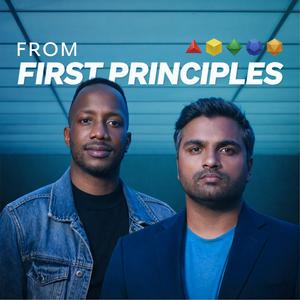
About From First Principles
From First Principles is a fast, funny, and rigorous breakdown of the biggest science stories of the week, hosted by Lester Nare and physicist Krishna Choudhary, PhD. We go past headlines into the actual mechanics: what happened, why it matters, and what everyone’s missing.
Expect physics, space, AI, energy, biotech, and the occasional “wait… is that real?” story. If you’re curious, skeptical, and you like learning in public — you’re in the right place.
Podcast websiteListen to From First Principles, The Rest Is Science and many other podcasts from around the world with the radio.net app
Get the free radio.net app
- Stations and podcasts to bookmark
- Stream via Wi-Fi or Bluetooth
- Supports Carplay & Android Auto
- Many other app features
Get the free radio.net app
- Stations and podcasts to bookmark
- Stream via Wi-Fi or Bluetooth
- Supports Carplay & Android Auto
- Many other app features
From First Principles
Scan code,
download the app,
start listening.
download the app,
start listening.
 South Africa