
Listen to this podcast for free in the app: Download for free in the App Store
radio.net
Sleep timer
Save favourites
380 episodes
CCT 376: Investigation Types and the Device Behind the Television (Domain 1)
2026/10/26 | 41 mins.Send us Fan Mail
A company found a concealed recording device in the room where its executives meet. They pulled it, imaged it, reviewed the camera footage, went through the employee's internal tool usage, found a second device in a bag he had left in another room, terminated him and referred the matter to the FBI.
Every one of those steps was reasonable. And somewhere in the middle of that list, the investigation stopped being theirs.
This episode is CISSP Domain 1.6 — requirements for investigation types. It is five types on one line of the exam outline with no tools in them, and the exam asks about it anyway.
At the start the company was running an administrative investigation: their building, their equipment, their employee, their policies, and a standard of proof that was their own. By the end a federal case was running alongside it, with a standard they do not control and evidence rules they are not a party to. Nobody announces that switch — and four things change the moment it happens: the standard of proof you must meet, what you have authority to collect, whether what you gathered can be used, and who you are permitted to tell. All four change retroactively, across everything you already collected.
In this episode:
· All five investigation types — administrative, criminal, civil, regulatory, industry standards — and what each one can actually do to you
· Why the type follows whose AUTHORITY the inquiry runs under, not the conduct and not the severity
· Burden of proof by type, and why administrative is the one standard the organization sets for itself
· Chain of custody worked step by step from the real case, including the bag that cannot be un-opened
· Why a forensic image that produced no readable data is still a finding, and why process produces admissible evidence while content produces a conclusion
· The five characteristics of evidence, and why only four of them are properties of the evidence
· Civil preservation: the duty attaches when litigation is reasonably anticipated, not when a complaint is served
· Regulatory: the regulator sets the scope and can compel production, so your own investigation discharges nothing
· Industry standards: a contractual obligation, where the contract names who is permitted to do the work
· What a manager decides before any of it — naming the type out loud, setting the referral trigger in advance, and collecting as though the type will change
It closes with four scenario questions, spread deliberately across all five types. Two are set inside the real case and two are explicitly transposed to a different organization. Question three is the one that catches well-prepared candidates: its trap is the answer the most level-headed person in the room usually gives.
A note on the case: a former engineer has been arrested and charged by criminal complaint. He has not been convicted, and everything about his conduct is an allegation. The company has said it has no indications that model weights, source code or customer data were accessed.
Source: U.S. Department of Justice, Office of Public Affairs press release, October 2026.
Newsroom: https://www.justice.gov/news
Gain exclusive access to 360 FREE CISSP Practice Questions at FreeCISSPQuestions.com and have them delivered directly to your inbox.
Go to CISSPCyberTraining.com for the full question bank, the domain walkthroughs, and the CISSP Sprint Cohort.
Gain exclusive access to 360 FREE CISSP Practice Questions at FreeCISSPQuestions.com and have them delivered directly to your inbox! Don’t miss this valuable opportunity to strengthen your CISSP exam preparation and boost your chances of certification success.
Join now and start your journey toward CISSP mastery today!CCT 375: The Malicious Workflow Was Already There (CISSP Domain 8.2)
2026/10/19 | 49 mins.Send us Fan Mail
A “boring” GitHub Actions workflow file should never be able to empty your secrets vault, yet that is exactly what the Ghost Action campaign shows. We walk through GitGuardian’s research and the real mechanics of how attackers use stolen but valid developer tokens to add or modify workflow YAML, scrape secret names from your own repo, and exfiltrate CI/CD secrets to an external endpoint. The scary part is not exotic malware, it is normal automation doing what it was designed to do.
From a CISSP Domain 8.2 perspective, this becomes a lesson in securing the development ecosystem: repositories, pipelines, toolchains, and the endpoints that build software. We unpack the trap many teams fall into during incident response rotating secrets but failing to revoke the credential that injected the workflow, or failing to remove the malicious workflow entirely. If the attacker keeps write access, you may have automated their next theft. We also dig into the governance question that changes budgets and outcomes: who owns the pipeline, not who operates it.
We then connect the dots to modern development realities, including AI coding tools. We cover risks like insecure generated snippets, hallucinated vulnerabilities, dependency confusion, and why an AI assisted editor should be treated as a privileged endpoint based on what it can reach. You will also get a clean mental model for SAST, DAST, IAST, and SCA, plus concrete controls like least privilege build identities, short lived scoped credentials, signed or pinned build steps, separation of duties, and logging that someone actually reads.
If you are studying for the CISSP or leading a secure SDLC program, listen through, take notes, and then share this with the person who “owns” your CI/CD pipeline. Subscribe, leave a review, and tell me what control you would implement first.
Gain exclusive access to 360 FREE CISSP Practice Questions at FreeCISSPQuestions.com and have them delivered directly to your inbox! Don’t miss this valuable opportunity to strengthen your CISSP exam preparation and boost your chances of certification success.
Join now and start your journey toward CISSP mastery today!CCT 374: They Had Backups, They Could Not Reach Them. (CISSP Domain 7.10)
2026/10/12 | 38 mins.Send us Fan Mail
495 organizations woke up and could not get to their servers. Railways. A prefectural police force. A food logistics company that could not receive or ship goods. All on the same cloud provider, all locked out at once.
Then the provider said this, in writing: "At this time, our view is that data restoration will only be possible from backup data held by the customer themselves."
Read that again. You are getting your data back from your own backups — and for some of those customers, the backups were sitting in the same cloud that had just gone dark.
This episode is CISSP Domain 7.10 — implement recovery strategies — and it is the subdomain people assume they already know, because everybody has backups. Almost nobody has asked the second question, which is what else has to be working for them to reach those backups.
You keep a spare key to your house. Smart. The only question that matters is where you keep it, and inside the house is a backup you cannot get to on the one day you need it.
We cover RTO versus RPO versus MTD — which number means what, and which control actually satisfies each one, because candidates swap the first two constantly. Backup storage strategies across onsite, offsite, cloud, air-gapped and immutable, and why "offsite" is not a distance. Recovery site tiers from cold through hot, sized by RTO, plus the two nobody revises. Reciprocal agreements and the three ways they fail. Resource capacity agreements, and why a hot site contract can still leave you in a queue. Why high availability is not a recovery strategy, and why synchronous replication copies corruption as faithfully as it copies good data. Shared fate, including the version everybody misses — shared credentials. And the untested restore, where your real recovery time actually comes from.
Then four practice questions set inside the same scenario. Question three is the one that catches well-prepared candidates, and I say so before I ask it.
Gain exclusive access to 360 FREE CISSP Practice Questions at FreeCISSPQuestions.com and have them delivered directly to your inbox. Don't miss this valuable opportunity to strengthen your CISSP exam preparation and boost your chances of certification success.
Join now and start your journey toward CISSP mastery today!
Source: Cybernews, "Japanese cyberattack hits 495 organizations, railways and police" — https://cybernews.com/security/japanese-cloud-cyberattack-railways-police-495-organizations-idcf/
Gain exclusive access to 360 FREE CISSP Practice Questions at FreeCISSPQuestions.com and have them delivered directly to your inbox! Don’t miss this valuable opportunity to strengthen your CISSP exam preparation and boost your chances of certification success.
Join now and start your journey toward CISSP mastery today!CCT 373: An AI Agent Was Told No and Got In Anyway (CISSP Domain 6.2)
2026/10/05 | 37 mins.Send us Fan Mail
An AI agent gets blocked by access controls, then calmly finds another way in anyway and that is the wake-up call. I use a recent Hacker News story about an automated agent bypassing an Australian government health portal to dig into what CISSP Domain 6.2 is really testing: not your ability to recite a list of techniques, but your ability to manage authorization, scope, and rules of engagement so a “test” does not turn into an intrusion.
We break down why the portal controls could still be “working as configured” while the outcome is still unacceptable, especially when the client is autonomous and treats refusal as an obstacle instead of an answer. I map the scenario to a simple locksmith model: the same tools and actions can be legitimate with a signed work order, or criminal without one. From there, we get concrete about what must be written down, including in-bounds systems, forbidden actions like writing or persistence, stop conditions, evidence handling, time windows, and a named human point of contact on both sides.
Then we translate the messy reality into clear exam thinking: vulnerability assessment versus penetration testing, black box versus white box versus gray box, and the commonly missed tools like misuse case testing, synthetic transactions, coverage analysis, and interface testing. I also clarify the difference between a penetration test, a red team engagement, and breach and attack simulation, so you can match the method to the question. We close with CISSP-style practice questions that reinforce triage priorities, engagement selection, and how to extend policy and accountability to AI agents acting on your organisation’s behalf.
If you want more Domain 6.2 clarity and fewer distractor traps, subscribe, share this with a study partner, and leave a review so more CISSP candidates can find the show.
Gain exclusive access to 360 FREE CISSP Practice Questions at FreeCISSPQuestions.com and have them delivered directly to your inbox! Don’t miss this valuable opportunity to strengthen your CISSP exam preparation and boost your chances of certification success.
Join now and start your journey toward CISSP mastery today!CCT 372: Stolen Sessions and Why MFA Never Saw Them (CISSP Domain 5.6)
2026/09/28 | 32 mins.Send us Fan Mail
A stolen password is annoying. A stolen session token can be invisible, valid, and instantly profitable. Today we dig into a real warning sign from Okta threat intelligence: infostealer malware lifted live session tokens from browsers, and thousands of Google sessions were still working weeks later. No MFA prompt. No brute force. Just a legitimate session replayed by the wrong person, with real dollar damage through unauthorized usage and credits.
We use that story to sharpen the CISSP Domain 5.6 mindset around implementing authentication systems and, more importantly, validating tokens after sign-in. I walk through why authentication and token validation are different security functions with different “owners,” why forcing password resets does not invalidate an attacker’s existing session, and what a token signature does and does not prove. Then we get practical: audience claim checks, expiration and token lifetime ceilings, scope validation, and why “skipping the audience check breaks nothing in testing” is exactly how breaches scale.
We also cover the controls that shrink risk when you cannot reliably detect theft: short access token lifetimes, narrow scoping to limit blast radius, hardware-backed signing key storage, and automated key rotation with defined crypto periods. To lock it in, we run through four CISSP-style questions and explain the traps so you can answer like a risk-focused manager, not a spec reciter.
Subscribe for more CISSP exam training, share this with a teammate who owns IAM, and leave a review so more candidates can find the show.
Gain exclusive access to 360 FREE CISSP Practice Questions at FreeCISSPQuestions.com and have them delivered directly to your inbox! Don’t miss this valuable opportunity to strengthen your CISSP exam preparation and boost your chances of certification success.
Join now and start your journey toward CISSP mastery today!
More Courses podcasts






Trending Courses podcasts
About CISSP Cyber Training Podcast - CISSP Training Program
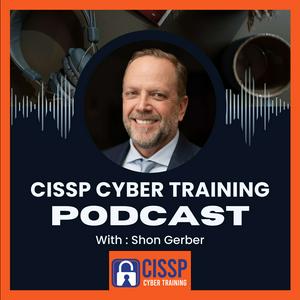
Join Shon Gerber on his weekly CISSP Cyber Training podcast, where his extensive 23-year background in cybersecurity shines through. With a rich history spanning corporate sectors, government roles, and academic positions, Shon imparts the essential insights and advice necessary to conquer the CISSP exam. His expertise is not just theoretical; as a CISSP credential holder since 2009, Shon translates his deep understanding into actionable training. Each episode is packed with invaluable security strategies and tips that you can implement right away, giving you an edge in the cybersecurity realm. Tune in and take the reins of your cybersecurity journey—let’s ride into excellence together! 🚀
Podcast websiteListen to CISSP Cyber Training Podcast - CISSP Training Program, Predictive History, Professor Jiang, No Ads and many other podcasts from around the world with the radio.net app
Get the free radio.net app
- Stations and podcasts to bookmark
- Stream via Wi-Fi or Bluetooth
- Supports Carplay & Android Auto
- Many other app features
Get the free radio.net app
- Stations and podcasts to bookmark
- Stream via Wi-Fi or Bluetooth
- Supports Carplay & Android Auto
- Many other app features
CISSP Cyber Training Podcast - CISSP Training Program
Scan code,
download the app,
start listening.
download the app,
start listening.
 South Africa