

Listen to this podcast for free in the app: Download for free in the App Store
radio.net
Sleep timer
Save favourites
Pass Your SBR ACCA Exams with Tom Clendon
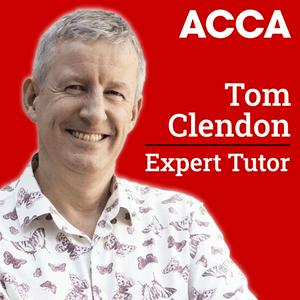
Tom Clendon | ACCA SBR Online Lecturer & Expert Tutor
Latest episode
106 episodes
Climate Change 101 and Sustainability Reporting | Old But Gold Series
2026/09/11 | 11 mins.This episode is part of my Old but Gold series, where I revisit some of my earlier podcasts that are still completely relevant for your SBR exam today. The recording may be from the archives, but the knowledge and exam technique are every bit as useful now.
In this episode, I strip climate change and sustainability reporting back to the basics. I explain greenhouse gas emissions, gross and net emissions, carbon credits and, crucially, the difference between Scope 1, Scope 2 and Scope 3 emissions. I also connect this terminology to the broader principles of sustainability reporting.
You’ll learn the language you need before you can confidently tackle an exam requirement on sustainability. I explain Scope 1 as direct emissions, Scope 2 as energy-related emissions and Scope 3 as emissions connected with the wider value chain. We also look at metrics, targets, governance, strategy, risk management and why concepts such as materiality, relevance and faithful representation still matter.
Thanks for listening to this episode of Pass Your SBR ACCA Exams with Tom Clendon.
If you’d like to view the exam question on screen and see my working, subscribe to the YouTube Channel: https://www.youtube.com/@tomclendonSBR.
For access to on-demand support and guidance for your ACCA SBR Journey, visit my website to see my current course offering: https://tomclendon.co.uk/.
(0:00) Old but Gold introduction
(0:57) Why climate change matters in SBR
(1:39) What is climate change?
(2:14) Greenhouse gases and carbon emissions
(3:12) Why accountants are involved in sustainability reporting
(4:00) Net zero, gross emissions and net emissions
(5:04) What are carbon credits?
(6:14) Scope 1 emissions
(6:43) Scope 2 emissions
(7:34) Scope 3 and the value chain
(8:08) Recap of Scope 1, 2 and 3
(8:34) IFRS S2, metrics, targets and materialityOCI and OCE: What’s the Difference? | Old But Gold Series
2026/08/28 | 7 mins.This episode is part of my Old but Gold series, where I revisit some of my earlier podcasts that are still completely relevant for your SBR exam today. The recording may be from the archives, but the knowledge and exam technique are every bit as useful now.
OCI and OCE sound very similar, but they are not the same thing. In this episode, I explain the difference between other comprehensive income, which is a performance statement for the period, and other components of equity, which is a cumulative balance within equity on the statement of financial position. I also show how the two are linked.
You’ll see how this terminology connects across SBR, including IAS 16 revaluations, IAS 21 foreign exchange differences, IFRS 9 financial instruments, IAS 19 pensions and IFRS 2 share-based payments. The key is not just learning two definitions. It is understanding where gains and losses go, how they build up within equity, and being comfortable with the integrated nature of SBR questions.
Thanks for listening to this episode of Pass Your SBR ACCA Exams with Tom Clendon.
If you’d like to view the exam question on screen and see my working, subscribe to the YouTube Channel: https://www.youtube.com/@tomclendonSBR.
For access to on-demand support and guidance for your ACCA SBR Journey, visit my website to see my current course offering: https://tomclendon.co.uk/.
(0:00) Old but Gold introduction
(1:00) OCI and OCE: same, same but different
(1:30) What is other comprehensive income?
(2:07) What is other components of equity?
(2:43) The relationship between OCI and OCE
(3:07) What goes through OCI
(3:22) Revaluations, foreign exchange, IFRS 9 and pensions
(4:36) Items in OCE that do not come through OCI
(5:21) IFRS 2 share-based payments and OCE
(6:16) Why this terminology matters across SBRAll About Ethics | Old But Gold Series
2026/08/14 | 10 mins.This episode is part of my Old but Gold series, where I revisit some of my earlier podcasts that are still completely relevant for your SBR exam today. The recording may be from the archives, but the knowledge and exam technique are every bit as useful now.
Ethics is guaranteed to matter in SBR, particularly in question two. In this episode, I take you through the five ethical principles and, more importantly, explain how ethics is actually examined. This is not about simply listing the principles. It is about spotting ethical issues in a practical accounting scenario and linking what is happening back to the ethical code.
You’ll learn how to identify issues such as lack of professional competence, deliberate manipulation, threats and inducements, and how to turn those observations into marks. I also explain why you should deal with the accounting treatment first, before discussing the ethics, and how giving sensible advice — including escalation, seeking independent advice and, ultimately, resignation — can strengthen your answer.
Thanks for listening to this episode of Pass Your SBR ACCA Exams with Tom Clendon.
If you’d like to view the exam question on screen and see my working, subscribe to the YouTube Channel: https://www.youtube.com/@tomclendonSBR.
For access to on-demand support and guidance for your ACCA SBR Journey, visit my website to see my current course offering: https://tomclendon.co.uk/.
Chapters
(0:00) Old but Gold introduction
(0:41) Why ethics matters in SBR
(1:25) The five ethical principles
(2:31) How ethics is actually examined
(3:01) Deal with the accounting first
(3:26) Errors, competence and deliberate manipulation
(5:34) Bullying, bribery and professional behaviour
(6:32) Giving advice in an ethics answer
(7:34) Escalation, independent advice and resignation
(9:03) Exam strategy and practising question twoYour Simple Guide to Deferred Tax for IAS 12 | ACCA Study
2026/07/31 | 31 mins.Deferred tax is one of those SBR topics that students often find difficult. In this episode, I go back to the basics of IAS 12 and explain both the why and the how. I show how deferred tax links to the matching concept before introducing temporary differences, tax bases, deferred tax liabilities and deferred tax assets.
You’ll then see how the rules work through four simple numerical examples covering revalued land, impairment, capital allowances and provisions. I’ll show you a logical step-by-step approach that you can apply in the exam, so you can explain the accounting treatment clearly, perform the calculations efficiently and earn the marks available.
Thanks for listening to this episode of Pass Your SBR ACCA Exams with Tom Clendon.
If you’d like to view the exam question on screen and see my working, subscribe to the YouTube Channel: https://www.youtube.com/@tomclendonSBR.
For access to on-demand support and guidance for your ACCA SBR Journey, visit my website to see my current course offering: https://tomclendon.co.uk/.
Chapters
(0:00) Why deferred tax matters
(1:51) What this episode will cover
(3:30) The matching concept explained
(6:15) Why current tax may not match accounting profit
(8:13) How deferred tax restores the match
(11:57) Temporary differences, carrying values and tax bases
(13:51) Deferred tax liabilities versus deferred tax assets
(16:21) The six-step approach to deferred tax questions
(16:36) Example 1: Revaluation of land
(21:05) Example 2: Impairment of investment property
(24:34) Example 3: Capital allowances on PPE
(27:20) Example 4: Deferred tax on a provisionAccounting for IAS 40 Investment Properties | ACCA Study
2026/07/17 | 19 mins.Accounting for tax with investment properties can involve plenty of other standards: IFRS 5, IAS 36, IAS 2… the trick is to know when to use each together with IAS 40.
In this episode, I talk through the accounting for Investment Properties under IAS 40. We start with the basic definition: property held to earn rentals, for capital appreciation, or both. And then compare it with PPE under IAS 16. Here’s the thing: the same physical building can be accounted for in different ways depending on why the business is holding it. That distinction is vital in SBR.
You’ll learn how investment property can be measured at cost or fair value, how fair value gains and losses are treated, and why this differs from PPE revaluations. We also look at how IAS 40 links with other standards, including IFRS 18, IAS 36, IAS 2 and IFRS 5. Most importantly, I explain how to think through the different, progressive scenarios so you can write clear answers and earn the marks.
Thanks for listening to this episode of Pass Your SBR ACCA Exams with Tom Clendon.
If you’d like to view the exam question on screen and see my working, subscribe to the YouTube Channel: https://www.youtube.com/@tomclendonSBR.
For access to on-demand support and guidance for your ACCA SBR Journey, visit my website to see my current course offering: https://tomclendon.co.uk/.
Chapters
(0:00) Introduction to IAS 40 investment properties
(1:57) What is an investment property?
(2:25) Investment property compared with PPE
(3:37) Recap of IAS 16 accounting for PPE
(5:19) Accounting for investment properties under IAS 40
(6:35) Why identical properties can have different accounting treatments
(8:29) IFRS 18 and where gains and rental income go in profit or loss
(9:27) Investment property in the statement of cash flows
(10:38) Cost or fair value — which measurement is more useful?
(13:04) Why property classification depends on business use
(15:08) Mixed-use property and splitting the asset
(16:09) Transfers from PPE to investment property
More Education podcasts
 The Mel Robbins PodcastEducation, Health & Wellness, Mental Health, Relationships, Self-Improvement, Society & Culture
 IMO with Michelle Obama and Craig RobinsonEducation, Self-Improvement, Society & Culture
 The Jefferson Fisher PodcastEducation, Relationships, Self-Improvement, Society & Culture
 Good Life ProjectBusiness, Education, Health & Wellness, Self-Improvement, Tutorials
 The Jordan B. Peterson PodcastEducation, Science, Society & Culture
 Finding Freedom with Peter CroneEducation, Health & Wellness, Mental Health, Religion & Spirituality, Self-Improvement, Spirituality
 Motivation Daily by MotiversityEducation, Health & Wellness, Self-Improvement
 How to Be a Better HumanEducation, Self-Improvement
 Jim Rohn Motivation DailyBusiness, Education, Self-Improvement
Trending Education podcasts
 The Fat Wallet Show from Just One LapBusiness, Education, Investing
 Easy German: Learn German with native speakers | Deutsch lernen mit MuttersprachlernCourses, Education, Language Learning
 SuccessfulEducation, Self-Improvement
 Moments PodcastEducation, Health & Wellness, Kids & Family, Self-Improvement
 Dry Creek Wrangler PodcastEducation, Self-Improvement, Society & Culture
 EconTalkCourses, Education, Philosophy, Science, Social Sciences, Society & Culture
 The Woman & Finance PodcastBusiness, Education, Investing, Self-Improvement
 Brazilian Portuguese Learning AcceleratorEducation, Language Learning
 All Ears English PodcastBusiness, Education, Language Learning
 80,000 Hours PodcastEducation, Technology
 Seasoned Dialogue with Lisa-MarieEducation, Religion & Spirituality, Self-Improvement, Society & Culture
 Certified: The ISACA CISA Audio CourseCourses, Education, Technology
 Learning English For WorkEducation, Language Learning
 'n Ma & 'n MikrofoonEducation, Kids & Family, Parenting, Relationships, Self-Improvement, Society & Culture
 6 Minute EnglishEducation, Language Learning
 Busy, Yet PrettyEducation, Health & Wellness, Mental Health, Self-Improvement
 Sleep Sounds - White Noise & Sleep Music from Calm CoveEducation, Health & Wellness, Kids & Family, Mental Health, Self-Improvement
 Aubrey Marcus PodcastEducation
 How I WorkBusiness, Careers, Education
 Python for Everybody (py4e.com)Courses, Education, Technology
About Pass Your SBR ACCA Exams with Tom Clendon
Tom Clendon is an online ACCA SBR Lecturer and Expert Tutor for students of ACCA across the globe. If you're a student currently studying for the ACCA Exams, then you're in the right place!
This is an award winning podcast. In 2023 it was recognised with a PQ award from PQ magazine.
To find out more about how Tom can help you with your ACCA studies, head to TomClendon.co.uk.
Podcast websiteListen to Pass Your SBR ACCA Exams with Tom Clendon, The Mel Robbins Podcast and many other podcasts from around the world with the radio.net app
Get the free radio.net app
- Stations and podcasts to bookmark
- Stream via Wi-Fi or Bluetooth
- Supports Carplay & Android Auto
- Many other app features
Get the free radio.net app
- Stations and podcasts to bookmark
- Stream via Wi-Fi or Bluetooth
- Supports Carplay & Android Auto
- Many other app features

Pass Your SBR ACCA Exams with Tom Clendon
Scan code,
download the app,
start listening.
download the app,
start listening.
 South Africa