

Listen to this podcast for free in the app: Download for free in the App Store
radio.net
Sleep timer
Save favourites
314 episodes
[Podcourse] Changing the Lens: Assessing Autism Through a Neuro Strengths-Based Perspective
2026/06/24 | 1h 3 mins.In this podcourse episode, we feature Staci Neustadt of Making Sense of Autism to discuss Staci’s framework and tools—the Strengths, Stressors, and Supports Profile and a Soft Skills Assessment—which use a holistic, criterion-referenced approach emphasizing how autistic individuals learn, their strengths and emerging strengths, barriers, triggers, and “unready” skills rather than deficit language.
Staci shares clinical examples showing how reframing behaviors as communication, supporting regulation, predictability, shared control, and self-advocacy can shift goal writing, motivation, and outcomes, while still allowing standardized testing to be interpreted through a neuro-affirming lens.[Podcourse] Decoding Dyslexia - Let's Talk About It! An SLP-Led Conversation About Dyslexia
2026/06/09 | 1h 2 mins.In this podcourse episode, we are joined by Tasha Wisehart to talk about dyslexia in an SLP-led podcourse covering definitions, common characteristics, evidence-based supports, and the Orton-Gillingham (OG) approach and associate-level certification.
Tasha, an SLP with 20+ years’ experience and OG associate certification, works at the Schenck School in Atlanta, a remediation day school where students attend for 2–3 years for intensive OG-based instruction.
She describes dyslexia as a neurobiological, language-based learning disability marked by weak word recognition, spelling, and phonological skills despite average cognitive abilities, and notes possible comorbidities including DLD, ADHD, articulation, and phonological disorders.
From an SLP lens, students may show phonological awareness and rapid naming weaknesses, word-finding delays, vocabulary and comprehension gaps, and morphology/syntax impacts. Supports discussed include Scarborough’s Reading Rope, vocabulary and narrative work, orthographic mapping with speech-sound awareness, phonemic manipulation, and classroom carryover; resources include IDA’s updated dyslexia definition, Literacy How, Reading Rockets, FCRR, and AOGPE.[Podcourse] From Evaluation to Impact: Supporting Students with Developmental Language
2026/05/13 | 1h 3 mins.In this podcourse, we are joined by Kendal Martes, a Speech Language-Pathologist on Developmental Language Disorder (DLD).
Kendal defines DLD as a common neurodevelopmental language disorder that affects spoken language processing/production and can impact academics, literacy, and social relationships, yet is often missed or mislabeled; DLD co-occurs with dyslexia about 50% of the time and with ADHD up to 75%.
She outlines comprehensive evaluation components including case history, teacher/family input on functional impact, and standardized assessment with attention to subtests (e.g., TILLS), plus literacy measures (CTOPP, TOWRE, spelling, GORT).
Using the Simple View of Reading, she explains how DLD relates to language comprehension and dyslexia to decoding, and recommends addressing both simultaneously.
Strategies include improved screening, collaboration with educators, explicit intervention for vocabulary, syntax, narratives, and inferencing, and increased DLD awareness; she notes screeners like LanguageScreen and the free CUBED.[Podcourse] Seeing the WholeStory: Partnering with Parents to Support Socially Sensitive Children
2026/04/29 | 1h 4 mins.In this podcourse, we are joined by Rochel Lieberman, PhD, CCC-SLP, the founder and owner of WholeStory Speech, a private practice in Brooklyn, New York, serving children with social-emotional challenges, co-treating their parents as an integral part of her work. She is the creator of the WholeStory Approach and a researcher in Story Emotion Social Therapy (SEST), an approach that uses wholesome storytelling to support mindful language and social communication.
We explore the WholeStory framework and how storytelling can support regulation, connection, and social communication in children with social-emotional needs.
Participants learn how Story Emotion Social Therapy (SEST) integrates speech-language therapy and mental health principles, and provides practical strategies to support families in using storytelling in daily life to strengthen social communication across real-world experiences.[Podcourse] Advocacy in Action: Securing and Sustaining AAC Use
2026/04/15 | 1h 1 mins.In this podcourse, I interview Rachel Zukose, an ASHA-certified SLP in New York who works in a special-needs school and a medical private practice, about advocacy in action for AAC/assistive technology across school, therapy, and home.
Rachel shares cases of school pushback (refusing AAC evals, IEP resistance, and cell phone bans), contrasts smoother adult AAC experiences, and highlights barriers such as parent concerns, lack of team carryover, charging, and limited device knowledge.
Strategies include team-wide shared Google Docs for programming requests, parent/staff trainings, low-tech backups, consistent modeling, home “base” locations for devices, leveraging IDEA and state law, using insurance when needed, and providing advocacy resources and templates.
More Education podcasts
 Begin Again with Davina McCallEducation, Health & Wellness, Mental Health, Self-Improvement, Society & Culture
 anything goes with emma chamberlainEducation, Personal Journals, Self-Improvement, Society & Culture
 Finding Freedom with Peter CroneEducation, Health & Wellness, Mental Health, Religion & Spirituality, Self-Improvement, Spirituality
 The Jordan B. Peterson PodcastEducation, Science, Society & Culture
 Motivation Daily by MotiversityEducation, Health & Wellness, Self-Improvement
 The Mel Robbins PodcastEducation, Health & Wellness, Mental Health, Relationships, Self-Improvement, Society & Culture
 How to Be a Better HumanEducation, Self-Improvement
 After School Is After School With Sis G.UEducation, Self-Improvement
 The Rich Roll PodcastEducation, Health & Wellness, Self-Improvement, Society & Culture
Trending Education podcasts
 Talk To Me In KoreanCourses, Education
 Dry Creek Wrangler PodcastEducation, Self-Improvement, Society & Culture
 Busy, Yet PrettyEducation, Health & Wellness, Mental Health, Self-Improvement
 You Should KnowEducation, Self-Improvement
 Motivational Speeches by Coach Pain and MotiversityEducation, Health & Wellness, Mental Health, Self-Improvement
 Brazilian Portuguese Learning AcceleratorEducation, Language Learning
 All Ears English PodcastBusiness, Education, Language Learning
 Learn About IslamEducation, Islam, Religion & Spirituality
 The Art of Public SpeakingEducation, Self-Improvement, Tutorials
 Certified: The ISACA CISA Audio CourseCourses, Education, Technology
 20 Minute BooksEducation, Self-Improvement
 The Florence Given ShowEducation, Health & Wellness, Mental Health, Philosophy, Self-Improvement, Society & Culture
 The Wellness CafeEducation, Self-Improvement
- After School Is After School With Sis G.UEducation, Self-Improvement
 Python for Everybody (py4e.com)Courses, Education, Technology
About Speechie Side Up
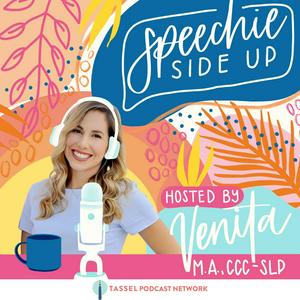
You’re listening to the Speechie Side Up podcast hosted by author, AAC specialist, and matcha tea lover, Venita Litvack! Every week, you get to hear what other SLPs are doing in the field and how they found their passion. This podcast was created to help YOU stop re-inventing the wheel and start loving your job again!
Podcast websiteListen to Speechie Side Up, Begin Again with Davina McCall and many other podcasts from around the world with the radio.net app
Get the free radio.net app
- Stations and podcasts to bookmark
- Stream via Wi-Fi or Bluetooth
- Supports Carplay & Android Auto
- Many other app features
Get the free radio.net app
- Stations and podcasts to bookmark
- Stream via Wi-Fi or Bluetooth
- Supports Carplay & Android Auto
- Many other app features
Speechie Side Up
Scan code,
download the app,
start listening.
download the app,
start listening.
Speechie Side Up: Podcasts in Family
 South Africa