

Listen to this podcast for free in the app: Download for free in the App Store
radio.net
Sleep timer
Save favourites
79 episodes

The Evolving Role of the Modern Dairy Nutrition Consultant
2026/07/21 | 35 mins.Timestamps & Summary
Chris Gwyn (02:00)
What drew you into dairy consulting, and how has that role evolved over the years as both the industry and your customers have changed?
Jodi Erickson
Back in the early 2000s, when I was hitting the job market, nutrition wasn't a career that I was seeking out, but there was an opportunity to work with an established team, an established feed supplier, and I was qualified for the job. It was shortly after that that I discovered my true passion for this career. […]
Over the last 15 to 20 years, my day-to-day role has had to adapt and evolve right along with the industry. I guess the first thing that comes to mind is the precision that we can do things now and the data that we have access to. […]
Chris Gwyn (07:26)
What does a day look like and what does a week look like in Jodi Erickson's dairy consulting business?
Jodi Erickson
My team is a team of 4 nutritionists. So, we do pretty much work independently. We do overlap on farms, just depending on size and location to a degree. But I'm generally covering dairy farms in east-central Wisconsin into central Minnesota. Generally, I am on farms every day of the week, some fairly closer to home to allow for a little bit more office time. But then obviously there are some very long, high-mileage days that happen as well. […]
But my routine farm visits, they're still based around finding what the obstacle is on the farm. Whether that's just visually identifying we're going to have a feed change, how are we going to blend, how are we going to transition this? This is something that we do 4 to 5 times a year on every farm, but it still seems like we need to revisit the procedure every time so it gets done correctly. […]
Chris Gwyn (12:12)
You have a family, you have farm work, you have your dairy consulting. How do you balance all that? What's your key to success in that area?
Jodi Erickson
The key to success there might just be failure. I can reflect on my earlier years with my children, during the hard stages of life when they're not sleeping through the night. So, all that whole dynamic, and I did lose accounts. It was a hard time in my career. And I think, in hindsight, those are probably the accounts that you weren't going to have long-standing relationships with anyway. Generally, something that I see on farms more and more is women stepping up into leadership roles. And these women have all lived through that as well. And it's just becoming, I think, more accepted. […]
But it's still a challenge, I guess. And you know, just communication. Again, it goes back to communicating with my customers. They're aware of what my life looks like, and they're respectful of me and my time. And those are the people that I want to align with.
Chris Gwyn (14:51)
If you reflect back on your 20 years of dairy consulting experience, how do you see that the role has changed over that time?
Jodi Erickson
What's really neat about the market that I'm in is we still have really quite a few dairy farms that are under 100 cows. We still have a lot of tie stall farms, a lot of upright feed units, silos, harvesters, etc. But really, our larger farms are expanding, and they are expanding rapidly. So, it's really neat. What used to be having 3, 4, or 5 large 500-cow freestyle farms was a pretty significant milestone when I was young in my nutrition work. And now, that's kind of the norm. I'm on more of the freestyle herds than the tie stall herds. And a lot of these farms, they grew within. So, the owners and the management are making these developments and management changes, really right along with myself. […]
Chris Gwyn (20:04)
I'd love if you could share an example of a small management change that you introduced to a client or a client introduced to you that really unlocked real key benefits later on or at that moment.
Jodi Erickson
Probably the first thing that comes to mind when you say a small management change, it's still really focusing on some of the basics in nutrition work. And you see people maybe with the Penn State Shaker Boxes but really focusing on proper feed moisture and length. There have been several occasions where we have just focused on if we're going to be feeding straw or hay to some pre-fresh or post-fresh animals, whether that's driving off of an energy issue or a potassium issue. If cows are sorting at the bunk, they're not eating the diet that we think they are. And there have been a multitude of times that we have really focused on mixer maintenance, whether that's keeping knives sharp or throwing the pitch of regrinding a lot of this straw. Maybe that involves getting a Haybuster. […]
Chris Gwyn (32:27)
If you could leave some advice to a dairy producer working with their dairy consultant, say maybe 3 recommendations on how they could get the most value out of that working relationship with their dairy consultant, what would that be?
Jodi Erickson
I would think the first thing, honestly, is “be prepared.” […]
Another thing is to always keep in the back of your mind that when things are going wrong, it's very easy to blame a person, whether it's a nutritionist or a feeder on a farm. But at the end of the day, we are all on the same team. We're all fighting to win. […]
I would really say those are probably my two big sound pieces of advice. Have a lot of trust but also utilize everyone's time. Be prepared.Smart Systems Rethinking Lameness Management
2026/06/30 | 23 mins.Timestamps & Summary
Chris Gwyn (01:35)
How would you describe the current state of lameness on dairy farms, and how has it evolved over your career?
Dr. Gerard Cramer
I started working on lameness when I started my graduate work in 2003. Things have progressed, but I think it's still probably one of the major animal welfare issues in the industry. So, I'd say we probably haven't progressed as much as I'd like. […]
We're creating too many chronic cows. That's kind of hampering, holding us back. We do all these things to prevent new cases, and I think we're doing a good job in that, but we haven't really focused on what I think is the biggest issue, which is finding lame cows and preventing chronic cows. […]
Chris Gwyn (04:01)
You said identifying; you've done some work with cameras and identification. Where are we going with that technology? Does it seem to be working?
Dr. Gerard Cramer
That's my interest in the cameras because, to me the issue is the people. We need people to find lame cows. You need to have a dedicated person looking for lame cows. So, depending on your size of operation, that's a couple of hours where a person is literally standing there watching cows. So, it looks like you're paying them to do nothing. […]
When I'm thinking about the camera technology, I want to be strategic and say, “Okay, the camera is going to find the lame cows, the newly lame cows, or the cows that are getting worse”. But if she's a chronic lame cow, she's just going to go on a routine schedule, and she might come up to the chute every 3 months. […]
Chris Gwyn (08:29)
You talked about inflammation and changes in bone growth. You want to expand a bit on that?
Dr. Gerard Cramer
Basically, what we're talking about is the last bone; we call that the P3. That's the last bone that's inside the hoof capsule. If we think about when a cow's walking on, she's walking on about 5 millimeters of horn, and then there's about 5 millimeters of something called the corium, and then the bone is kind of sitting on top of that. So when we get pressure on that corium, when it gets squished, basically, whether it's a sole ulcer or a white line, that creates an inflammatory process. So that inflammatory process happens in the corium. […]
Chris Gwyn (12:16)
Could you share with the audience your main findings on hoof trimming modeling and how that can be applied by hoof trimmers or producers at the farm level?
Dr. Gerard Cramer
When I first came to Minnesota, one of the first things I wanted to do was say, “Okay, there's basically one commonly taught trimming technique”, and there was a trimmer called Karl Burgi out there saying, “Okay, we have to do more modeling”. And modeling is basically taking more of the horn away from underneath the flexor tuberosity, which is what creates sole ulcers. So, we did a study where we compared doing that extra modeling- some hoof trimmers would call it excessive modeling— underneath that flexor tuberosity, but not getting into the toe triangle. The toe triangle is basically where the inside wall starts to go into the coronary band, so it’s not going too far into the toe. So, when we removed that extra horn, we had some impact on first-lactation cows where we did this at the time of drying. […]
Chris Gwyn (16:54)
So, trimming cows that are exhibiting signs of lameness is a more strategic approach?
Dr. Gerard Cramer
I get in trouble when I say this, and the hoof trimmers say, “Well, I'm doing this for comfort. Some of these cows are long.” But those are all things that we have to think about and say, “Okay, in the farms I work with, cows are walking a long distance. So, there are not many cows that have really long feet”. So, we're not trimming the cows because they have really long feet. Okay, then we're trimming them really to prevent lameness. And then we have to ask ourselves, “How much lameness are we preventing?” But if you have worked with a dairy and say, “Okay, I have a lot of long feet, these cows are walking on skis, they need to be trimmed.” So, strategic means: We look at the farm and say, “This is what the trimming program is”. And then even within the farm, we say, “Okay, for that cow, this is what her trimming program should be”. […]
Chris Gwyn (17:58)
We're talking about trimming. Is there anything we should be doing differently with pregnant heifers from a trimming perspective?
Dr. Gerard Cramer
I think it totally depends on where they're coming from. […]Managing Calf Stress from Day One to Weaning
2026/06/09 | 26 mins.Dr. Gail Carpenter explains how early-life stress, nutrition, and management shape calf health, resilience, productivity, and profitability.
Timestamps & Summary
Chris Gwyn (04:04)
Calfhood stress: what does that mean, and why is the timing of these stressors so important, in particular for the long-term health and productivity of the animal?
Dr. Gail Carpenter
It is a very stressful time in that animal's life. They don't have an immune system. They don't have the tools to really be able to thrive the way an older animal would. If we're doing our colostrum program, they've got that passive immunity, but that's about it. And there are a lot of things that happen in those first couple of months to our calves. […]
Chris Gwyn (07:59)
What are we seeing from financial or productivity loss in their first lactation or lifetime from the research that's been done more globally? But also, how is that impacting the dairy?
Dr. Gail Carpenter
I'll talk about the replacement heifers first. There's been quite a bit of research done; there's a study that gets often cited out of Mike VanAmberg's lab at Cornell showing more milk replacer. And this is where the accelerated growth programs really started, I think, taking hold was more milk replacer in early life, more milk production in the first lactation. And so, I think a lot of people have seen that research and thought, “Well, if I give more milk, I get more milk.” But there's a lot more nuance than that. […]
Chris Gwyn (18:45)
Can you see other aspects of management and nutrition that can help to reduce the negative impact? And where do you see the biggest opportunities for farmers or nutritionists to help better support those calves?
Dr. Gail Carpenter
You're absolutely right that we need to be thinking ahead. You've probably heard the phrase that genetics is the ceiling and nutrition is the floor. So genetics kind of sets that upper limit, and nutrition sets that lower limit. I don't actually think that's entirely accurate. I like to say that genetics is the ceiling, nutrition is the floor, and management is the foundation. Because you can't outfeed bad management. And I like the way you phrase that about looking ahead and kind of predicting when these stressors are going to happen, because if we can proactively manage them— and dairy farmers are super creative. There's a lot of different— there's no one right way to manage every stressor that a calf is going to have. But when you talk about low-hanging fruit and things that I want producers to think about a lot, the two main stressful points in a calf's early life are going to be that first day and weaning. […]
Chris Gwyn (22:35)
So, as we wrap up our discussion today, I always like to ask for that calf manager, that producer listening to the audience, in the audience today, what would be sort of 3 or 4 key takeaways about calfhood stress that you'd like them to impart and think more effectively about, and how that's being managed and implemented at their farms?
Dr. Gail Carpenter
I would say again, that day 1 care. Make sure you have those protocols locked in. And you're making sure that you're working with your veterinarian on that. I would also say the weaning side of things. And I think a lot of that weaning comes back to getting groceries in the calf and making sure some of those groceries are coming from the starter. [...]
And then cleanliness. That's obviously a big part of that day one process, but keeping that calf kitchen clean, keeping that immune system from having to fight off more germs than it has to because you're feeding with dirty nipples… […]
Chris Gwyn (24:07)
And is there anything specific related to the dairy-beef that you would like to reemphasize with the listening audience?
Dr. Gail Carpenter
There's a lot we don't know about the beef-on-dairy side. There's a lot we're still trying to figure out. But what we do know is that those best practices for heifers are often going to be the same best practices for beef-on-dairy.How Wildfire Smoke Impacts Calf Growth
2026/05/19 | 27 mins.Timestamps & Summary
Chris Gwyn (02:19)
Tell us about your Rancher program and your background journey.
Dr. Juliana Ranches
Rancher is a webinar series that brings most of the day’s information to cattle producers and livestock producers around the globe. […]
I wanted it to be something unique that would highlight the work of women in this industry. So female scientists, ranchers, farmers, in the industry, faculty that work in the beef cattle industry or in the cattle industry in general, to showcase their career, to show their trajectory, and also to, you know, inspire the younger generation. […]
I actually started my research career as a dairy person, but my heart was always beef. So I got a lot of experience in the dairy industry, working as an intern in one of the largest dairy farms in Brazil. […]
Later, I moved to Florida to do my master's and PhD. And there I was trained in nutrition, ruminant nutrition, with a major focus on mineral nutrition. […]
Moving to Oregon, to the Western US, brought another set of challenges and questions that need to be addressed for our producers. And then the wildfire smoke exposure studies, that's definitely something that has been a challenge for producers. […]
That got me thinking about the smoke because we were in a situation where there were a lot of poor air quality days with very poor outside environmental conditions. […]
Chris Gwyn (09:28)
How does wildfire smoke impact cattle biology, physiology, and performance?
Dr. Juliana Ranches
In 2022, when we started doing our smoke exposure studies with natural exposure. So we had a project throughout the state, we had 3 different locations where we were monitoring cattle all over the seasons. So basically, what we tried to do was to create a good, strong baseline of data on the health and other parameters. And then we were hoping that a fire would happen. […]
And in one of those locations, we actually got a fire. Once that fire happened, calves were exposed to that natural smoke, and there was poor air quality, and we started to intensify our monitoring and sampling of those animals.
By the end of that study, we got samples and monitoring prior to smoke, during smoke exposure, and post-smoke exposure. So that was one of the initial works we did.
What we learned in that study is that smoke exposure led to increases in cortisol, immunoglobulins, cytokines, and an acute phase response. So, with that initial study, we are sure now that smoke from wildfires can be considered an environmental stressor. And that leads to some energy losses through the development of that immune response. […]
Chris Gwyn (11:57)
Are there morphological or lung-related changes from smoke exposure?
Dr. Juliana Ranches
For that study in particular, unfortunately, we did not do any lung ultrasounds or anything more morphological. I know some of our colleagues from the University of Idaho, who are also working in this area of smoke exposure. […]
What we are doing now on the smoke exposure is we now have developed a methodology that we can control and mimic the smoke exposure that we see from natural fires. So we can actually have a little bit more control over it. […]
What we are seeing right now with those control-type studies is that the responses are very similar to what we’ve seen in the first study in terms of immunology. […]
But we also now have the ability to measure feed intake and look at average daily gain on those calves. And what we are seeing is that calves that are exposed to smoke have delayed and slower gains. […]
Chris Gwyn (15:21)
Do the effects of smoke exposure persist after the event?
Dr. Juliana Ranches
At this point, our studies are very short. We're trying to just look at up to 3 weeks after that smoke exposure. […]
We ran this study for about 36 days. We do a week of acclimation, a week of smoke exposure, and then 3 weeks of following those calves.
In this most recent study that we did, we saw that calves that were exposed to smoke never reached the same performance or final gain as the calves that were outside. […]
What we've seen so far is that calves that were exposed to smoke never caught up to the calves that were not exposed. They were lighter at the end of this study in terms of average daily gain, final gain, and final body weight.
Chris Gwyn (16:42)
Can we extrapolate these findings to older animals or feedlot situations?
Dr. Juliana Ranches
I feel like this is a frequent problem here in the Western states of the United States. […]
So, I feel like an older animal that has been able to mature and be in the herd is unlikely to suffer so much through it. But I think what smoke might do is actually cut the productivity of that animal shorter. […]
So those animals entering the feedlot might be more susceptible. […]
I think they might be more susceptible to disease and not necessarily stay long in the herd. So far in our studies, it seems that calves exposed to smoke have the same visual signs as a calf with BRD (Bovine Respiratory Disease), but they don’t have a fever. […]
They might just look like they have BRD, but they might not have it.
Chris Gwyn (19:46)
How does wildfire smoke compare to dust exposure in feedlots?
Dr. Juliana Ranches
In smoke exposure, we tend to look at the fine particulate matter of PM2.5, which is the smallest one. That tends to be the major concern of smoke from wildfires because it's a very, very small particulate. It can actually dry the airways, and with that, it can be inhaled by the animals and get into the bloodstream through the airways. […]
And when we think about the dust and smoke from feedlots, that's probably going to be on the bigger size. It's still very small, but it's probably more of the PM10. […]
But both are very destructive and will negatively impact animals. I would say that maybe the type of response we get in both scenarios might be similar; it's just that what is causing it might be a little bit different.
Chris Gwyn (21:17)
What management strategies can help mitigate wildfire smoke impacts?
Dr. Juliana Ranches
Our first recommendation for producers is “be prepared”. […]
If you get in a situation that a fire is coming, you might have to evacuate, so keep in mind where you're going to move your animals, who's going to move them, when you're going to do it, and what feed resources you have to move with you. […]
And then for producers that are affected by the smoke itself, we always recommend not stacking stressors. […]
If you're planning any type of management like weaning, commingling, transporting, vaccination, and you know there's smoke, you might want to consider delaying that practice. […]
We also recommend always having lots of clean water for those animals. […]
We want to make sure that the airways are always moist, so we avoid giving opportunity to opportunistic diseases. And in terms of nutrition, make sure that those animals have very good, high-quality feed. If they eat a little bit, they might want to eat the best food we can possibly offer.
Chris Gwyn (24:33)
What are your key take-home messages?
Dr. Juliana Ranches
I think at this point we now know that smoke is an environmental stressor, so it should be treated as one. So, try not to stack those stressors and make sure we provide the best feed and water to those animals during that stressful period. Reduce that stressor load in that production moment.
If you are in a situation where you might be subject to evacuation, make sure you have a plan so the outcomes are more likely to be positive. So again, plan and make sure not to stack stressors. […]
Everything that we suspect would happen when those animals were exposed to smoke basically happened. So, we know it's not good, exposure is not good, and it does impact production. So more questions are coming, more research is coming. […]Turning Feed Analysis into Real Gains in Milk Production
2026/04/28 | 28 mins.Timestamps & Summary
Chris Gwyn (02:58)
How should nutritionists use lab data to confirm that what’s formulated on paper matches what cows are actually eating and performing?
Katie Raver
A lot of times when we get a feed analysis, we use those feed analysis to formulate our ration.
So we'll pull those into a model and build a ration around those. […]
But I think there's a lot of value beyond that. […]
Even testing things like commodities can help us confirm what we put into that model is what's getting fed to cows. […]
And we can even do this from testing our TMR and making sure what is coming out in the feed mixer and getting fed to cows matches what we have formulated.
Chris Gwyn (04:54)
What are the key recommendations for setting up an effective and practical feed and forage sampling program?
Katie Raver
It's definitely based on a farm-by-farm situation, and so we have to take into account a lot of factors when we set out a sampling recommendation. […]
We have to make sure that we've got someone who's capable of taking those samples, that we trust to take those samples. […]
So some of the key points… is the recommendation of sampling feeds more than we're using 4 or more pounds of. […]
We really weigh it based off of the usage and what the farm can accomplish along with farm size. […]
We've seen success sampling as much as 3 to 5 times a week for our very, very large farms, and as low as 1 every week to every 10 days or 2 weeks.
Chris Gwyn (07:53)
What tools or innovations are helping producers and nutritionists get more value from feed testing data?
Katie Raver
In terms of tools to establish a testing routine would just simply be creating a list of the feeds that we're feeding, usage rates. […]
And we've got some tools built to help producers do that. […]
I think being flexible to dairies is what's enabled us to really capture the most benefit. […]
So some new tools would be being able to trend and track this over time. So if we get a robust enough data set, we can use trend tracking tools and statistics to look at how that feed is changing over time and automatically notify the producer. […]
Chris Gwyn (10:27)
How will artificial intelligence and machine learning impact feed analysis and decision-making?
Katie Raver
One of the challenges… is that for the grand majority of our farms, we don't have a very big dataset. […]
Feed sampling, we maybe do every other week. And so… we have about 25 data points per feed per year. […]
When we look at AI models and machine learning, typically those are able to be utilized when we get hundreds of data points. And so now with a more robust sampling program, we're able to develop this really big dataset that we can leverage these AI tools on. […]
Chris Gwyn (12:28)
What feed hygiene issues are limiting performance, and how should producers think about them?
Katie Raver
I think feed hygiene really is something that we all need to take quite seriously because it can be a production limiter. […]
One of the biggest… misconceptions… is that when we have an issue on a farm, it's one problem. […]
However, most of the time… it's often a combination of these negative things working together that are leading to these issues. So maybe it's not that one thing that we're looking to find, but it's a combination of things. […]
But as we look at the whole picture of what the cow is taking in, that's when we start to see a clearer picture. […]
Chris Gwyn (15:34)
How should feed hygiene testing be used, and what signs should producers watch for on-farm?
Katie Raver
This is a test that's done when we suspect an issue. So we're often a little bit retroactive in our testing for these feed hygiene parameters. […]
However, if we feel like we're not getting the productivity we expect, feed hygiene is definitely something to look at. […]
So, one thing that I tend to recommend people look into would be, are we seeing heating? […]
When we look at our bunk face, is it hot? Do we see evidence of spoilage? Does it smell good or are there some off smells that maybe we need to look into? […]
Chris Gwyn (19:17)
How should fecal analysis be used alongside forage and TMR testing?
Katie Raver
It gives us an insight into what the cow is actually doing with our feed. […]
So things like fecal starch and fecal fat, now we can test through NAR. And so, we have this opportunity to look at what the cow is doing with the starch that we're providing and if there's any opportunity to improve starch digestion. […]
And so it gives us opportunities to look at where we can fine-tune these nutrients and where we can potentially gain more energy from these nutrients. […]
So we can use these tools quite a bit to help benchmark within a herd… to make sure we're making improvements in the right direction. […]
Chris Gwyn (23:07)
What are best practices for sampling and submitting fecal samples?
Katie Raver
If we know that shipping a sample in the heat, we get continual degradation of the starch. So especially in summer months, we want to freeze those samples before we send them. […]
We don't want a pile that's been sitting there for, you know, 2 or 3 hours because again, that starch can be degrading. So when we do it, we want to make sure we're taking the right steps, getting fresh samples, making sure we're getting a representative sample from the pen. […]
So I think always having that baseline is good… we need that baseline to know where we're going and help us make sure we're achieving our goals.
Chris Gwyn (25:35)
What key habits should nutritionists adopt to get more value from lab analysis?
Katie Raver
So what the first one would be: test all your feeds at some routine frequency. […]
Understanding and creating a baseline for the regional area of feeds that you're sourcing, I think is really important. […]
And so just understanding what that is, where you're at, I think will really help fine-tune that ration. […]
And then number two would be looking at trends over time. […]
Tracking those changes over time will give us better insight into how our feed is changing… and that our data is representative of what we're feeding to cows.
More Life Sciences podcasts
 UnexplainableLife Sciences, Science
 Stuff To Blow Your MindLife Sciences, Science
 The Quanta PodcastLife Sciences, Science
 Ask the Naked ScientistsHealth & Wellness, Life Sciences, Medicine, Natural Sciences, Science
 Ask the Naked ScientistsHealth & Wellness, Life Sciences, Medicine, Natural Sciences, Science
 Short WaveDaily News, Life Sciences, News, Science
 the bioinformatics chatLife Sciences, Science
 Speaking of PsychologyHealth & Wellness, Life Sciences, Mental Health, Science
 The Naked Scientists PodcastHealth & Wellness, Life Sciences, Medicine, Natural Sciences, Science
 The Naked Scientists PodcastHealth & Wellness, Life Sciences, Medicine, Natural Sciences, Science
Trending Life Sciences podcasts
- The Naked Scientists PodcastHealth & Wellness, Life Sciences, Medicine, Natural Sciences, Science
- Ask the Naked ScientistsHealth & Wellness, Life Sciences, Medicine, Natural Sciences, Science
 The Beyond Tomorrow Podcast with Julian IssaEducation, Life Sciences, Science, Self-Improvement
 The Language Neuroscience PodcastLife Sciences, Science
- RumiNationLife Sciences, Science, Technology
 COMPLEXITYLife Sciences, Mathematics, Nature, Science
- the bioinformatics chatLife Sciences, Science
 Epigenetics PodcastLife Sciences, Science, Technology
 Terrace | تراسHealth & Wellness, Life Sciences, Mental Health, Science, Society & Culture
 Life Sciences 360Life Sciences, Science
 Resilient Futures PodcastEducation, Life Sciences, Science, Social Sciences
 All In The MindHealth & Wellness, Life Sciences, Mental Health, Science
 This Week in ParasitismLife Sciences, Science
- Stuff To Blow Your MindLife Sciences, Science
About RumiNation
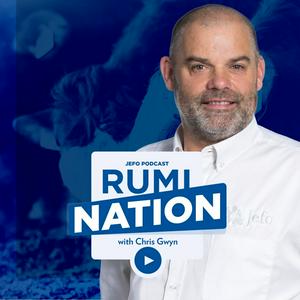
RumiNation is a series of conversations with key influencers in the North American dairy and cattle industries. The discussions focus on topics such as animal welfare, management, profitability, productivity, longevity, and sustainability.
Podcast websiteListen to RumiNation, Unexplainable and many other podcasts from around the world with the radio.net app
Get the free radio.net app
- Stations and podcasts to bookmark
- Stream via Wi-Fi or Bluetooth
- Supports Carplay & Android Auto
- Many other app features
Get the free radio.net app
- Stations and podcasts to bookmark
- Stream via Wi-Fi or Bluetooth
- Supports Carplay & Android Auto
- Many other app features

RumiNation
Scan code,
download the app,
start listening.
download the app,
start listening.
RumiNation: Podcasts in Family
 South Africa