

Listen to this podcast for free in the app: Download for free in the App Store
radio.net
Sleep timer
Save favourites
89 episodes

88. Northern Ireland and International Law: Borders, Brexit and the Constitutional Life of Ireland
2026/09/20 | 1h 8 mins.Imogen Saunders is joined by Professor Aoife O'Donoghue (Queen's University Belfast), Professor Colin Murray (Newcastle University) and Dr Sylvia de Mars (Newcastle University) to discuss the distinctive constitutional and international legal position of Northern Ireland.
The conversation explores the Belfast/Good Friday Agreement, including self-determination, power-sharing, rights and equality, and the complex relationships between Northern Ireland, Ireland and the United Kingdom. The discussion then turns to Brexit, considering the Northern Ireland Protocol and Windsor Framework, the Irish Sea border, and the challenge of reconciling Brexit with the commitments made in 1998.
The guests also examine Northern Ireland's post-Brexit human rights architecture, including the European Convention on Human Rights, EU law, and the Agreement's non-diminution commitment. Finally, Colin Murray and Sylvia de Mars discuss their work on governance and the politics of scale, and what Northern Ireland reveals about the relationship between international law, regional integration and local institutions.
As always, the episode ends with discussion of the guests' current research - and whether anyone ever really escapes Northern Ireland and international law.
Art: Kat Weir (www.instagram.com/katweir/)
Music: Sam Barsh, Oils of au Lait87. Gender, Perpetrators and the Violence of International Criminal Law
2026/08/23 | 59 mins.In this episode, Tamsin Philippa Paige is joined by Olivera Simić and Caitlin Biddolph to explore the international criminal courtroom as a site not only of justice, but also of punishment, power and violence.
Drawing on their work on the International Criminal Tribunal for the former Yugoslavia, the conversation asks what international criminal law is actually trying to achieve when it punishes perpetrators, and what may be lost when punishment is privileged over rehabilitation and accountability. It also considers the courtroom itself as a potentially violent institutional space, and examines feminist approaches to women who participate in atrocities, including the difficulties that can arise when assumptions about gender, victimhood and agency collide.
The discussion also reflects on the very different personal and intellectual paths that brought Olivera and Caitlin to these questions, including Olivera's experiences of war and displacement in the former Yugoslavia and the relationship between lived experience, scholarship and the pursuit of justice.
Recommendations
Olivera Simić, Madam War Criminal
https://www.hurstpublishers.com/book/madam-war-criminal/
Caitlin Biddolph, Queering Governance and International Law: The Case of the International Criminal Tribunal for the Former Yugoslavia
https://academic.oup.com/book/59490
Art: Kat Weir (www.instagram.com/katweir/)
Music: Sam Barsh, Oils of au Lait86. When mining companies sue for access to the seabed
2026/08/09 | 47 mins.In this episode, Douglas Guilfoyle speaks with Dr Aline Jaeckel and Dr Daiana Seabra Venancio about recent developments in deep seabed mining before the International Tribunal for the Law of the Sea and the International Seabed Authority.
The conversation revisits the origins of the seabed mining regime, the “common heritage of humankind” idea, and the changing politics around exploitation and moratorium calls. It then turns to the ISA’s current work on the mining code, environmental governance, and contractor compliance.
A major focus is the Nori/TOML proceedings and the wider questions they raise about due process, enforcement, and the capacity of the international legal framework to regulate seabed mining effectively.
Music: Sam Barsh, Oils of au Lait85. The Removal of the ICC Prosecutor
2026/08/02 | 39 mins.In this episode, Juliette McIntyre and Douglas Guilfoyle examine the unprecedented removal from office of International Criminal Court Prosecutor Karim Khan by the Assembly of States Parties.
The discussion explains the legal basis for removal under Article 46 of the Rome Statute, the investigation and disciplinary process that preceded the decision, and the principal procedural objections raised by critics. It considers the appropriate standard of proof in disciplinary proceedings, the respective roles of investigators, judicial experts and States Parties, and the tension between prosecutorial independence and institutional accountability.
Juliette and Douglas also place the decision within the ICC’s longer-standing problems of workplace culture, including previous findings concerning bullying, harassment, discrimination and perceived impunity among senior officials. They conclude by considering what Khan’s removal means for the Court’s continuing investigations, the election of a new Prosecutor, threatened US sanctions and the withdrawal of several States Parties.
Content warning: This episode discusses allegations of workplace sexual harassment, sexual misconduct, abuse of power and retaliation. Although the discussion avoids unnecessary detail, listeners who may find this material distressing should exercise care.
Recommended Reading:
CNN, Lawyer goes public with sexual misconduct claims against ICC chief prosecutor (2026) https://edition.cnn.com/2026/07/16/europe/icc-prosecutor-allegations-interview-un-investigation-amanpour-intl
Rebecca Hamilton and Nema Milaninia, Before the Assembly: The Removal Vote and the Question of Fitness for Office (2026)
https://www.justsecurity.org/148713/icc-prosecutor-removal-vote/
Kevin John Heller, The Bureau’s “Serious Misconduct” Bait and Switch (2026), https://opiniojuris.org/2026/07/03/the-bureaus-serious-misconduct-bait-and-switch/
Music: Sam Barsh, Oils of au lait84. Journal Editors, Gen AI and Legal Scholarship
2026/07/26 | 50 mins.In this episode of Called to the Bar, Tamsin Philippa Page is joined by Karen Scott (University of Canterbury) and Camille Goodman (ANCORS, University of Wollongong), editors of Ocean Development & International Law, to discuss the challenges that generative AI poses for legal scholarship and academic publishing.
Drawing on their experience managing one of the leading specialist journals in the law of the sea, they explain why the journal has adopted a restrictive policy on the use of generative AI in research and writing. The conversation explores the risks of AI-generated scholarship, including fabricated citations, questions of academic integrity, the responsibilities of editors and reviewers, and the practical challenges of enforcing editorial policies.
The episode also considers broader issues facing legal academia, including the impact of AI on non-native English-speaking scholars, tensions between publishers' AI policies and journal ethics, and how the academic community might preserve originality, trust, and scholarly standards in an era of rapidly evolving AI technologies.
Recommendations:
Episode 60. Publishing, Peer Review and What Editors Wish You Knew, https://soundcloud.com/calledtothebar/60-publishing-peer-review-and-what-editors-wish-you-knew
Music: Sam Barsh, Oils of au Lait.
More Education podcasts
 Finding Freedom with Peter CroneEducation, Health & Wellness, Mental Health, Religion & Spirituality, Self-Improvement, Spirituality
 After School Is After School With Sis G.UEducation, Self-Improvement
 anything goes with emma chamberlainEducation, Personal Journals, Self-Improvement, Society & Culture
 IMO with Michelle Obama and Craig RobinsonEducation, Self-Improvement, Society & Culture
 How to Be a Better HumanEducation, Self-Improvement
 The Jefferson Fisher PodcastEducation, Relationships, Self-Improvement, Society & Culture
 The Jordan B. Peterson PodcastEducation, Science, Society & Culture
 The Rich Roll PodcastEducation, Health & Wellness, Self-Improvement, Society & Culture
 Motivation Daily by MotiversityEducation, Health & Wellness, Self-Improvement
 The Mel Robbins PodcastEducation, Health & Wellness, Mental Health, Relationships, Self-Improvement, Society & Culture
Trending Education podcasts
 Talk To Me In KoreanCourses, Education
 Dry Creek Wrangler PodcastEducation, Self-Improvement, Society & Culture
 Busy, Yet PrettyEducation, Health & Wellness, Mental Health, Self-Improvement
 You Should KnowEducation, Self-Improvement
 Motivational Speeches by Coach Pain and MotiversityEducation, Health & Wellness, Mental Health, Self-Improvement
 Brazilian Portuguese Learning AcceleratorEducation, Language Learning
 All Ears English PodcastBusiness, Education, Language Learning
 Learn About IslamEducation, Islam, Religion & Spirituality
 The Art of Public SpeakingEducation, Self-Improvement, Tutorials
 Certified: The ISACA CISA Audio CourseCourses, Education, Technology
 The Florence Given ShowEducation, Health & Wellness, Mental Health, Philosophy, Self-Improvement, Society & Culture
 20 Minute BooksEducation, Self-Improvement
 The Wellness CafeEducation, Self-Improvement
- After School Is After School With Sis G.UEducation, Self-Improvement
 Python for Everybody (py4e.com)Courses, Education, Technology
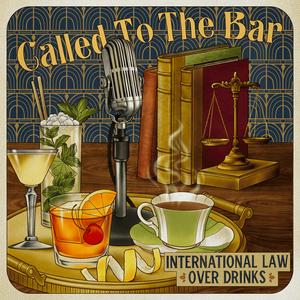
About Called to the Bar: International Law over Drinks
A podcast of informal conversation about topical issues in international law, life in academia and whatever else is on our mind. Hosted by Douglas Guilfoyle, Juliette McIntyre, Tamsin Paige, Imogen Saunders, and Nitna Tzouvala.
Art: Kat Weir (https://www.instagram.com/katweir/)
Banner Art: Tim Henderson (@pretendbeard.bsky.social)
Music: Sam Barsh, Oils of Au Lait
Podcast websiteListen to Called to the Bar: International Law over Drinks, Finding Freedom with Peter Crone and many other podcasts from around the world with the radio.net app
Get the free radio.net app
- Stations and podcasts to bookmark
- Stream via Wi-Fi or Bluetooth
- Supports Carplay & Android Auto
- Many other app features
Get the free radio.net app
- Stations and podcasts to bookmark
- Stream via Wi-Fi or Bluetooth
- Supports Carplay & Android Auto
- Many other app features

Called to the Bar: International Law over Drinks
Scan code,
download the app,
start listening.
download the app,
start listening.
 South Africa