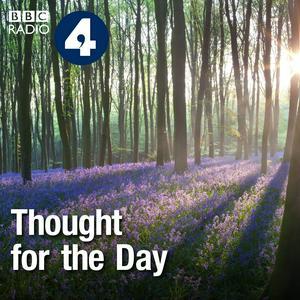
Thought for the Day

BBC Radio 4
Thought for the Day
Latest episode

286 episodes

  • Thought for the Day

    Rabbi Jonathan Wittenberg

    2026/04/01 | 3 mins.
    Good Morning.
    Tonight is Seder night, the start of Passover, the Jewish Festival of Freedom, when we recall the Exodus from Egypt, our people’s journey from slavery to liberation. It’s a story which embraces all our stories. My mother, aged a hundred, tells how she escaped Nazi Europe. A woman whose husband is imprisoned in the Congo says, ‘May God who freed your people, free him.’ A Muslim guest who fled for his life stands up and exclaims: ‘Your story is my story too.’
    For, far from free, so much of the world suffers beneath oppression and war.
    Maybe that’s why the Seder ends with a song, Chad Gadya, which means ‘one little goat’ in Aramaic. It’s a ditty in the style of The House That Jack Built: a cat eats the goat, dog bites cat, stick hits dog, fire burns stick, water quenches fire, cow drinks water, butcher kills cow, the angel of death despatches the butcher. But then comes God and slays the angel of death.
    I have a vivid memory of my grandfather, aged and weak, catching my eye and whispering at what he knew would be his final Seder, ‘after death comes God.’ That was his faith, his hope.
    But does God have the last word in our violent world? It hardly feels that way today. I phone family in Jerusalem: we’re in and out of bomb shelters. My heart goes out to them. I call an Iranian friend: ‘No word from my sisters in Tehran.’ ‘My hometown’s just been bombed,’ a Ukrainian acquaintance texts me.
    So that Chad Gadya song feels like a metaphor for history, only it’s not goats and cats, but humanity who’s the victim. In their heart-rending shared memorial service, bereaved Israeli and Palestinian families sing that song in Hebrew and Arabic together.
    Yet, I still see my grandfather’s face and hear his whisper: after the angel of death comes God; life is greater than death.
    But I hear those words as a question: What world is this? What do we want it to be? Of death, or life; oppression or freedom; cruelty or compassion?
    I pray this Passover will truly mark our journey towards freedom, so that we can celebrate God’s world together, knowing that the same sacred spirit flows through us all, whatever our faith or nationality, giving life to all that breathes.
    We’ve had too much of cat eating goat, human devouring human. May this Festival of Freedom mark our liberation from hatred, violence and fear, for my people, and every people.
  • Thought for the Day

    Rev Dr Sam Wells

    2026/03/31 | 2 mins.
    31 MAR 26
  • Thought for the Day

    Rev David Wilkinson

    2026/03/30 | 3 mins.
    30 MAR 26
  • Thought for the Day

    Martin Wroe

    2026/03/28 | 2 mins.
    28 MAR 26
  • Thought for the Day

    Bishop Richard Harries - 27/03/2026

    2026/03/27 | 3 mins.
    Good morning. I recently came across a new term - ‘chronically terminal’. Janis Chen, has stage four lung cancer and writing in the Guardian, she describes how every day is a struggle to go on. She lives in what she calls ‘The long middle’, the period between first diagnosis and the time when she will finally pass from this life; a time that is ‘chronically terminal’. But still a time for living, of living as best she can. As 3.5 million people in the UK live with cancer and there are 420,000 new cases a year, many will resonate with her situation.
    In this beautifully written piece she describes the effect of illness on people’s religious belief or lack of belief. She said that she found herself back in church on Sundays. ‘Faith furnished me with a different architecture for endurance: it offered a vocabulary of hope’. But she also notes that a member of her support group who previously had a faith totally lost it as a result of the illness. They could not understand why it had happened to them. ‘To some, the diagnosis is a clarifying fire that burns away the trivial, leaving a refined spiritual core. To others, it is an acid dissolving everything they once held.’
    What the illness has done for her more than anything else has sharpened her discernment. As she put it:
    It leaves only the essential, revealing that meaning resides entirely in the quality of our attention. To walk through a park, to watch the sunlight catch a river or to register the laughter of children against the thrum of a passing bus is to realise these are no longer background noise; they are the destination.
    Particularly at this time of year with trees budding and blossom coming out what she writes seems particularly pertinent and it brought to mind a famous interview between Melvyn Bragg and the playwright Dennis Potter as he was dying. Dennis Potter said that when he looked out of the window he did not just say ‘Oh that’s nice blossom’.
    I see it is the whitest, frothiest, blossomest blossom that there ever could be, and I can see it. the nowness of everything is absolutely wondrous.
    It is this living in the moment that the discipline of mindfulness is trying to achieve, whatever stage of life we are at. Father Pierre de Caussade, in the first half of the 18th century, wrote about it and called it ‘the Sacrament of the present moment’. For him however it was not just about experiencing the present more intensely, but being open and receptive to what might be being asked of us in that moment-in every now there was, he taught, a providence to be discerned and responded to.

More Religion & Spirituality podcasts
About Thought for the Day

Reflections from a faith perspective on issues and people in the news.
Podcast website

Listen to Thought for the Day, Joel Osteen Podcast and many other podcasts from around the world with the radio.net app
Get the free radio.net app

  • Stations and podcasts to bookmark
  • Stream via Wi-Fi or Bluetooth
  • Supports Carplay & Android Auto
  • Many other app features

Thought for the Day: Podcasts in Family
  • Podcast Stalked
    Stalked
    True Crime
  • Podcast Science In Action
    Science In Action
    Science, Technology