
Listen to this podcast for free in the app: Download for free in the App Store
radio.net
Sleep timer
Save favourites
7 episodes
Episode 7 — America’s Defection Cascade Scenario and the Grim Trigger Strategy
2026/06/11 | 36 mins.There is a rhythm to history and we’ve spent some time over 6 previous episodes focused on the comparison between Adolf Hitler’s Third Reich, his rise to power, and Donald Trump’s MAGA administration.
If you’ve followed you’ll know there is more than a fleeting comparison. The structural similarity is the definitive roadmap for understanding modern autocracy. It shifts the focus away from superficial political theater and places it at the unsexy procedural place of state apparatus.
What the National Socialists of Germany, the Nazi’s, called Gleichschaltung (synchronization) in 1933, the modern American populist movement executes under the banners of unitary executive theory, Project 2025 blueprints, and the systematic deconstruction of the administrative state.
By looking closely at the events of 2025 and mid-2026, we can see exactly how this administrative colonization is being carried out across specific United States departments. It is not occurring via sweeping legislative transformations, but through an intricate web of Executive Orders, Reductions in Force (RIFs), and administrative reclassifications designed to trade professional competence for absolute ideological obedience.
Starting with the Office of Personnel Management, the OPM and the Office of Management and Budget, the OMB.
To dismantle the independent civil service, the White House first had to capture and weaponize the agencies that dictate federal employment and budgetary rules.
January 28, 2025 Trump issued Executive Order 14171, creating a new excepted-service job classification called Schedule Policy/Career (Schedule P/C). This is the direct, evolved successor to his first term's aborted Schedule F, targeting any career, non-political federal job deemed to be confidential, policy-determining, policymaking, or policy-advocating. ON February 12 2025 Office of Personnel Management Acting Director Charles Ezell issued a sweeping directive instructing all federal agencies to immediately dismiss probationary employees - those with less than a year of service. The directive commanded agencies to state that the worker's performance was inadequate without citing any evidence, bypassing traditional civil service evaluation metrics.
When William Shirer walked through the ministries of Berlin in 1933, he didn’t find a state shattered by bombs; he found a state hollowed out by clerks. Under the banner of Gleichschaltung, the Nazis realized that if you control the personnel, the laws don't matter.
Thus Project 2025’s main engine — internal evisceration — not external revolution.
Just as in 1933, competence has been demoted to a secondary trait, replaced entirely by absolute ideological obedience. The state hasn't been overthrown; it has been colonized from within.
But if you want to see the true masterpiece of this modern administrative colonization, look at the Department of Education. For decades, the populist right promised to abolish it. But they didn't need a vote in Congress to do it. By May of 2026, they simply unbolted the building from the inside.
So how does this end - with a bang or a whimper?
Because dear friends, end it shall - so let’s see where we’re likely to be going.
Hitler died after shooting his new wife in the head on a spring day in Berlin in 1945, then chewed down on a cyanide capsule while simultaneously shooting himself. He had already poisoned his favourite dog, thus taking those closest to him along for his final ride into fires of Hades. If you believe that sort of thing.
What will happen to Trump?
Here are a few scenarios - a few possibilities. This episode will eventually be overcome by time, the future will have passed but I want to place on record what history determines as the likeliest trajectories America will take.Episode 6 - How to Steal a Country: Adolf and Donald’s Grand Scheme
2026/06/03 | 25 mins.The Date - March 5th 1933, the day of the the last semi-free election Germans would know during Hitler’s lifetime.
Hitler’s party polled 17.2 million votes — 44 percent. Only when combined with the 3.1 million votes of the conservative Nationalists did the authoritarian right finally edge past 20 million votes needed to secure a narrow parliamentary majority. This was not close to a landslide.
Even then, most Germans had not voted directly for Hitler’s party. The dictatorship that followed emerged not from overwhelming democratic consensus, but from coalition, intimidation, and the systematic dismantling of the state from within.
The Centre Party and its Bavarian Catholic Party allies together polled 5.5 million votes. The Social Democrats secured 7.1 million, the Communists drew almost 5 million.
Altogether, 17 million Germans voted for parties outside Hitler’s movement showing that Germany was far from being politically unified behind National Socialism. It was fractured, exhausted, polarised, and increasingly incapable of defending its own democratic institutions against a movement that understood power more clearly than its opponents did.
That, in a nutshell, is how you could characterize America a quarter of the way into the 21st Century.
Back to 1933 - The Nationalists threw in their lot with the Nazis, their 52 seats added to the 288 of the National Socialists, the Nazi’s, which gave Hitler a majority of 16 in the Reichstag. Pretty slim majority.
That was enough to rule, but not the two-thirds majority needed to carry out Hitler’s bold plan to establish a dictatorship.
The secret plan was deceptively simple, Hitler was going to cloak his coming actions as he seized power in legality — he was going to say he had the right to usurp constitutional power through legal gymnastics.
One of the enduring myths of modern populist movements is that they represent an overwhelming uprising of the people. The numbers are usually more complicated than the emotion.
In the 2024 American election for example, 244 million Americans were eligible to vote, yet only around 156 million actually cast ballots. Donald Trump received 77 million votes — enough to secure victory, enough to dominate the Electoral College, enough to reshape the American state once again — but still only about 31 percent of the total eligible electorate.
It goes to show then, that if you don’t vote, you get the leader you deserve.
That means seven out of ten eligible Americans either voted against Trump or did not vote at all. This is historically important because it reveals something profound about the mechanics of democratic power in moments of social fracture.
Transformative political movements seldom require unanimous national conviction.
They require intensity, discipline, emotional cohesion, and an opposition that is divided and its voters are disengaged. The illusion created afterward is one of inevitability — as though the entire nation rose in one direction at once. But history is often moved by organised minorities operating inside societies too distracted or exhausted to resist with equal force. Casting an eye on America in 2026 we can see just how exhausted, deflated and flaccid the Democratic Party appears. They can’t agree on anything right now even though Trump 2.0 has been an unmitigated disaster for the USA.
Back to Hitler.
The one main stumbling block for Nazi ambitions, Hitler’s ambitions, was the Army - where the leadership had taken a dim view of his dishonourable approach to social mores and their ancient traditions. It was time to make a grandiose gesture to the aging Field Marshall Hindenburg, the military, as well as nationalist conservatives. Hitler desperately needed to link his rowdy, brutal and violent Nazi movement to Count Hindenburg’s venerable name as a First world War hero.
In 1933, Hitler needed The Enabling Act because the Weimar Republic was structurally rigid—he had to murder the constitution legally.Episode 5 - The Role of Religion, Industrialists and Tech Bro’s in Developing an Autocratic State
2026/05/26 | 19 mins.Welcome back to Weimar Washington podcast with me your host Des Latham. This is Episode 5 - The Role of Religion, Industrialists and Tech Bros in an autocratic state.
In our last episode, we looked at the symbols—the fasces and the red hats—that create a sense of belonging. But symbols need a soul, and a soul needs to eat.
To truly capture the hearts of a nation, the strongman must infect not only the minds, but the consciousness of their citizens and to do this, they need money.
We’ll explore how the industrialists of Germany were enticed into Hitler’s ambit by the opportunity to make loads of dosh, and how Trump’s rise has been oiled by the financial and technology moguls of modern America, not to mention corporate USA.
First off, Adolf Hitler and Donald Trump represent a masterclass in the same dark art: the co-option of the pulpit. Neither was a man of the cloth, yet both convinced millions of believers that the survival of their faith was synonymous with the survival of the leader.
While Hitler was a 1930s dictator and Trump is a 21st-century autocrat, both have utilized a transactional theology. In Hitler’s model he signed the Reichskonkordat with the Vatican so that the Catholics of Germany were neutralised. Up until the early 30s, Germany’s Catholic Church had always been directly involved in politics. Not so much after Hitler’s rise to power.
On the other, The Trump MAGA power era has been dominated by evangelicals who view Trump as a "Cyrus" figure—a flawed, non-believing king used by God to protect the faithful. It’s not about his personal morality; it’s about his utility as a strongman for their cause — he’s been very useful and when I say evangelicals, I include African-Americans and Latino evangelicals and traditionalists who helped put Trump into the presidency. They believe he is anointed by God - the number of his concubines not quite in King David’s league — not that he isn’t trying.
The Nazi War on the Christian Churches began more moderately, Hitler was a nominal Catholic, but had railed against political Catholicism in Mein Kampf and attacked both the Catholics and Protestants for their failure to recognize the racial problem as he put it.
Trump on the other hand, used the MAGA narrative focusing on a Great Replacement Populist Myth, where they hold that the Deep State has a plot to erase traditional values. Great Replacement Theory also holds that elites and academics and Democrats are trying to dilute the number of whites in America by supporting immigration from Latino countries, Asia and Africa by introducing a secular satanism under the cloak of intellectual pursuit.
In both Germany and America, the leader is framed as the only one who can restore the natural order or divine hierarchy of the world. But if you peer closely at the events, a certain pattern emerges.
When Hitler came to power in 1933 he faced a State which was suspicious of his National Socialist agenda. Within six months he had hollowed out the offices, replacing all main members with men who would do his bidding.Donald Trump, having learned a great deal from the chaotic staff turnover of his first presidency, moved with equal speed by his second to allay the fears of the technological elite.The very tech moguls who had once publicly demeaned him, or secretly funded his opponents, slid effortlessly into his transactional worldview. He even hired the world’s richest tech bro, Elon Musk, to treat the federal government like a failing Twitter acquisition—unleashing a chaotic wave of arbitrary firings and unconstitutional AI-driven budget cuts before the short-lived Department of Government Efficiency (DOGE) collapsed into a administrative disaster.
Next time on Weimar Washington, we move from the capture of the public mind to the quiet execution of the state itself.Episode 4 - Aesthetic and Propaganda From Mussolini’s Fasces to the MAGA Hat
2026/05/17 | 21 mins.This episode is about how extremists take control using a language of war, of violence, a call to action. A capacity to enthral is crucial — through charisma, through energy, through sheer force of presence — this is a fundamental tool in the populist leader's kit.
They understood the power of oratory. Followers are drawn in, bedazzled by the tricks of speech, enraptured by ideas that test then break the boundaries of social convention.
Chanting simple phrases repeatedly.
The incantations of the populist wash over rows of followers like a tide — oral and visual at once, and viscerally emotive. Everything in that combination of sound and image is calibrated to stir feeling rather than thought. Romantic, hysterical, deliberately so.
Threading through it all are the senses: the acrid drift of gunpowder smoke from fireworks lending an air of controlled drama; the heat rising from a packed crowd; the press of bodies. Each small sensory detail becomes part of the experience — lodged permanently in the memory of those adoring, rapturous, and sometimes genuinely hysterical masses.
Hitler understood this, and spent a decade honing his speechmaking skill until he had perfected the art of tension. Trump has achieved the same, developing symbolism on the stage, managing each part of his performance for maximum effect, tapping into the energy of a crowd — chanting Stop the Steal, or Lock her Up, shouting, directing emotions.
Mussolini perfected this technique before either Hitler or Trump, and Trump has drawn much from Mussolini's playbook — the lowered brows, the furrowed fury, the pout — these are Mussolini's gestures. As is the balcony. Mussolini understood the theatre of elevation, appearing above the Roman crowd, arms akimbo, head thrown back. Trump's appearances on the White House balcony or stage carry that same choreography, whether consciously borrowed or arrived at by some instinct for spectacle.
Long before fascism became a political system, it was an aesthetic system. The strongman movements of the 20th and 21st centuries understood people do not emotionally attach themselves to policy documents. They attach themselves to symbols, colours, uniforms, songs, flags, and rituals.
Then the emblem becomes the gateway drug to belonging. Fascism, and later populist-nationalist movements, mastered the art of reducing vast and often contradictory ideas into a handful of emotionally charged visual signals. The symbol says: you are either inside our tribe, or outside it - and therefore either friend or enemy.
It begins most clearly with Benito Mussolini.
Italian Fascism was obsessed with the aesthetics of imperial rebirth. Mussolini understood that the modern mass age required theatre, and theatre required visual coherence. He reached backward into Ancient Rome, reviving the *fasces*—the bundle of rods wrapped around an axe carried before Roman magistrates as a symbol of authority and collective power. The symbolism was psychologically brilliant.
A single rod snaps easily; a bound bundle becomes unbreakable. Unity through force. Submission through cohesion. This is where the word fascism originates, from this object — the fasces bundle —revived by the Italian fascist for whom the word was not an insult but his identity. This is one of the reasons Donald Trump accepts it when he is called a fascist, for him it is a verbal medal of honour not an insult. He believes himself to be a strongman, part of the strongmen of the world like Vladimir Putin and Victor Orban, Xi Zinping and if strongmen are fascists, then he wants to be one. Mussolini wrapped his movement in black shirts, polished leather, torchlight, Roman salutes, banners drenched in dramatic contrasts of black, red, and white. Black was especially important: It is the colour of authority, of death, mystery, and intimidation. It flattens individuality and transforms crowds into a single organism.Episode 3 - The Architecture of Allegiance: Building the Shadow State
2026/05/10 | 22 mins.There are lean years in any autocrats life and for Adolf Hitler and the Nazi movement those lay between 1925 and the depression of 1929.
It was all about patience, he had to wait until the feeling of relaxation in Germany as William Shirer calls it, had worn off. American money was pouring into Germany as it rebuilt following the First World War, between 1924 and 1930 Germany borrowed 7 billion dollars from American investors. These New York based capitalists appeared unconcerned about how the German’s may eventually repay their debts, and Germans appeared to give even less thought to it.
Germany’s social services in the 1920s were the envy of Europe, and the world, each state, city and municipality borrowed vast sums to build airfields, theaters, sports stadiums, swimming pools. German industry borrowed billions to retool factories. It’s output had dropped 55 percent between 1913 and 1923, but rose 122 percent by 1927.
Unemployment fell below a million in 1928, retail sales rose 20 percent in 1925, in 1926 real wages were 10 percent higher than where they’d been only four years earlier. The lower middle class, the people Hitler needed most as voters, the shopkeepers and small salaried folks, shared in general prosperity.
This was not the time for Hitler’s bitterness to flood the political landscape so he waited. It was the Great Depression that brought Hitler to power.
Trump needed a bitter landscape too.
Trump fiddled about with politics through most of the middle oughts, 2000 through to the banking crisis of 2007/8. During the first years of the 21st century, Trump was not yet a coherent political figure in the traditional sense. He flitted between parties, donated opportunistically, and treated politics less as public service than as branding. But beneath the theatricality, certain themes were starting to gel.
His America was being ripped off thread, combined with a gut feel that elites were incompetent and the political class was full of weak slack jaws, the Democrats and Republicans with their family wealth and class, the Bushs, the Kennedy’s.
These instincts intensified as the financial system began to buckle in 2007 and 2008.Trump approached the looming collapse as a familiar cycle of winners and losers. Having survived his own debt implosions in the early 1990s, he viewed crisis as opportunity. In 2007 he openly remarked that a property downturn could create enormous buying opportunities, stating that he had “always made more money in bad markets than in good markets.” Like Hitler, he realised that a weakening economy was his opportunity to gain. At this point, he wasn’t thinking seriously about entering a presidential race, but it had been on his mind for two decades.
As the subprime mortgage system unraveled, he warned that rising interest rates could “kill the real estate market,” while simultaneously positioning himself as someone prepared to exploit the wreckage. This duality is revealing: Trump’s worldview was never conventionally conservative in the Reaganite sense of disciplined free markets and restrained state intervention.
He admired strength, leverage, and survival. When the Bush administration proposed unprecedented banking rescues in October 2008, and new President Barack Obama signed off on quantative easing, pumping money into the market, Trump startled orthodox conservatives by endorsing the bailout logic, calling it “almost socialistic, but I like it.”
To him, ideology mattered less than preserving the system that protected property and hierarchy. Trump then began intuitively speaking the language of civilisational decline.
America, in his telling, was no longer the confident imperial centre of the 1990s. It was being cheated by China, weakened by bad trade deals, hollowed out by financial incompetence, and betrayed by its own elites. The banking crisis amplified a deep psychological fracture in American society.
More History podcasts



Trending History podcasts









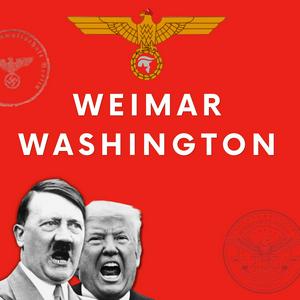
About Weimar Washington
What if history isn’t repeating—but rhyming with unsettling precision?
Weimar to Washington is a gripping, narrative-driven podcast that explores the ideological, cultural, and psychological parallels between the rise of the Third Reich under Adolf Hitler and the modern political movement surrounding Donald Trump. Through sharp analysis and storytelling, the series examines how extreme conservatism and Traditionalist philosophy can reshape democracies from within.
From the romanticization of a lost “Golden Age” to the weaponization of race, religion, and nostalgia, this episode traces the philosophical threads connecting past and present. The show dives into the architecture of power: how figures like Benito Mussolini, Viktor Orbán, and Jair Bolsonaro crafted narratives of national rebirth—and how similar patterns echo in contemporary America. It explores the role of Traditionalism, a little-understood ideology rooted in thinkers like Julius Evola, and how it reframes modern politics as a spiritual war for civilizational survival.
At its core, this is a story about belief: how myths become movements, how grievance becomes identity, and how democracy can unravel when emotion overtakes reason.
This isn’t just left vs right. It’s past vs present. Myth vs reality.
And the question lingers—are we watching history unfold… or repeat?
Podcast websiteListen to Weimar Washington, Short History Of... and many other podcasts from around the world with the radio.net app
Get the free radio.net app
- Stations and podcasts to bookmark
- Stream via Wi-Fi or Bluetooth
- Supports Carplay & Android Auto
- Many other app features
Get the free radio.net app
- Stations and podcasts to bookmark
- Stream via Wi-Fi or Bluetooth
- Supports Carplay & Android Auto
- Many other app features

Weimar Washington
Scan code,
download the app,
start listening.
download the app,
start listening.
Weimar Washington: Podcasts in Family





 South Africa

