

Listen to this podcast for free in the app: Download for free in the App Store
radio.net
Sleep timer
Save favourites
232 episodes
Episode 127 - What If Wood Could Flow?
2026/09/30 | 41 mins.What if structural timber could be shaped to put material exactly where it's needed? In this episode, we sit down with the team from Strong by Form to explore Woodflow, a new approach to engineered timber that combines material efficiency, structural performance, and advanced manufacturing.
We break down how Woodflow is formed, how strand length and wood grade influence its behavior, and how it compares with established mass timber products. We also get into the engineering: strength and stiffness, weight, failure modes, durability, connections, field modifications, and the testing required to bring a new structural system to market. From current applications and code approval to manufacturing scale, embodied carbon, cost, and future research, this conversation looks at what it takes to move an emerging timber technology from the lab into real structures.
Guest Profile:
Jorge Christie is the co-founder and Chief Product Officer of Strong by Form, where he leads the development of Woodflow, a biomimetic engineered-wood technology that combines computational design, material optimization, and advanced manufacturing. An architect with advanced degrees in computational design and digital fabrication from the University of Stuttgart and ETH Zurich, Jorge's work focuses on translating the structural efficiency found in nature into high-performance timber products for construction and other industries.
Links & Resources:
structurEd (our free PE/SE study tool): TheEngineeringPodcast.com/structurEd
https://strongbyform.com/
https://strongbyform.com/woodflow-core
https://www.youtube.com/watch?v=casNqN2u
Reach out to us:
TheEngineeringPodcast.com
Instagram
Linkedin
Disclaimer: HereEpisode 126 - Your Design Works… But Can It Be Built?
2026/09/23 | 1h 6 mins.In this episode, we step outside the design office to explore what structural engineers often get wrong about construction. We discuss the disconnect between design intent and what actually happens in the field from constructability and tolerances to sequencing, temporary conditions, and coordination.
We also look at the details engineers tend to overcomplicate, the information contractors wish they had on structural drawings, and what makes an RFI response actually useful. Through real-world lessons from the field, we explore how understanding construction can help structural engineers design better, communicate more effectively, and ultimately deliver more successful projects.
Guest Profile:
Sergio Ortiz is a Senior Project Manager at Fransen Pittman Construction with extensive experience managing complex construction projects throughout Colorado and beyond. His portfolio includes schools, healthcare facilities, fire stations, commercial developments, historic renovations, and major additions to existing buildings. Sergio brings a field-focused perspective on constructability, coordination, sequencing, and the challenges that arise when structural designs move from drawings to reality.
Links & Resources:
structurEd (our free PE/SE study tool): TheEngineeringPodcast.com/structurEd
Reach out to us:
TheEngineeringPodcast.com
Instagram
Linkedin
Disclaimer: HereEpisode 125 - The Building Doesn't Match the Drawings
2026/09/16 | 1h 3 mins.In this episode, we explore the unique challenges of structural engineering in existing buildings, where the drawings don't always match what's actually in the field. We discuss how engineers navigate unknown conditions, undocumented modifications, aging materials, and the constraints that can make seemingly simple projects incredibly complex.
We also dive into creative problem solving how to avoid getting stuck on the first workable solution, think beyond conventional approaches, and find better ways to work within an existing structure. From deformation compatibility and load redistribution to constructability and historic building practices, this episode explores what existing buildings can teach us about becoming better structural engineers.
Guest Profile:
Dan Sloat, S.E., is an Associate Principal with Degenkolb Engineers in Seattle, where his work focuses on structural engineering, seismic evaluation, and the challenges of existing buildings. He earned his B.S. in Structural Engineering from Rice University and his M.S. in Structural Engineering from the University of Washington. Dan is passionate about creative problem solving and finding practical solutions within the constraints of existing structures topics he recently presented on at NASCC: The Steel Conference.
Links & Resources:
structurEd (our free PE/SE study tool): TheEngineeringPodcast.com/structurEd
Reach out to us:
TheEngineeringPodcast.com
Instagram
Linkedin
Disclaimer: HereEpisode 124 - Your Concrete Numbers Are Wrong. Does It Matter?
2026/09/09 | 53 mins.In this episode, we take a closer look at the concrete mixture requirements structural engineers encounter in ACI 318. We explore where the familiar values for water-to-cementitious-material ratio, air content, aggregate size, cement type, and durability requirements come from—and what they mean for the concrete we specify on our projects. We discuss how ACI durability exposure classes influence mixture requirements, including maximum water-to-cementitious-material ratios, minimum specified strength, air entrainment, and other material requirements.
Guest Profile:
Tyler Ley is a professor and concrete researcher whose work focuses on concrete materials, mixture proportioning, durability, cement chemistry, air entrainment, curing, and field performance. Through his research and educational work, Tyler has become known for making complex concrete concepts accessible to practicing engineers and for emphasizing the connection between concrete mixture design and real-world performance.
Links & Resources:
Tyler Ley on YouTube: YouTube.com/@TylerLey
Tarantula Curve resources: ConcretePavements.org
structurEd (our free PE/SE study tool): TheEngineeringPodcast.com/structurEd
And as promised ~7 videos I really liked to help me learn about concrete mixes:
Introduction to Concrete Mix Design
How to Make Concrete Last 100 Years
Aggregate in Concrete Mix Design
Compressive Strength and Water-to-Cement Ratio
Why Do We NEED Air Bubbles in Concrete?
Intro to Curing Concrete
Tarantula Curve
Reach out to us:
TheEngineeringPodcast.com
Instagram
LinkedIn
Disclaimer: HereEpisode 123 - What's Next for Structural Steel?
2026/09/02 | 1h 27 mins.In this episode, we explore what's next for the American Institute of Steel Construction (AISC) and the future of structural steel. We discuss how AISC's role extends beyond the Steel Manual, how research makes its way into the codes and standards engineers use every day, and the trends shaping the steel industry over the next decade.
We also dive into AISC's 2033 Initiative and what it could mean for engineers, fabricators, and the broader steel industry. Finally, we look at the next generation of structural engineers where new graduates are excelling, where they need more development, and what young engineers should learn to become better steel designers.
Guest Profile:
Dr. Christopher Raebel, P.E., S.E., Ph.D., is Vice President of Engineering and Research at AISC, where he oversees technical activities including standards, research programs, and technical publications. Before joining AISC, Chris spent 12 years in structural engineering practice and later served as a professor, department chair, and director of the Architectural Engineering Program at the Milwaukee School of Engineering. His expertise includes structural steel design, connections, structural robustness, floor vibrations, and engineering education.
Links & Resources:
structurEd (our free PE/SE study tool): TheEngineeringPodcast.com/structurEd
Reach out to us:
TheEngineeringPodcast.com
Instagram
Linkedin
Disclaimer: Here
More Courses podcasts
 Sight To The BlindCourses, Education, Philosophy, Religion & Spirituality, Society & Culture, Spirituality
 Platypus Economics with Justin WolfersBusiness, Courses, Education, Science, Social Sciences
 EconTalkCourses, Education, Philosophy, Science, Social Sciences, Society & Culture
 Abnormal Psychology LecturesEducation, Science, Social Sciences
 Exam Study Expert: ace your exams with the science of learningCourses, Education, Education for Kids, Kids & Family
 Learn Japanese with Masa sensei!Courses, Education
Trending Courses podcasts
 Neurology Exam Prep PodcastCourses, Education, Tutorials
- Learn Japanese with Masa sensei!Courses, Education
 Certified: The ISACA CISA Audio CourseCourses, Education, Technology
 Certified - AWS Certified Cloud Practitioner Audio CourseCourses, Education, Technology
- Exam Study Expert: ace your exams with the science of learningCourses, Education, Education for Kids, Kids & Family
About The Structural Engineering Podcast
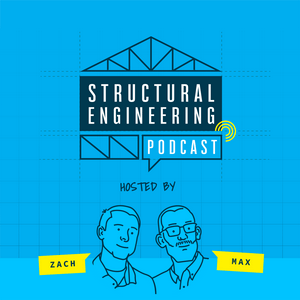
Hosted by Max and Zach, The Structural Engineering Podcast dives into the world of structural design, real-world engineering challenges, and the stories behind the structures that shape our world. Whether you're a practicing engineer, an aspiring student, or just curious about how buildings stand tall, tune in for expert insights, industry interviews, and relatable experiences from the field.
Podcast websiteListen to The Structural Engineering Podcast, My Favorite Learners Podcast and many other podcasts from around the world with the radio.net app
Get the free radio.net app
- Stations and podcasts to bookmark
- Stream via Wi-Fi or Bluetooth
- Supports Carplay & Android Auto
- Many other app features
Get the free radio.net app
- Stations and podcasts to bookmark
- Stream via Wi-Fi or Bluetooth
- Supports Carplay & Android Auto
- Many other app features

The Structural Engineering Podcast
Scan code,
download the app,
start listening.
download the app,
start listening.
The Structural Engineering Podcast: Podcasts in Family
 South Africa