

Listen to this podcast for free in the app: Download for free in the App Store
radio.net
Sleep timer
Save favourites
59 episodes

Before Today’s Political Retribution, There Was Jane Fonda
2026/07/07 | 1h 2 mins.Retribution and weaponization of governmental agencies against political foes are on the rise but the motivations behind them are not new. To see them in action in our recent history, we only need turn back to Jane. Fonda, 89, who has been the target of the government for decades.
A new biography about Fonda spotlights years of her activism but also focuses on her being a frequent target of government abuses. The book is written by award-winning biographer Marilyn Greenwald, professor emerita at the E.W. Scripps School of Journalism at Ohio University. It’s titled Jane Fonda: There is a Great Deal to Say, and it’s published by Rutgers University Press.
In the book, Greenwald chronicles Fonda’s social activism for almost 60 years and describes how it has evolved. Fonda has often said that activism is her major goal and acting is her “side gig.” Greenwald also details how Fonda was targeted for harassment by the federal government.
Fonda was on President Richard M. Nixon’s “Enemies List” and was a favorite target of then FBI Director J. Edgar Hoover. She was harassed by the Federal Bureau of Identification (FBI), the Central Intelligence Agency (CIA) and the White House. She was falsely arrested in Cleveland for allegedly possessing drugs, which turned out to be vitamins, and then accused of a “cover-up” when the case was dismissed. Additionally, the CIA intercepted her mail even though the CIA was not to be involved in domestic investigations.
Greenwald discusses the book on this edition of Next Witness…Please with hosts retired judges Thomas Hodson and Gayle Williams-Byers. They focus on the concept of political weaponization of federal agencies by presidents and high-level governmental officials.America’s True Crime Fix: Why We Can’t Look Away from Real-Life Tragedy
2026/05/14 | 55 mins.We live in an era where our dinner conversations are often dominated by the darkest corners of the human psyche, as society remains endlessly gripped by the world’s most chilling true crime cases.
Why are we so occupied with reality television and the popularity of true crime shows when our current news headlines are full of real-life and real-time legal dramas of national proportion?
Next Witness…Please decided to explore this question with one of the leading producers of true crime/reality television.
Jack Cole is an executive producer, documentary filmmaker and write behind some of the most popular reality and true crime series, including Suddenly Amish on HBO’s Max and The Curious Case Of… series on Prime.
He breaks down for our audience, how cases are found to portray, and walks us through his thought processes in editing reality and true crime programming. Many critics say that reality television is staged and acted pursuant to scripts. However, Cole assures us there are no scripts and that “reality tv is more real than not.”
Cole also discusses why, we as a culture are so “uniquely at home” with stories of tragedy and strife. Why are we innately curious? He compares our reactions as being the same as when we “rubberneck” to see the details of a vehicular accident we may pass on the highway. We want to see the destruction and sometimes the carnage. We also are intrigued with other people’s travails and tragedies. He says we, as individuals, can either identify with a person in trauma or be thankful that we are not experiencing the same in our lives or both. Cole does not see the popularity of true crime or reality shows abating any time soon.
Most people’s lives are tough, and we are often looking for a way to escape into someone else’s trauma, he says.Trump’s Civil Service Shakeup Reaches a Breaking Point
2026/03/10 | 56 mins.President Donald Trump’s attack on federal civil service workers continues and is about to hit a new crescendo. For two terms Trump has been targeting some federal civil service workers trying to take them out of civil service protections and make them employees “at will.” This allows for political appointees, patronage, and quick hiring and firing of top-ranking federal workers without civil service procedures. It also makes the federal workforce totally loyal to one person, Trump, its leader.
Trump did this by Executive Order in 2020, but that order was repealed by President Joseph Biden in 2021. On Inauguration Day, Jan. 20, 2025, Trump reissued his original order from 2020. Trump’s federal Office of Personnel Management, then in Feb. 2026, issued a final order titled “Improving Performance, Accountability and Responsiveness in the Civil Service” which formerly reclassifies nearly 50,000 workers out of the civil service on March 8. Dr. Stephen Goldman, psychiatrist, author, and historian along with being a person who spent years as a product safety and risk management expert and regulator for the Food and Drug Administration, joins Next Witness…Please to critique this new development.
Dr. Goldman argues that the federal government has relied on a robust civil service since the 19th century. He fears that true federal experts, who are not politically aligned, will now be stripped of civil service protections and replaced by less qualified political appointees. Dr. Goldman also joins retired judges Gayle Williams Byers and Thomas Hodson to discuss the numerous federal lawsuits that have been filed to stop this transition.
They also examine the parallel case of Trump v. Cook that awaits a Supreme Court decision this spring. That case, although not directly on point, will give politicians and legal experts a precedent for how much authority the President has to fire “inferior officers without traditional civil service protections.”Federal Sentencing Guidelines Explained: What They Are and How Judges Use Them
2026/01/07 | 54 mins.One often hears the term “sentencing guidelines” when following a federal criminal case. But what are they and how do they work?
The guidelines are for federal judges to use in sentencing defendants convicted of federal crimes so there is some consistency from court to court across the country, says John R. Mitchell, award-winning attorney in the Taft Law Firm’s Compliance, Investigations, White-Collar Defense and Commercial litigation practices.
The guidelines are established by the U.S. Sentencing Commission consisting of lawyers, judges, and legal scholars. The guidelines also are reviewed periodically by the commission to see if any of the guidelines need to be changed.
The guidelines are intended to provide fairness and consistency, to reduce disparities by preventing arbitrary or biased sentencing, to provide transparency for the public, and to give judges some structure in fashioning the right sentence.
The guidelines originally were mandatory but since 1987 they have become advisory to judges. This flexibility allows judges some discretion in sentencing convicted individuals.
Attorney Mitchell explains, in depth, on this edition of Next Witness…Please the key components of the guidelines. A judge must first consider the seriousness of the offense considering the nature of the crime, whether a weapon was used, and the harm to the victim.
Secondly, a judge must consider the defendant’s criminal history – whether the defendant has a past criminal record.
Finally, a judge must look at a Sentencing Table or Sentencing Grid. This table takes into consideration the offense level and the criminal history of the defendant to arrive at a recommended sentence of prison, fines, or probation.
The use of sentencing guidelines by the prosecution and the defense, often creates incentives for a negotiated guilty plea in a matter – with sentencing recommendations to the judge. That often avoids a trial Mitchell says.
Some states have sentencing guidelines for state crimes but not all.Ohio Lawmakers Target Judge Over Social Media Posts, Raising Judicial Free Speech Concerns
2025/12/18 | 39 mins.Judges, both federal and state, are increasingly under attack and are becoming targets of abuse and even violence from citizens and politicians alike.
Sometimes, state legislatures target judges for punishment for First Amendment speech. One such case is happening in Ohio.
On Oct. 21, two members of the Ohio House filed a joint resolution demanding that a Hamilton County (Cincinnati) Municipal Court judge resign immediately or be brought before the General Assembly for impeachment proceedings.
Judge Ted N. Berry is being targeted for his social media comments after the death of conservative leader Charlie Kirk. Judge Berry is the son of the first African American Mayor of Cincinnati.
Adam Mathews (R-Lebanon) and DJ Swearingen (R-Huron) claim that Judge Berry made inappropriate comments. They site three.: First, “So, a white guy killed him! Color it KARMA.” Second, “Rest in Hatred & Division!” and finally “How’s he feel about gun violence and gun control in Hell, now?”
Matthews and Swearingen claim that these statements show a clear “personal bias or prejudice” and therefore, Judge Berry should be removed from the bench.
This legislative action bypasses the usual disciplinary processes conducted and managed by the Ohio Supreme Court and makes this whole free speech issue political.
Sponsor testimony was given to the resolution in the House General Government Committee on Nov. 4, but no further action has been taken.
Some observers see this resolution as a political stunt to silence judges since Judge Berry’s term of office ends on Jan. 4, 2026.
This edition of Next Witness…Please examines this legislative action and other attempts to curtail the free speech rights of judges and to target them if they do not follow the conservative path.
More Government podcasts
 The InterviewGovernment, News, Politics
 The Coming StormDocumentary, Government, Society & Culture
 Inside the FBIGovernment
 The DSR NetworkGovernment
 Optimist EconomyGovernment, Society & Culture
 The John Phillips ShowGovernment, News, News Commentary
 MacroaggressionsComedy, Government, News
 The Ayaan Hirsi Ali PodcastChristianity, Government, News, Politics, Religion, Religion & Spirituality
 What Trump Can Teach Us About Con LawGovernment
 American PowerGovernment, History, News
Trending Government podcasts
 Inside Briefing with the Institute for GovernmentGovernment, News, Politics
 Outside the Secret Service PodcastGovernment, History, True Crime
 The Oath and The OfficeGovernment, News, Politics
- American PowerGovernment, History, News
- Inside the FBIGovernment
- What Trump Can Teach Us About Con LawGovernment
 Into AfricaBusiness, Government, Non-Profit
 Capitalisn'tBusiness, Government, News
- The John Phillips ShowGovernment, News, News Commentary
- The InterviewGovernment, News, Politics
 Question TimeGovernment, News
 Ones ReadyEducation, Fitness, Government, Health & Wellness, Self-Improvement
 Dairy StreamBusiness, Education, Government
 GB WhatsApp Unlocked: Smart Messaging InsightsGovernment
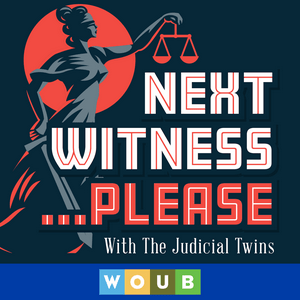
About Next Witness...Please
Ever found yourself lost in legal jargon? Fear not! Our mission is to decode complex legal concepts into everyday language, making them accessible to all.
Meet your hosts, the dynamic duo known as the Judicial Twins!
Retired judge Tom Hodson brings over 50 years of legal expertise as a trial judge, defense attorney, and former Judicial Fellow at the Supreme Court of the United States.
Retired judge Gayle William-Byers, with more than two decades of public service as a prosecutor and judge, is now sharing her knowledge as a Judicial Fellow for The National Judicial College and a legal analyst.
Join us as we embark on a quest to demystify the legal system and increase your understanding of its complexities.
Tune in to "Next Witness... Please" for enlightening discussions, insightful perspectives, and a deeper understanding of the law. Don't miss out – subscribe now and let's unravel the mysteries of the legal world together!
Podcast websiteListen to Next Witness...Please, The Interview and many other podcasts from around the world with the radio.net app
Get the free radio.net app
- Stations and podcasts to bookmark
- Stream via Wi-Fi or Bluetooth
- Supports Carplay & Android Auto
- Many other app features
Get the free radio.net app
- Stations and podcasts to bookmark
- Stream via Wi-Fi or Bluetooth
- Supports Carplay & Android Auto
- Many other app features

Next Witness...Please
Scan code,
download the app,
start listening.
download the app,
start listening.
Next Witness...Please: Podcasts in Family
 South Africa