PodcastsGovernmentMultilateralism UNpacked

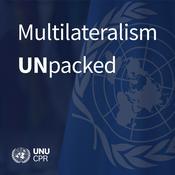
Multilateralism UNpacked

United Nations University Centre for Policy Research
Multilateralism UNpacked
Latest episode

9 episodes

  • Multilateralism UNpacked

    Meeting the Needs of Future Generations, Part 1 – Intergenerational Equity Explained

    2026/03/10 | 34 mins.
    In this episode of Multilateralism UNpacked, UNU-CPR’s Daouia Chalali welcomes Professor Edith Brown Weiss of Georgetown University, one of the leading architects of the concept of intergenerational equity in international environmental law.
    Their conversation revisits the ideas behind her landmark book In Fairness to Future Generations and explores how the principle of intergenerational equity has evolved over the past decades, and why considering the rights and wellbeing of future generations is increasingly urgent.
    Drawing on legal cases, international agreements and national policies, Professor Brown Weiss reflects on how courts, governments and international institutions are beginning to translate this principle into practice and what more can be done to ensure that today’s decisions do not undermine the world inherited by future generations.
    Together, they discuss how the UN system, policymakers and civil society can help build an “ecosystem for future generations,” embedding long-term thinking into global governance at a critical moment for people and the planet.
    For more information:
    Access new research on future generations
    Access the Future Generations Platform
  • Multilateralism UNpacked

    Governing AI for Humanity: Reflections on Risks, Opportunities and Global Cooperation

    2026/02/04 | 27 mins.
    Episode 8 of Multilateralism UNpacked examines how artificial intelligence is reshaping global governance at a moment when the technology is advancing faster than multilateral systems can adapt. AI is reshaping information environments, influencing conflict dynamics, transforming labour markets, and accelerating both opportunities and risks for sustainable development.
    For the United Nations – an institution mandated to maintain peace and security, protect human rights and advance global development – AI presents both a major governance challenge and an important test of international cooperation.
    To examine these issues, Dr. Jack Durrell, Head of Communications at UNU-CPR, speaks with Dr. Eleonore Fournier-Tombs, whose research at UNU-CPR has helped shape global debates on AI governance. Her work has ranged from analysing AI’s implications for peace and conflict to co-developing the Hamburg Declaration on Responsible AI for the SDGs and contributing to emerging thinking on scientific consensus mechanisms and the International Scientific Panel on AI. Most recently, she co authored the ITU’s AI for Good flagship report, Unlocking AI’s Potential to Serve Humanity, which outlines practical pathways for deploying AI in support of human and planetary well being.
    As Eleonore now transitions into a senior public leadership role as New York State’s Chief AI Officer, she reflects on her work at UNU CPR and considers:
    How AI is challenging existing UN capacities and processes;
    What role the UN can realistically play in global AI governance;
    How that role is evolving as Member States, companies and civil society shape the agenda;
    And where the most significant future risks and opportunities are likely to emerge.

    For more information:
    Unlocking AI's Potential to Serve Humanity: https://unu.edu/cpr/report/unlocking-ais-potential-serve-humanity-robotics-geospatial-ai-and-communications
    Four Ways the International Scientific Panel on AI Should Approach AI Risks: https://theglobalobservatory.org/2025/09/how-international-scientific-panel-on-ai-should-approach-risk/
    Hamburg Declaration on Responsible AI for the SDGs: https://unu.edu/cpr/news/hamburg-declaration-responsible-ai-sdgs
    Foundation of Scientific Consensus for International Cooperation: https://unu.edu/cpr/brief/foundations-scientific-consensus-international-cooperation
    Disinformation and Peacebuilding in Sub-Saharan Africa: https://unu.edu/publication/disinformation-and-peacebuilding-sub-saharan-africa
    A Global Architecture for Artificial Intelligence: https://unu.edu/publication/global-architecture-artificial-intelligence
  • Multilateralism UNpacked

    COP 30: A Turnaround COP or a Missed Opportunity?

    2025/12/05 | 33 mins.
    In this episode of Multilateralism Unpacked, UNU-CPR’s Head of Communications, Jack Durrell, speaks with Senior Researcher Michael Franczak, sharing insights from his experience at COP30 in Belém.
    Their conversation explores why COP 30 felt substantially different from previous summits – marked by the acknowledgement of a 1.5°C overshoot, shrinking aid budgets and Europe’s energy and security pressures.
    While meaningful advances emerged on trade, adaptation and subnational leadership, the absence of new finance pledges and stalled fossil fuel phase-out language underscored the limits of the process.
    Together, they reflect on the mixed outcomes, the obstacles holding back global climate ambition and the opportunities that could still drive momentum forward.
  • Multilateralism UNpacked

    AI, War and International Humanitarian Law

    2025/10/27 | 33 mins.
    In this episode of Multilateralism Unpacked, Eleonore Fournier-Tombs, Head of Anticipatory Action and Innovation at UNU-CPR, speaks with Laurent Gisel, Head of the Arms and Conduct of Hostilities Unit at the International Committee of the Red Cross (ICRC), about one of the most urgent challenges in global governance: the rise of AI-enabled autonomous weapons.
    Military investment in AI is accelerating, and systems capable of independently selecting and attacking targets are already being developed. Gisel explains how the use of these weapons can violate the principles of the Geneva Conventions.
    Drawing on a recent ICRC report to the UN Secretary-General, as well as the ongoing activities of the UN’s First Committee, which deals with disarmament and international security, the podcast explores the various military uses of AI and considers the urgent need for a new international treaty on lethal autonomous weapons systems.
    Related information:
    The Geneva Conventions and Additional Protocols: https://www.icrc.org/en/law-and-policy/geneva-conventions-and-their-commentaries
    ICRC Submission to the UN Secretary-General on Artificial Intelligence in the Military Domain: https://www.icrc.org/sites/default/files/2025-04/ICRC_Report_Submission_to_UNSG_on_AI_in_military_domain.pdf
    United Nations Resolution 78/241 on lethal autonomous weapons: https://docs.un.org/en/A/RES/78/241
  • Multilateralism UNpacked

    Exploring the UN’s Role in the Global Governance of AI

    2025/10/02 | 28 mins.
    Artificial Intelligence (AI) has rapidly become one of the most transformative technologies of our time. From reshaping industries and labour markets to influencing education, healthcare and security, AI is increasingly embedded in every part of our societies.
    Although there is increasing convergence on the risks and opportunities associated with AI, policy solutions are diverse and fragmented, with standards, sectoral regulations and strategies varying from country to country.
    In response, the United Nations has provided a platform for global dialogue and scientific consensus on AI, and recently, during this year’s 80th General Assembly, Member States launched both the International Scientific Panel (ISP) on AI , designed to build a common, evidence-based understanding of the technology, and the Global Dialogues on AI Governance, bringing together governments, civil society, industry and academia to exchange perspectives on a regular basis.
    This episode of Multilateralism UNpacked explores these developments with Lucia Velasco, Head of AI Policy at the Office of the UN Office of Digital and Emerging Technologies, who spoke to Eleonore Fournier-Tombs, Head of Anticipatory Action and Innovation at UNU-CPR, about where global AI governance stands today, what the ISP and Global Dialogues mean in practice, and how AI governance may evolve in the years ahead.
    Suggested reading list:
    Global Digital Compact: https://www.un.org/global-digital-compact/sites/default/files/2024-09/Global%20Digital%20Compact%20-%20English_0.pdf.
    International Scientific Panel on AI: https://www.un.org/independent-international-scientific-panel-ai/en.
    Global Dialogues on AI Governance: https://www.un.org/global-dialogue-ai-governance/en.
    A Global Architecture for Artificial Intelligence: https://collections.unu.edu/eserv/UNU:9284/A_Global_Architecture_for_Artificial_Intelligence.pdf
    ¿Te va a sustituir un algoritmo?: El futuro del trabajo en España: https://www.amazon.com/-/es/%C2%BFTe-sustituir-algoritmo-futuro-trabajo/dp/8418895055

More Government podcasts

About Multilateralism UNpacked

Multilateralism UNpacked is produced by the United Nations University Centre for Policy Research. Each month, we take a deep dive into a key challenge facing the United Nations and its Member States; and offer evidence-based solutions that can be adopted in response to help avert crisis and strengthen the multilateral system.
Podcast website

Listen to Multilateralism UNpacked, The Lawfare Podcast and many other podcasts from around the world with the radio.net app

Get the free radio.net app

  • Stations and podcasts to bookmark
  • Stream via Wi-Fi or Bluetooth
  • Supports Carplay & Android Auto
  • Many other app features

Multilateralism UNpacked: Podcasts in Family

Social
v8.7.2 | © 2007-2026 radio.de GmbH
Generated: 3/11/2026 - 3:40:50 AM