

Listen to this podcast for free in the app: Download for free in the App Store
radio.net
Sleep timer
Save favourites
23 episodes
#22 From Automatic to Analytical: Comparing Instructional Models for Digital Source Evaluation, with Gaston Saux
2026/07/06 | 32 mins.The proliferation of complex and often conflicting digital information demands advanced cognitive strategies to discern source trustworthiness effectively. Yet, many readers remain on “autopilot” or favour personal justification over investigating who's behind the information. Let's explore how different educational strategies can break these automatic habits and foster a more analytical mindset. Drawing on a study of 179 university students, Gaston Saux and his team compared traditional teacher-led instruction with symmetric peer-tutoring. Their findings reveal that while both methods were effective, peer-tutoring's effect was clearer when participants justified their evaluation decisions in a specific task and reported their criteria for justifying their trust in online information in general. By bridging the gap between cognitive theory and classroom practice, this research aims to reflect on what interventions are more effective to promote critical source evaluation.
More about the speaker
Gaston Ignacio Saux is a researcher at the Argentinean National Scientific and Research Council (CONICET) and head of the “Text Comprehension and New Reading Contexts” program at CIPP-UCA (Buenos Aires). After earning a Ph.D. from the University of Buenos Aires and completing a CNRS-funded postdoctoral position at the University of Poitiers, he shifted his focus from inference generation to strategic source evaluation while reading in unreliable digital environments. Currently, his research team seeks to bridge the gap between basic cognitive research and effective, reflective reading practices.#21 How to ensure your research benefits the greatest number? with Colin de la Higuera
2026/04/21 | 27 mins.In this episode, we explore a personal and professional journey beyond the code. Our guest, Colin de la Higuera, shares the realization that guiding research toward human values is not something that can be improvised; rather, it has become a vital field of research in its own right.
We move beyond the personal narrative to examine the critical interactions between Artificial Intelligence and the sharing of knowledge. With a primary focus on education, we discuss how we can intentionally steer AI to empower learners and democratize information, rather than letting it be defined by market forces alone.#20 Modeling creativity for learning: from computational approaches to educational futures? with Chloé Mercier
2026/03/30 | 20 mins.In this episode, we explore creativity not as a mysterious gift, but as a process that can be studied, modeled, and nurtured. At the crossroads of computer science, cognitive science, and the learning sciences, our guest, Chloé Mercier, examines creativity as a situated and iterative learning process shaped by reflection and feedback.
Using computational approaches, we discuss how creative work can be analyzed without reducing its educational richness. These models help us understand how learners generate ideas from prior knowledge and environmental stimuli, revise their work, and gradually develop creative strategies.
Looking ahead, the conversation turns to writing education and the goal of fostering creativity alongside metacognitive awareness, not automating production. We also reflect on digital humanities and STEAM education, asking whether bridging the sciences and humanities could support more inclusive pathways and help address persistent social and gender inequalities.#19 Learning to teach humans and neural networks, with Jean Vassoyan
2026/03/04 | 23 mins.In this episode, Jean Vassoyan explores a fundamental question in machine learning: how can we design “teacher” algorithms that effectively guide “student” agents?
Using a broad and abstract framework, he connects fields such as Curriculum Learning, Active Learning, and Reinforcement Learning, showing how they share a common mathematical foundation aimed at optimizing learning.
Applied to human education, this approach becomes Adaptive Learning, intelligent tutoring systems that personalize instruction for each learner. By viewing machine and human teaching through a unified lens, Jean invites us to rethink what it truly means to be a teacher and how this role can be defined and formalized in quantitative terms.#18 Empowering students: how to make digital transition an opportunity for inclusive education? with Muriel Epstein
2025/12/18 | 18 mins.Empowering students: how to make digital transition an opportunity for inclusive education?
Empowering students is the cornerstone of inclusive education. To do this, we look at inspiring situations to understand the conditions and context that help teachers grow into inclusive practice. We ask what travels and what needs tailoring – what can be replicated, what must be adapted to local conditions and context, and what should not be copied. In particular, we will address the ambivalent role of digital technology: it can lock in inequities or, when guided on purpose, expand agency and support the sustainability transition.
More about our guest
Muriel Epstein is a researcher in the educational sciences at the EMA laboratory (Ecole Mutations Apprentissage) at CY Cergy Paris University, and is affiliated with the SAMM laboratory (Statistical Analysis and Multidisciplinary Modeling) at Université Paris 1 Panthéon-Sorbonne.
After working on school dropout and spatial segregation, her research focuses on digital technology as a possible lever for transforming schools toward greater inclusion. She is particularly interested in the risks of “crystallization” associated with digital technology and in the potential evolution of teachers’ roles and professional stance. She also works on methodological issues and on how qualitative and quantitative methods can be combined in social science research.
More Science podcasts
 The Naked Scientists PodcastHealth & Wellness, Life Sciences, Medicine, Natural Sciences, Science
 Hidden BrainArts, Performing Arts, Science, Social Sciences
 More or LessMathematics, News, News Commentary, Science, Society & Culture
 Making Sense with Sam HarrisNews, Philosophy, Politics, Religion, Religion & Spirituality, Science, Society & Culture
 Ologies with Alie WardComedy, Science, Society & Culture
 Science VsEducation, Health & Wellness, Science
 Boring History for SleepScience, Social Sciences
 RadiolabDocumentary, History, Natural Sciences, Science, Society & Culture
 UnexplainableLife Sciences, Science
 The Rest Is SciencePhilosophy, Physics, Science, Society & Culture, Technology
Trending Science podcasts
 Outside/InDocumentary, Natural Sciences, Nature, Science, Society & Culture
 BrainStuffNatural Sciences, Science, Technology
 Nature PodcastNews, Science, Technology
 Students of SurgeryEducation, Natural Sciences, Science
 Terrible LizardsNatural Sciences, Nature, Science
 DiscoveryScience
 The Birding Life Podcast NetworkHobbies, Leisure, Nature, Science, Social Sciences
 Space Nuts: Astronomy Insights & Cosmic DiscoveriesAstronomy, Natural Sciences, Science
 Deep Insights with Mining Review AfricaEarth Sciences, Science
 That UFO PodcastDocumentary, Religion & Spirituality, Science, Social Sciences, Society & Culture
 Mysterious Radio: Paranormal, UFO & Lore InterviewsDocumentary, Natural Sciences, Personal Journals, Science, Social Sciences, Society & Culture
 Short WaveDaily News, Life Sciences, News, Science
 inControlScience
 This Week in VirologyHealth & Wellness, Medicine, Science
 WaterlandsNature, Science, Society & Culture
 Origin StoriesEducation, Life Sciences, Natural Sciences, Science
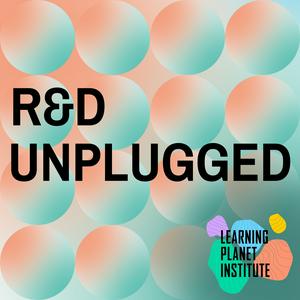
About R&D Unplugged
Welcome to "R&D Unplugged", a podcast from the Learning Planet Institute that delves into the real-world impact of research. Each episode features an insightful conversation with a leading researcher who shares their journey, key findings, and the practical implications of their work.
Our aim is to make complex research accessible and relatable. How research addresses critical global challenges, providing concrete examples of its impact on society? Listen to us and gain valuable insights into how research bridges the gap between theory and practice, transforming lives and communities!
Through engaging stories and clear explanations, "R&D Unplugged" demonstrates the vital role of research in solving real-world problems. Whether you're a student, a professional, or simply curious about the world, our podcast offers a unique perspective on how research drives positive change. Join us and be inspired to see how research can make a difference!
Podcast websiteListen to R&D Unplugged, The Naked Scientists Podcast and many other podcasts from around the world with the radio.net app
Get the free radio.net app
- Stations and podcasts to bookmark
- Stream via Wi-Fi or Bluetooth
- Supports Carplay & Android Auto
- Many other app features
Get the free radio.net app
- Stations and podcasts to bookmark
- Stream via Wi-Fi or Bluetooth
- Supports Carplay & Android Auto
- Many other app features
R&D Unplugged
Scan code,
download the app,
start listening.
download the app,
start listening.
R&D Unplugged: Podcasts in Family
 South Africa