
Listen to this podcast for free in the app: Download for free in the App Store
radio.net
Sleep timer
Save favourites
119 episodes
HBH 67: How to Build a Ghost: The Philip Experiment
2026/07/27 | 22 mins.In 1972, eight people in Toronto invented a seventeenth-century ghost named Philip Aylesford. They gave him a face, a tragic history, and a personality—then gathered weekly to contact him. For nearly a year, nothing happened. Then the table began to knock, move, and answer questions. Was Philip evidence of psychokinesis, unconscious muscular action, collective expectation, or something stranger? This episode examines the remarkable Philip Experiment and what it may reveal about how human minds can turn a shared story into something that feels—and sometimes behaves—as though it were real.
Become a supporter of this podcast: https://www.spreaker.com/podcast/the-history-of-being-human--5806452/support.HBH 66: The Moon, In Fact
2026/05/18 | 44 mins.By special request from a brilliant young listener - an episode about the moon!
Be careful what you wish for, because it's all here lol.
Become a supporter of this podcast: https://www.spreaker.com/podcast/the-history-of-being-human--5806452/support.HBH 65: Future Self Continuity and Bad Decisions
2026/01/05 | 11 mins.How well do you know your future self?
How much do you like yout future self?
The answer to these two questions has implications for how you plan and provide for that person.
Today, we cover the work of Hal Hershfield and others about how well or poorly we identify with Future Us, and what it means for how short- or far-sighted we are in our decision-making.
Become a supporter of this podcast: https://www.spreaker.com/podcast/the-history-of-being-human--5806452/support.HBH 64: Homo Antecessor: The Disturbing Dead End Cannibals of Atapuerca
2025/08/12 | 39 mins.Recent finds in the Atapuerca site in Spain have confirmed and expanded our understanding of the tates and culinary practices of Homo antecessor. This species is enigmatic and its place in the evolutionary tree unclear.
But what is very clear is that it was cannibalistic. And on a large scale. It had a taste for young hominins, probably from competing tribes. How, you ask, could we possibly know that?
In this epsiode of The History of Being Human, we cover everything we know and how we know it. Height, habitus, habits, diet of animals and hominins, and behavior.
This episode expands significantly on the previous consideration of archaic human cannibalism in episode 3.
Become a supporter of this podcast: https://www.spreaker.com/podcast/the-history-of-being-human--5806452/support.HBH 63: Overkill! The Ongoing End of the Megafauna with Dr. Rhys Lemoine
2025/08/02 | 31 mins.Rhys Taylor Lemoine is a postdoctoral researcher in extinction, megafauna, rewilding, and novel ecosystems. Today he speaks to us about the late quaternary extinction.
We discuss what megafauna are, their key roles in ecosystems, and the worldwide number and types that died off during the extinction of the late quaternary period (including the present). Rhys discusses the two main theories about what drove -- and still drives -- these extinctions, overKILL and overCHILL. He then tells us why he and his research team posit that climate change was a lesser factor driving these extinctions.
For Rhys, the extinctions are best explained by the introduction of a novel, insatiable, armed predator. One that could attack the largest and most dangerous animals from a distance with relatively little risk to itself. In other words, humans did it.
One of the evidences he considers is that the extinctions of the late quaternary continue to this day, and the current culprit in large animal extinction is not in dispute.
Become a supporter of this podcast: https://www.spreaker.com/podcast/the-history-of-being-human--5806452/support.
More History podcasts






Trending History podcasts














About The History of Being Human
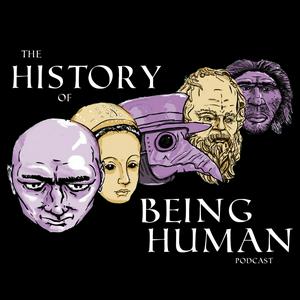
History, anatomy and physiology, philosophy, psychology, anthropology. The podcast that attempts to resurrect sense and meaning from the dust of a billion factoids.Become a supporter of this podcast: https://www.spreaker.com/podcast/the-history-of-being-human--5806452/support.
Podcast websiteListen to The History of Being Human, The Ancients and many other podcasts from around the world with the radio.net app
Get the free radio.net app
- Stations and podcasts to bookmark
- Stream via Wi-Fi or Bluetooth
- Supports Carplay & Android Auto
- Many other app features
Get the free radio.net app
- Stations and podcasts to bookmark
- Stream via Wi-Fi or Bluetooth
- Supports Carplay & Android Auto
- Many other app features
The History of Being Human
Scan code,
download the app,
start listening.
download the app,
start listening.
 South Africa

