
Listen to this podcast for free in the app: Download for free in the App Store
radio.net
Sleep timer
Save favourites
24 episodes
Would We Even Recognize Alien Life If We Found It?
2026/11/07 | 1h 18 mins.Could we recognize life that looks nothing like us? Before we can answer that, we have to decide what counts as alive. Even here on Earth, that question gets complicated quickly.
Expect to learn why movement, growth, and energy use aren’t enough to identify life, why viruses sit near the boundary, and why depending on a host doesn’t disqualify a parasite from being alive. I also talk through siphonophores, hypothetical reproducing machines, and the ways ideas can spread and evolve without being biological organisms.
From there, I turn to the search beyond Earth: carbon and water, Titan’s methane lakes, alternatives to DNA, and the chemical signals astronomers look for in distant atmospheres. This connects directly to my research on exoplanets and a problem I keep coming back to: an inhabited planet could be out there without giving us a signal we know how to recognize.
Hosted by Dr. Dakotah Tyler.
Lead with curiosity.They Say Science Isn't Spiritual. But I Disagree. Here's Why.
2026/10/30 | 1h 3 mins.What has science confirmed that people once understood as a spiritual belief? Someone asked me that recently, and it turned into a much bigger conversation about what I believe and why.
Expect to learn how the elements in our bodies connect us to the history of the universe, how those ingredients get recycled here on Earth, and how common ancestry connects us to other living things. I explain why I find personal meaning in those discoveries, while distinguishing that interpretation from what the science actually establishes.
We also take a few detours through dinosaurs, whale evolution, and the questions I still have about epigenetics. Then I get into meditation, the psychology of awe, and the perspective astronauts describe when they see Earth from space.
By the end, I’m talking about my own sense of purpose: what it means to have this particular combination of ancestry, experiences, and perspective, and what I want to do with the time I have.
Hosted by Dr. Dakotah Tyler.
Lead with curiosity.Could Earth Life Survive on Enceladus? Inside the Alien Ocean Experiment
2026/09/29 | 30 mins.Could something alive on Earth survive in the ocean beneath an alien moon’s ice? Researchers tested that question by recreating some of the conditions thought to exist on Enceladus, a small moon of Saturn. The archaea they introduced survived and multiplied under some of those simulated conditions.
I wanted to understand how you even design that experiment when the ocean you’re studying is buried beneath ice. We talk through Cassini’s encounters with Enceladus’s plumes, how tidal heating keeps water liquid, and how microbes can get their energy from chemistry instead of sunlight.
I also follow this into a more speculative question: could life travel between worlds inside rocks launched by asteroid impacts? If we ever discover organisms on Enceladus, finding out whether they share an ancestor with Earth life would be incredible. There are a lot of hurdles between surviving a laboratory experiment and making that journey, and I walk through those too.
study link:
https://www.science.org/doi/10.1126/sciadv.aei0167
Hosted by Dr. Dakotah Tyler.
Lead with curiosity.Sunscreen, Skin Cancer, and How Medical Advice Fails Black Patients | Dr. Adewole Adamson, M.D.
2026/09/28 | 1h 19 mins.Relevant studies mentioned:
https://jamanetwork.com/journals/jamadermatology/fullarticle/2774113 - melanoma
https://jamanetwork.com/journals/jamadermatology/fullarticle/2790089 (free version: https://pmc.ncbi.nlm.nih.gov/articles/PMC8943625/) - Keratinocyte carcinoma (aka Non-melanoma skin cancer)
https://pubmed.ncbi.nlm.nih.gov/10896812/ — The evolution of human skin coloration
https://link.springer.com/article/10.1007/s43630-026-00940-x — Blindspot: how sun exposure guidelines have ignored the health of individuals with skin of color
https://faseb.onlinelibrary.wiley.com/doi/10.1096/fj.201701472R - Research on the protective role of melanin in black skin against UV DNA damage
Dr. Adewole Adamson is a board-certified dermatologist and health services researcher at UT Austin’s Dell Medical School. He has co-authored systematic reviews examining UV exposure and skin cancer in people of color. I asked him to come on because his findings challenge something I’ve been told my entire life: that everybody needs sunscreen to prevent skin cancer.
UV radiation damages DNA, and its connection to skin cancer is well established in white populations. But Dr. Adamson explains that studies looking for a connection between UV exposure and melanoma in Black people largely haven’t found one. His review of other common skin cancers found no studies directly examining that question in Black populations. So why are we giving everyone the same cancer-prevention message?
We talked about melanin, the different types of skin cancer, why sunscreen wouldn’t have prevented Bob Marley’s melanoma, and the questions around vitamin D. We also discussed sunscreen’s uses for sunburn and other skin damage, and why later cancer diagnoses demand attention to healthcare access and recognition of disease on darker skin.
For me, this is also a conversation about Black people being marginalized in medicine. When the evidence differs but the advice stays the same, whose health are we actually accounting for?
Hosted by Dr. Dakotah Tyler.
Lead with curiosity.How Fast Can a Planet Form? The Youngest Planet Ever Discovered
2026/09/24 | 46 mins.Elias 2-24b is already several times Jupiter’s mass, yet its star system is estimated to be less than a million years old. This episode follows the discovery and asks how a gas giant can grow so massive, so quickly.
We cover how astronomers use infrared and radio observations to study young planets, how they estimate ages, and why growing from tiny grains into a giant planet is a bit more complicated than it sounds.
We also look at how an early forming giant planet can influence the future planets that are able to form around it, with connections to Jupiter, Mars, atmospheric loss, and the delivery of rock and ice in our solar system. Could the timing of planet formation help shape a system’s chances for life?
Hosted by Dr. Dakotah Tyler.
Lead with curiosity.
More Astronomy podcasts


Trending Astronomy podcasts
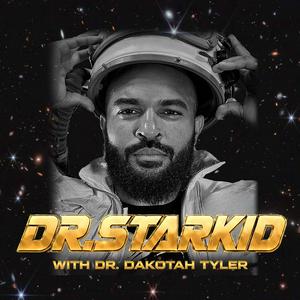
About Dr. Starkid
Hosted by Dr. Dakotah Tyler, a former Division-I college football player turned PhD astrophysicist, science communicator, author, and professor of physics and astrobiology.Science is one of humanity’s most powerful tools for understanding reality. From the cosmos above us to the questions that shape our daily lives, every discovery offers a new way to see the world.Through deep dives, interviews, conversations, and curiosity-driven storytelling, Dr. Starkid explores the ideas, discoveries, and mysteries that capture our imagination and expand our understanding of the universe. Featuring scientists, researchers, creators, and other fascinating minds, the show examines everything from space exploration and the search for life to the scientific discoveries reshaping how we understand ourselves and our place in the cosmos.Lead with Curiosity.
Podcast websiteListen to Dr. Starkid, Universe Today Podcast and many other podcasts from around the world with the radio.net app
Get the free radio.net app
- Stations and podcasts to bookmark
- Stream via Wi-Fi or Bluetooth
- Supports Carplay & Android Auto
- Many other app features

Dr. Starkid: Podcasts in Family
 South Africa

