

Listen to this podcast for free in the app: Download for free in the App Store
radio.net
Sleep timer
Save favourites
179 episodes
Revisiting Hospital Sepsis Programs
2026/09/10 | 1h 5 mins.Sepsis remains one of the leading causes of death and disability worldwide, making early recognition and coordinated care essential to improving patient outcomes.
In honor of Sepsis Awareness Month, observed every September, we are revisiting an episode of Critical Matters featuring a conversation about hospital sepsis programs and the CDC Hospital Sepsis Program Core Elements.
Originally debuting in 2023, Dr. Sergio Zanotti’s discussion with guest Hallie Prescott, MD, MSc, Associate Professor of Pulmonary and Critical Care Medicine at the University of Michigan, hits on evidence-based approaches to building effective sepsis initiatives and advancing quality care across healthcare organizations.
Additional resources:
CDC Hospital Program Sepsis Program Core Elements
CDC Additional Sepsis Clinical Resources
SCCM Surviving Sepsis Guidelines 2021
Characterizing an implementation intervention in terms of behaviour change techniques and theory: the ‘Sepsis Six’ clinical care bundle. Steinmo S, et al. Implementation Science 2015
Effect of a Multicomponent Sepsis Transition and Recovery Program on Mortality and Readmissions After Sepsis: The Improving Morbidity During Post-Acute Care Transitions for Sepsis Randomized Clinical Trial. Crit Care Medicine 2022
Recent episodes of Critical Matters related to sepsis:
Sepsis – Beyond the guidelines
Surviving Sepsis Campaign 2026 Guidelines
Capillary Refill Time (CRT)
Books mentioned in this episode:
The Autumn Ghost: How the Battle Against a Polio Epidemic Revolutionized Modern Medical Care. By Hannah WunschCommunication with mechanically ventilated patients
2026/08/27 | 58 mins.For patients receiving mechanical ventilation, losing the ability to speak can be one of the most frightening and frustrating aspects of critical illness.
In this episode of Critical Matters, Dr. Sergio Zanotti discusses the experience of being "voiceless" in the ICU and examines evidence-based strategies to improve communication between patients, families, and care teams.
He is joined by Mary Beth Happ, PhD, RN, Nursing Distinguished Professor of Critical Care Research at The Ohio State University College of Nursing and a nationally recognized researcher whose work has transformed our understanding of communication during mechanical ventilation.
Additional resources:
Giving Voice: Nurse-Patient Communication in the Intensive Care Unit. Happ MB. American Journal of Critical Care 2021.
Effect of a multi-level intervention on nurse-patient communication in the intensive care unit: results of the SPEACS trial. Happ MB, et al. Heart Lung 2014.
The Patient Communication Support Guide (PCSG): Development and Pilot Field Testing of a Digital Clinical Guide for Patient Communication in ICU. Tate, JA, Happ MB, et al. Ann Am Thorac Soc 2026.
Shin JW, Happ, MB., Tate, J. (2021). VidaTalk™ communication application “opened up” communication between nonvocal ICU patients and their family caregivers. Intensive and Critical Care Nursing, 66:103075. doi: 10.1016/j.iccn.2021.103075.
Shin JW, Happ MB., Tate, J., Balas, MC., Dabelko-Schoney, H., Tan, A. (2025). Preliminary efficacy of an electronic VidaTalkTMcommunication application on family-patient communication and family psychological distress in the intensive care unit: A pilot study. Heart Lung, 70: 14-22. PMCID: PMC11846697.
Books mentioned in this episode:
Culpability: A Novel. By Bruce HolsingerCommunicating to Patients and Families about PICS
2026/08/13 | 1h 3 mins.Recovering after a stay in the intensive care unit (ICU) is a long and difficult process, and for some survivors, healing the body may only be a fraction of the journey.
In recent years, attention has increasingly turned to the cognitive impact post-intensive care syndrome, or PICS, has on ICU patients. In this episode of Critical Matters, Dr. Sergio Zanotti explores how to communicate with patients and families about post-intensive care syndrome.
He is joined by Dr. Carla M. Sevin, an Associate Professor of Medicine in the Division of Allergy, Pulmonary, and Critical Care Medicine at Vanderbilt University Medical Center (VUMC). Dr. Sevin also serves as Director of the Pulmonary Patient Care Center and Director of the ICU Recovery Center.
Previous episodes of Critical Matters related to this topic:
Post-Intensive Care Syndrome (PICAS)
The Forgotten Patient
Additional resources:
Communicating to Patients and Families About Post-Intensive Care Syndrome. CHEST, 2025.
Post-Intensive Care Syndrome Awareness and Communication: Surveys of ICU Providers and Patients. CHEST, 2026.
The Heroism of Incremental Care. Atul Gawande. The New Yorker, 2017.
Critical Illness, Brain Dysfunction. And Survivorship (CIBS) Center.
CAIRO- Critical and Acute Illness Recovery Organization.
Books mentioned in this episode:
The Diving Bell and the Butterfly: A Memoir of Life in Death. By Jean Dominique-Bauby
The Correspondent: A Novel. By Virginia Evans.
The Wall. By Marlen HaushoferCommunicating to Patients and Families about PICS
2026/08/10 | 1h 3 mins.Recovering after a stay in the intensive care unit (ICU) is a long and difficult process, and for some survivors, healing the body may only be a fraction of the journey.
In recent years, attention has increasingly turned to the cognitive impact post-intensive care syndrome, or PICS, has on ICU patients. In this episode, Dr. Sergio Zanotti explores how to communicate with patients and families about post-intensive care syndrome.
He is joined by Dr. Carla M. Sevin, an Associate Professor of Medicine in the Division of Allergy, Pulmonary, and Critical Care Medicine at Vanderbilt University Medical Center (VUMC). Dr. Sevin also serves as Director of the Pulmonary Patient Care Center and Director of the ICU Recovery Center.
Previous Critical Matters episodes related to this topic:
Post-Intensive Care Syndrome (PICAS)
The Forgotten Patient
Additional Resources:
Communicating to Patients and Families About Post-Intensive Care Syndrome. CHEST, 2025.
Post-Intensive Care Syndrome Awareness and Communication: Surveys of ICU Providers and Patients. CHEST, 2026.
The Heroism of Incremental Care. Atul Gawande. The New Yorker, 2017.
Critical Illness, Brain Dysfunction. And Survivorship (CIBS) Center.
CAIRO- Critical and Acute Illness Recovery Organization
Books mentioned in this episode:
The Diving Bell and the Butterfly: A Memoir of Life in Death. By Jean Dominique-BaubyNutrition Therapy in the ICU
2026/07/30 | 1h 7 mins.When it comes to critical illness, nutrition isn't just supportive care—it can be a key part of the treatment plan.
In this episode, Dr. Sergio Zanotti sits down with Dr. Jayshil Patel to discuss nutrition therapy for critically ill adults and the growing evidence behind enteral nutrition's role in improving outcomes.
Dr. Patel is a pulmonary and critical care physician in the Division of Pulmonary at the Medical College of Wisconsin whose research focuses on how enteral nutrition influences outcomes in critical care settings.
Additional resources:
Nutrition Therapy in Critically Ill Adults. J. Patel, S McCLave. NEJM 2026.
Trial of the Route of Early Nutritional Support in Critically Ill Adults. CALORIES Trial. NEJM 2015.
Enteral versus parenteral early nutrition in ventilated adults with shock: a randomised, controlled, multicentre, open-label, parallel-group study (NUTRIREA-2). LANCET 2018.
Books mentioned in this episode:
The Road to Character. By David Brooks.
More Science podcasts
 UnexplainableLife Sciences, Science
 RadiolabDocumentary, History, Natural Sciences, Science, Society & Culture
 More or LessMathematics, News, News Commentary, Science, Society & Culture
 Suspicious Minds: AI and the ApocalypseDocumentary, Health & Wellness, Mental Health, Science, Social Sciences, Society & Culture, Technology
 Science VsEducation, Health & Wellness, Science
 Hidden BrainArts, Performing Arts, Science, Social Sciences
 The Rest Is SciencePhilosophy, Physics, Science, Society & Culture, Technology
 Science WeeklyScience
 The Naked Scientists PodcastHealth & Wellness, Life Sciences, Medicine, Natural Sciences, Science
 StarTalk RadioEducation, Science
Trending Science podcasts
 Students of SurgeryEducation, Natural Sciences, Science
 Chasing ConsciousnessScience
 Relebogile Mabotja hosts The Naked ScientistScience
 Science & Futurism with Isaac ArthurScience
 Wild Times: Wildlife EducationNature, Science
 Astrum SpaceAstronomy, Science
 Breaking Math PodcastArts, Books, Education, Mathematics, News, Performing Arts, Science, Tech News, Technology
 You Are Not So SmartEducation, Science, Social Sciences, Society & Culture
 Astronomy Daily: Latest Space NewsAstronomy, Natural Sciences, Science
 The Climate QuestionScience, Technology
 Fresh Thinking by Snowden OptiroEarth Sciences, Natural Sciences, Science, Technology
 Wildest Kruger StoriesLeisure, Nature, Places & Travel, Science, Society & Culture
 Rewilding the World with Ben GoldsmithEarth Sciences, Nature, Science
 This Week in CardiologyHealth & Wellness, Medicine, Science
 Robinson's PodcastNatural Sciences, Science
 6 Ranch PodcastNatural Sciences, Science
 In Defense of Plants PodcastNatural Sciences, Science
 Tooth & Claw: True Stories of Animal AttacksComedy, Nature, Science, True Crime
 RadiowissenScience
 Synapsen – ein WissenschaftspodcastNatural Sciences, Science
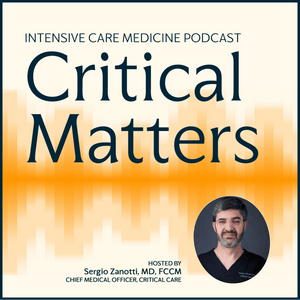
About Critical Matters
Podcast by Sound Physicians
Podcast websiteListen to Critical Matters, Unexplainable and many other podcasts from around the world with the radio.net app
Get the free radio.net app
- Stations and podcasts to bookmark
- Stream via Wi-Fi or Bluetooth
- Supports Carplay & Android Auto
- Many other app features
Get the free radio.net app
- Stations and podcasts to bookmark
- Stream via Wi-Fi or Bluetooth
- Supports Carplay & Android Auto
- Many other app features
Critical Matters
Scan code,
download the app,
start listening.
download the app,
start listening.
 South Africa