

Listen to this podcast for free in the app: Download for free in the App Store
radio.net
Sleep timer
Save favourites
125 episodes
CERN Recreates Cosmic Particle Storms Inside the Large Hadron Collider
2026/10/10 | 24 mins.CERN physicists have used the Large Hadron Collider to recreate how high-energy cosmic particles interact with Earth’s atmosphere.
By colliding protons with oxygen atoms, the ATLAS experiment produced data more than ten times more precise than previous models, offering new clues about cosmic radiation and extreme events around exploding stars and black holes.
This episode includes AI-generated content.How Scientists Close a Major Loophole in Quantum Physics
2026/10/09 | 20 mins.Quantum experiments can lose photons and still reveal genuine quantum behavior—but only if researchers handle missing detections correctly.
This study explores how different strategies can prevent the detection loophole from allowing classical explanations, with some requiring adjustments based on the loss rate. The results could help make quantum cryptography and future quantum networks more reliable in real-world conditions.
This episode includes AI-generated content.Scientists Turn Ordinary Light Into a Quantum Computing Tool
2026/10/08 | 21 mins.Could ordinary light be turned into a powerful quantum computing tool?
Researchers have developed a room-temperature system that uses individual photons and the natural fluctuations of classical light to perform quantum-like information processing. The approach could make quantum simulations and multiphoton technologies far more practical and scalable.
This episode includes AI-generated content.Could New Quantum Materials Finally Detect Dark Matter?
2026/10/07 | 23 mins.Could exotic quantum materials make dark matter detectable? Researchers have identified three unusual materials whose unique electronic properties could amplify signals from extremely light dark matter particles.
If the approach works as predicted, these materials could dramatically improve detector sensitivity and offer a new way to search for one of the universe’s greatest mysteries.
This episode includes AI-generated content.Scientists Challenge What We Thought We Knew About Black Hole Event Horizons
2026/10/06 | 20 mins.What if a black hole’s event horizon is not the ultimate barrier we thought it was? New theoretical research suggests quantum entanglement could form across the horizon, while the geometry of spacetime may determine whether that fragile information can escape.
The findings offer a surprising new view of the event horizon as an active interface where quantum connections can emerge.
This episode includes AI-generated content.
More Chemistry podcasts
 Adventures into ChemistryChemistry, Science
 Science History PodcastChemistry, Science
 Bench Boost by Inorganic VenturesChemistry, Education, Science
 The Episodic Table of ElementsChemistry, History, Science
 Chemistry For Your LifeChemistry, Science
 The chemical breakdown & Chemistry in its elementChemistry, Natural Sciences, Science
Trending Chemistry podcasts
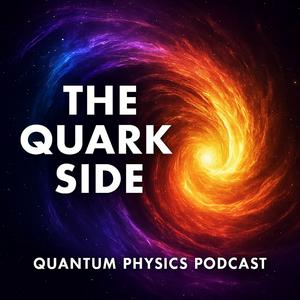
About The Quark Side - Quantum Physics Podcast
The Quark Side is a quantum physics podcast that explores the strange foundations of reality—from quarks and fields to spacetime, uncertainty, and the limits of knowledge. Each episode breaks down cutting-edge research and deep ideas in modern physics with clarity, rigor, and curiosity, revealing how the quantum world shapes everything we observe.
Podcast websiteListen to The Quark Side - Quantum Physics Podcast, Adventures into Chemistry and many other podcasts from around the world with the radio.net app
Get the free radio.net app
- Stations and podcasts to bookmark
- Stream via Wi-Fi or Bluetooth
- Supports Carplay & Android Auto
- Many other app features
Get the free radio.net app
- Stations and podcasts to bookmark
- Stream via Wi-Fi or Bluetooth
- Supports Carplay & Android Auto
- Many other app features

The Quark Side - Quantum Physics Podcast
Scan code,
download the app,
start listening.
download the app,
start listening.
The Quark Side - Quantum Physics Podcast: Podcasts in Family
 South Africa