
Listen to this podcast for free in the app: Download for free in the App Store
radio.net
Sleep timer
Save favourites
34 episodes

Bengal’s Arsenic Groundwater Crisis Explained with Prof. Abhijit Mukherjee
2026/10/13 | 1h 11 mins.How does water that looks perfectly clean contain dangerous levels of arsenic? Even after decades of research and treatment technologies, why does arsenic exposure remain a drinking-water problem?
In this episode of The Water Data Podcast, hydrogeologist Prof. Abhijit Mukherjee joins host Veena Srinivasan to trace the arsenic story across the Bengal and Ganga-Brahmaputra aquifer systems.
In the conversation, Veena and Abhijit explore how arsenic naturally occurs in sediments, why the geology and geochemistry of the Bengal Delta allow it to enter groundwater, and how microbial activity, iron minerals, and changing chemical conditions underground influence its mobilization.
The conversation also examines how large-scale pumping can change groundwater flow and potentially mix water between aquifer layers, making apparently simple rules about "safe" and "unsafe" groundwater much harder to apply.
Abhijit argues that arsenic treatment itself is not necessarily the biggest challenge. Filters need to be maintained, contaminated filter media must be safely disposed of, drinking-water sources must be monitored, and solutions have to work after researchers and engineers leave.
Veena and Abhijit also discuss arsenic in irrigated agriculture and the unequal vulnerability to exposure. This episode asks a larger question: when the science of a water problem is reasonably well understood, what prevents that knowledge from becoming safe water for everyone?
The Water Data Podcast is hosted by Veena Srinivasan and produced by WELL Labs.
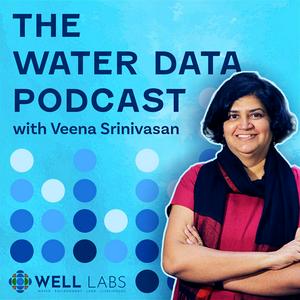
The Water Data Podcast is a talk show on the science, systems, and stories of water, hosted by Veena Srinivasan.
For all references and further readings related to the episode, visit https://welllabs.org/wdp-abhijit-mukherjee/
Subscribe to The Water Data Podcast on your favourite podcast app—and catch video episodes on the WELL Labs YouTube channel @welllabs.
Subscription links: Youtube, Apple Podcasts, Spotify, YouTube Music, Amazon Music, Audible, Castbox, and wherever you get your podcasts!
Recording by Nabina Chakraborty and Nanditha Gogate. Video editing by Srisabari Varaguna Pandian. Graphics and artwork by Aparna Nambiar. Audio mixing and mastering by Vijay Doiphode. Podcast production and management by Nabina Chakraborty and Pavan Srinath.How can we measure Evapotranspiration from Space? with Gilles Boulet
2026/09/29 | 55 mins.Can we measure evapotranspiration from space? And when a satellite produces a map of crop water use, how certain are those numbers?
Dr. Gilles Boulet joins host Veena Srinivasan for a deep dive into one of the most important and difficult-to-measure components of the hydrological cycle: evapotranspiration.
Evapotranspiration, or ET, combines evaporation from soil with transpiration through vegetation. In many semi-arid landscapes, it accounts for most of the water leaving the land surface. However, measuring ET across individual farms, irrigation commands, and entire watersheds is remarkably difficult.
In this episode, Gilles and Veena unpack what satellites actually observe, from vegetation and radar signals to land-surface temperature. They also discuss how scientists turn those observations into estimates of evapotranspiration.
They explore the role of flux towers and scintillometers, why satellite ET products contain uncertainty, and the differences between contextual and physics-based modeling approaches.
The conversation also looks ahead to TRISHNA, the Indo-French thermal-infrared satellite mission that aims to provide much more frequent land-surface-temperature observations at field-relevant spatial scales.
Additionally, the conversation answers questions regarding how better ET observations could help irrigation departments and groundwater agencies understand where water is actually being consumed, and whether we are close to producing reliable, near-daily maps of agricultural water use.
Dr. Gilles Boulet is a senior scientist at IRD and works with the Indo-French Cell for Water Science at the Indian Institute of Science, Bengaluru. His research focuses on land-surface processes, remote sensing, evapotranspiration, and field instrumentation.
The Water Data Podcast is a talk show on the science, systems, and stories of water, hosted by Veena Srinivasan.
For all references and further readings related to the episode, visit https://welllabs.org/wdp-gilles-boulet/
Subscribe to The Water Data Podcast on your favourite podcast app—and catch video episodes on the WELL Labs YouTube channel @welllabs.
Subscription links: Youtube, Apple Podcasts, Spotify, YouTube Music, Amazon Music, Audible, Castbox, and wherever you get your podcasts!
Recording by Nabina Chakraborty, Vraj Acharya and Nanditha Gogate. Video editing by Srisabari Varaguna Pandian. Graphics and artwork by Aparna Nambiar and Kanishka Goyal. Audio mixing and mastering by Vijay Doiphode. Podcast production and management by Nabina Chakraborty and Pavan Srinath.25 Years of Watching Groundwater at the Kabini Critical Zone Observatory with Sekhar Muddu
2026/09/15 | 1h 11 mins.What can 25 years of observing the same watershed teach us about groundwater? Can intensive pumping make groundwater deeper in valleys than on hills? Can decades of depletion be reversed by just a few exceptionally wet years? And how does fertilizer applied at the surface end up contaminating groundwater tens of metres below?
Professor Shekhar Muddu joins host Veena Srinivasan on the Water Data Podcast for a deep dive into the Kabini Critical Zone Observatory and what decades of field measurements have revealed about groundwater, agriculture, pollution and climate.
The conversation traces the evolution of the observatory from paired forested and agricultural catchments to a long-term interdisciplinary experiment studying groundwater levels, geochemistry, soil moisture, evapotranspiration and human water use.
Shekhar and Veena explore how intensive groundwater pumping altered natural groundwater gradients, how farmers responded to declining well yields, and how extreme rainfall events can produce large pulses of recharge. They also discuss research showing very high nitrate concentrations in parts of the aquifer, revealing how modern agricultural pollution can travel rapidly into deep groundwater through fractured hard-rock systems.
The episode also looks at the future of water observation in India, from satellite-based soil-moisture measurements to evapotranspiration monitoring, solar-induced fluorescence, carbon fluxes and the need for long-term environmental observatories.
The Water Data Podcast is a talk show on the science, systems, and stories of water, hosted by Veena Srinivasan.
For all references and further readings related to the episode, visit https://welllabs.org/wdp-sekhar-muddu/
Subscribe to The Water Data Podcast on your favourite podcast app—and catch video episodes on the WELL Labs YouTube channel @welllabs.
Subscription links: Youtube, Apple Podcasts, Spotify, YouTube Music, Amazon Music, Audible, Castbox, and wherever you get your podcasts!
Recording by Nabina Chakraborty, Vraj Acharya and Nanditha Gogate. Video editing by Srisabari Varaguna Pandian. Graphics and artwork by Aparna Nambiar and Kanishka Goyal. Audio mixing and mastering by Vijay Doiphode. Podcast production and management by Nabina Chakraborty and Pavan Srinath.Why Safe Drinking Water Is More Than a Technology Problem with Isha Ray
2026/09/01 | 1h 12 mins.What does it actually take to provide safe and affordable drinking water for everyone? And if households must store, filter, boil or buy water before they can safely drink it, can we really say the water system is providing a service?
In this episode of The Water Data Podcast, host Veena Srinivasan speaks with Professor Isha Ray, formerly of the Energy and Resources Group at the University of California, Berkeley, about drinking water access, affordability, inequality and the hidden labour involved in making water safe.
Drawing on research from India and California, Isha explains why drinking water deprivation is not simply a problem of poor countries. From nitrate-contaminated farmworker communities in California to intermittent urban water systems in India, the conversation shows how marginalisation, infrastructure and political power shape who receives safe water.
They explore the idea of “source-to-sip” water safety, why household filters can be technically effective yet fail in everyday life, and why asking women to continually store, treat and monitor their water creates an overlooked burden of time, money and anxiety.
The episode also examines India’s intermittent water systems and the Hubballi-Dharwad experiment with continuous 24/7 supply. Isha discusses what researchers learned about water quality, child health, household expenditure and the time people spend coping with unreliable supply.
Finally, Veena and Isha tackle one of the hardest questions in urban water management: how should water be priced? They discuss metering, cross-subsidies, lifeline water, affordability and why safe drinking water must ultimately be treated as a public service rather than simply a household responsibility.
The Water Data Podcast is a talk show on the science, systems, and stories of water, hosted by Veena Srinivasan.
For all references and further readings related to the episode, visit https://dev.welllabs.org/wdp-isha-ray/
Subscribe to The Water Data Podcast on your favourite podcast app—and catch video episodes on the WELL Labs YouTube channel @welllabs.
Subscription links: Youtube, Apple Podcasts, Spotify, YouTube Music, Amazon Music, Audible, Castbox, and wherever you get your podcasts!
Recording by Nabina Chakraborty and Nanditha Gogate. Video editing by Srisabari Varaguna Pandian. Graphics and artwork by Aparna Nambiar and Kanishka Goyal. Audio mixing and mastering by Vijay Doiphode. Podcast production and management by Nabina Chakraborty and Pavan Srinath.Why More Water Won't Fix Water Scarcity with Newsha Ajami
2026/08/18 | 1h 10 mins.How does saving water create a financial crisis for the utilities that supply it? And why do cities continue building water systems based on laws, infrastructure, and climate assumptions that are no longer relevant?
In this episode of The Water Data Podcast, Newsha Ajami joins host Veena Srinivasan to unpack the hidden risks inside modern water systems- from outdated water rights and groundwater overuse to drought, demand management, decentralised reuse, and climate resilience.
Newsha Ajami is an Iranian-American hydrologist, civil engineer, and environmental policy expert. Her work spans sustainable urban water management, the water-energy-food nexus, data science for environmental governance, and climate resilience. She is the founding director of the Governance for Risk, Resilience, and Recovery (GR3) program at the Stanford Doerr School of Sustainability. She has also worked with the Lawrence Berkeley National Laboratory and served on utility and regulatory boards in California.
In this conversation, Newsha and Veena discuss why water law often fails to align with water science, how California’s experience with the Colorado River and Central Valley groundwater holds lessons for India, and why bringing in more surface water does not automatically solve groundwater depletion.
Newsha explains why she prefers the term “demand management” over “conservation,” how outdoor water use and lawns shape urban water demand, and why utilities often face financial stress when conservation efforts succeed.
The episode then explores decentralised wastewater reuse, comparing San Francisco’s on-site reuse model with Bengaluru’s apartment-level sewage treatment systems, emphasising how growing cities can avoid copying outdated centralised models and instead build flexible, modular, and resilient water systems.
The Water Data Podcast is a talk show on the science, systems, and stories of water, hosted by Veena Srinivasan.
For all references and further readings related to the episode, visit https://welllabs.org/wdp-newsha-ajami/
Subscribe to The Water Data Podcast on your favourite podcast app—and catch video episodes on the WELL Labs YouTube channel @welllabs.
Subscription links: Youtube, Apple Podcasts, Spotify, YouTube Music, Amazon Music, Audible, Castbox, and wherever you get your podcasts!
Recording by Vraj Acharya and Nabina Chakraborty. Video editing by Srisabari Varaguna Pandian. Graphics and artwork by Aparna Nambiar and Kanishka Goyal. Audio mixing and mastering by Vijay Doiphode. Podcast production and management by Nabina Chakraborty and Pavan Srinath.
More Earth Sciences podcasts


Trending Earth Sciences podcasts
About The Water Data Podcast
The Water Data Podcast is a talk show on the science, systems, and stories of water hosted by Veena Srinivasan. Every other Tuesday, sit down and listen to researchers, innovators, government officials and business leaders working on the forefront of water systems. Veena Srinivasan is an award-winning socio-hydrologist as well as the founder and Executive Director of WELL Labs, a water systems research and innovation centre based in Bengaluru, India. The Water Data Podcast features discussions on what data and research tell us about water systems, about how climate change is affecting them and how human use of water is transforming the stock and flow of water across diverse landscapes and aquifers. The show focuses on how we can collectively manage water systems better.Subscribe to The Water Data Podcast on your favourite podcast app - and catch video episodes on the WELL Labs YouTube channel.
Podcast websiteListen to The Water Data Podcast, Alberi e altri umani and many other podcasts from around the world with the radio.net app
Get the free radio.net app
- Stations and podcasts to bookmark
- Stream via Wi-Fi or Bluetooth
- Supports Carplay & Android Auto
- Many other app features
Get the free radio.net app
- Stations and podcasts to bookmark
- Stream via Wi-Fi or Bluetooth
- Supports Carplay & Android Auto
- Many other app features
The Water Data Podcast
Scan code,
download the app,
start listening.
download the app,
start listening.
The Water Data Podcast: Podcasts in Family
 South Africa

