
Listen to this podcast for free in the app: Download for free in the App Store
radio.net
Sleep timer
Save favourites
9 episodes
You Only Exist in 5% of Reality | Deep Sleep Physics
2026/10/21 | 20 mins.You're lying in bed, and something feels enormous right now. A problem. A worry. A fear. But here's a quiet thought from the edge of astrophysics: everything you can see, touch, and measure makes up only about 5% of reality.This is the invisible universe. The stars, the planets, the oceans, your own body — all of it is just a tiny slice of what's actually there.
The rest is dark matter, a ghost-like substance that passes through you every second without you feeling a thing. And dark energy, an unknown force stretching space itself apart faster and faster. We are also trapped inside a bubble of light — the "observable universe" — because light has only had 13.8 billion years to reach us. The true universe beyond that bubble is estimated to be at least 32,000 times larger in volume, and possibly infinite.In 1990, the Voyager 1 spacecraft turned its camera back toward Earth from 3.7 billion miles away. In the photo, our entire world is a single pale blue pixel — a speck caught in a sunbeam.
Every human who ever lived, every war, every love story, every empire — all of it happened on that one tiny dot.Tonight, we wander through this mystery gently, with no equations and no fear. We'll watch the universe stretch, we'll peer beyond the bubble of light, and we'll end with the most freeing truth of all: you are small. And that means your worries are small too.So breathe. Let the vastness of space soften your edges. The universe doesn't demand anything from you. It simply holds you, a tiny breathing part of something unimaginably vast. Let that be enough to fall asleep.
This podcast episode was created with AI-assisted narration and music generation.
Become a supporter of this podcast: https://www.spreaker.com/podcast/the-quantum-curious-deep-sleep-physics--7215963/support.
This episode includes AI-generated content.You Are Not Living in a Simulation | Deep Sleep Physics
2026/09/14 | 18 mins.You're lying in bed, and maybe the thought drifts in: what if none of this is real? What if you're just code, running on some distant supercomputer? It's a strange, lonely thought. But tonight, we have something quietly reassuring to share.
Scientists recently proved, with mathematics, that reality is not a simulation. And the proof is beautiful.For years, the simulation hypothesis felt almost plausible. Physicists zoomed in on reality and found it's made of tiny, discrete units — like pixels on a screen. The universe seemed to be built from information, just like computer code. But when they checked the math, they found something profound. To simulate even one planet at full quantum resolution would require the energy of an entire star cluster.
The computer would collapse into a black hole before it could render a single day.But the real proof came from pure logic. A mathematician named Kurt Gödel proved that every system of rules contains truths it can never prove from within itself. And in October 2025, researchers at the University of British Columbia showed that the deepest layer of reality — the quantum realm where space and time are born — contains exactly those kinds of truths. They are non-algorithmic.
They cannot be computed. No simulation could ever run them.And here's the most beautiful part: your mind can understand this. The very fact that you can grasp a truth no computer can reach suggests that your consciousness is not code. You are not a program. You are something far more profound.So breathe. Let the mystery settle over you like a soft blanket. You are real. Your thoughts are real. Your tired body is real. And the universe — deeper, stranger, and more wonderful than any algorithm — is holding you right now. Let that be enough to fall asleep.This podcast episode was created with AI-assisted narration and music generation.
Become a supporter of this podcast: https://www.spreaker.com/podcast/the-quantum-curious-deep-sleep-physics--7215963/support.
This episode includes AI-generated content.Does the Universe Ever Forget? | Deep Sleep Physics
2026/09/06 | 21 mins.You're lying in bed, and maybe you're thinking about something you lost — a memory, a person, a version of yourself. But here's a quiet question from the edge of physics: when something falls into a black hole, does the universe forget it forever?This is the black hole information paradox, and it has haunted the greatest minds for over fifty years. In quantum mechanics, there's a sacred rule: information is never truly destroyed. Burn a book, and in theory, you could track every molecule of ash and every wisp of smoke and rebuild it perfectly.
The universe keeps a perfect ledger of everything. But black holes seemed to break that rule. Stephen Hawking discovered that black holes slowly leak a faint, random whisper of particles — and that whisper seemed to carry no memory of what fell in. If the black hole eventually evaporates into nothing, where did the information go?Tonight, we'll wander through this mystery gently, with no equations and no fear. We'll meet the radical idea that entanglement and wormholes are the same hidden bridge.
We'll explore the recent breakthrough — a mathematical proof that black holes do give back their memories, slowly, like a friend opening a diary after years of silence. And we'll end with a humbling truth: nothing is ever truly lost. The universe holds on to everything. It holds on to every star, every particle, every moment. It holds on to you.So breathe. Let the mystery settle over you like a soft blanket. The universe never forgets. And tonight, it remembers you exactly as you are — quietly breathing, safely held, ready to rest.
This podcast episode was created with AI-assisted narration and music generation.
Become a supporter of this podcast: https://www.spreaker.com/podcast/the-quantum-curious-deep-sleep-physics--7215963/support.
This episode includes AI-generated content.Why There’s Something Instead of Nothing | Deep Sleep Physics
2026/08/17 | 37 mins.You’re lying in bed, and maybe you’re wondering if you matter. But here’s a quiet truth from the very beginning of time: according to the laws of physics, you shouldn’t be here at all. And yet, you are.When the universe was born 13.8 billion years ago, it created equal amounts of matter and antimatter — perfect mirror images of each other, like a left-handed and right-handed glove. The rule is simple: when they meet, they don’t fight. They dissolve into pure light, perfectly, completely, as if they were never separate.
In the first instant of existence, this meeting happened trillions of times per second. By every known law, everything should have returned to light, leaving a silent, empty void.But it didn’t.For every billion antimatter particles, there was one extra matter particle. One tiny imbalance. When the great meeting was over, 99.99999% of the universe had melted back into light. But a handful of lonely matter particles remained — survivors with no partners to meet. Those survivors became the stars. The planets. The air you breathe. Every atom in your body.Tonight, we’ll wander through this beautiful, unsolved mystery with no equations and no fear. We’ll meet the mirror particles called antimatter, and see how their perfect union with matter should have erased everything. We’ll discover the subtle glitch — nature’s tiny preference for matter over antimatter — that scientists finally caught in the act in 2025. And we’ll search for the answer in the quietest, most invisible particles in the universe: the ghost-like neutrinos that pass through you right now, by the trillions, without you ever feeling a thing.So breathe.
You are not ordinary. You are the one-in-a-billion leftover from the greatest cosmic event that ever happened. The universe nearly erased itself, and then — for reasons we still don’t fully understand — it saved a tiny handful of matter. And that handful became you. That is not a mistake. That is a miracle. And tonight, it is more than enough reason to rest.
This podcast episode was created with AI-assisted narration and music generation.
Become a supporter of this podcast: https://www.spreaker.com/podcast/the-quantum-curious-deep-sleep-physics--7215963/support.
This episode includes AI-generated content.Empty Space Isn’t Empty: The Worst Prediction in Physics | Deep Sleep Physics
2026/08/15 | 18 mins.You’re lying in bed, and your mind won’t stop. The day’s worries feel enormous. But what if I told you there’s a mystery so vast, so mind-bending, that the brightest physicists on Earth have been stuck on it for nearly a century — and that mystery could finally make your worries feel small?Tonight, we drift into the quietest, emptiest place imaginable: the space between atoms, between stars, between galaxies. And we discover something strange. That emptiness isn’t empty at all. It shimmers. It jitters.
It bubbles with a restless energy that physics says should tear the universe apart — but somehow doesn’t. Scientists calculated how much energy empty space should contain. Their answer was off by a number so enormous it has no name — a 1 followed by 120 zeros. It’s been called the worst prediction in the history of science. And it remains completely unsolved.We’ll wander through the mystery gently, with no equations and no pressure. We’ll meet the physicist who first saw the problem in the 1930s and realized the universe should have collapsed into a space smaller than the Moon. We’ll explore the possible answers: hidden twin particles, cosmic lottery tickets, and the wild idea that our 3D world might be a hologram — a projection on a flat, distant surface. Each idea is a doorway into the unknown, and none of them are proven.But here’s the quiet truth: you don’t need to understand any of this to rest.
The same empty space that baffles the greatest minds is also cradling you right now. The same mystery that defies physics is holding your heart, your breath, your tired thoughts. So let go. You are small in a beautiful way. And that’s more than enough to fall asleep.
This podcast episode was created with AI-assisted narration and music generation.
Become a supporter of this podcast: https://www.spreaker.com/podcast/the-quantum-curious-deep-sleep-physics--7215963/support.
More Physics podcasts



Trending Physics podcasts
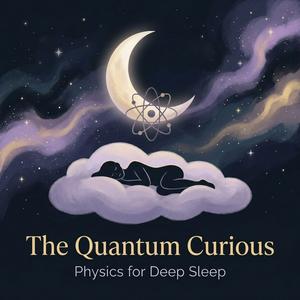
About The Quantum Curious | Deep Sleep Physics
You don’t need a science degree. You just need a racing mind and a ceiling you’ve been staring at for hours.The Quantum Curious is a sleep podcast for everyone who knows that Earth is their only and only home. No complex equations, no exams — just soothing stories about black holes, entanglement, and the fabric of reality, whispered to help you drift into deep, restorative sleep.Here’s the secret: when you truly grasp how vast the universe is, your worries shrink. Your to-do list loses its grip. Ego dissolves. The cosmos shows you, gently, that you’re a small, beautiful part of something unimaginably larger — and that’s the deepest comfort an insomniac mind can receive.Physics for Deep Sleep.🎧 New episodes weekly.Subscribe and let the stars carry your thoughts away.👉 Follow our YouTube channel for visual sleep journeys: Click here This podcast uses AI-assisted narration and music generation.Become a supporter of this podcast: https://www.spreaker.com/podcast/the-quantum-curious-deep-sleep-physics--7215963/support.
Podcast websiteListen to The Quantum Curious | Deep Sleep Physics, Shirtloads of Science and many other podcasts from around the world with the radio.net app
Get the free radio.net app
- Stations and podcasts to bookmark
- Stream via Wi-Fi or Bluetooth
- Supports Carplay & Android Auto
- Many other app features
Get the free radio.net app
- Stations and podcasts to bookmark
- Stream via Wi-Fi or Bluetooth
- Supports Carplay & Android Auto
- Many other app features

The Quantum Curious | Deep Sleep Physics
Scan code,
download the app,
start listening.
download the app,
start listening.
 South Africa

