
Listen to this podcast for free in the app: Download for free in the App Store
radio.net
Sleep timer
Save favourites
12 episodes
Dr. Iroro Tanshi: Rediscovering a Lost Bat, Then Saving Its Forest From Fire
2026/07/15 | 1h 30 mins.Dr. Iroro Tanshi found a bat species unseen in Nigeria for 45 years. Eight days later, she watched the forest it lived in catch fire.
That collision, a rediscovery and a disaster eight days apart, is what launched one of the most innovative community-led wildfire prevention programs in West Africa, and it's a big part of why Iroro just won the 2026 Goldman Environmental Prize, conservation's "Green Nobel." In this conversation, we talk about the short-tailed roundleaf bat she rediscovered on a mountain on the Nigeria-Cameroon border, the 2016 wildfire that nearly trapped her field team, and how a local farmer's simple question, "could you just tell us when to burn?", became the seed of a science-based fire prediction system that now uses town criers and "Forest Guardians" to keep entire communities safe. Her program has hit zero forest fires in Afi for five consecutive years and is now scaling to the DRC, Madagascar, and Indonesia through the Tropical Fire Alliance.
In this conversation:
00:00:18 – Introduction
00:00:31 – Rediscovering the short-tailed roundleaf bat after 45 years
00:05:06 – Ten new bat species records for Nigeria
00:13:36 – The hammer-headed fruit bat's booming mating call
00:25:47 – Growing up in Warri, an oil town, and her father's nature-documentary rule
00:32:05 – Founding SMACON and winning the 2026 Goldman Environmental Prize
00:41:00 – The 2016 wildfire that nearly trapped her field team
01:01:19 – Building a fire prediction model with town criers and Forest Guardians
01:02:25 – Zero wildfires for five years, and scaling globally with the Tropical Fire Alliance
01:25:15 Her advice for young African women in conservation
About Dr. Iroro Tanshi:
Dr. Iroro Tanshi is a Nigerian bat biologist and conservationist who co-founded SMACON, where she serves as Director of Research. She holds a BSc in Environmental Science and a Master's in Environmental Quality Management from the University of Benin, an MSc in Biodiversity Conservation from the University of Leeds, and a PhD from Texas Tech University. In 2016, she rediscovered the short-tailed roundleaf bat in Nigeria for the first time in 45 years. She has since won the Future for Nature Award (2020), the Whitley Award (2021), and the 2026 Goldman Environmental Prize.
About SMACON:
SMACON (Small Mammal Conservation Organization) protects at-risk small mammals in West Africa through evidence-based conservation and community partnership. Its flagship wildfire prevention program combines weather-based fire risk prediction with traditional town crier networks and community "Forest Guardian" response teams, achieving zero forest fires in Afi for five consecutive years while protecting roughly 27,000 people across 16 communities. SMACON is now scaling that model globally through the Tropical Fire Alliance.
Learn more:
SMACON Website: https://www.smacon-africa.org
Donate: http://wildnet.org/smacon
Instagram: https://www.instagram.com/smaconafrica/
CONNECT WITH SAVING WILDLIFE WITH SAM:
Subscribe: https://www.youtube.com/@savingwildlifewithsam
Facebook: https://www.facebook.com/savingwildlife
Join the newsletter: https://forms.gle/3v5UCmN6CgLGGM3s5
Follow Sam on LinkedIn: https://www.linkedin.com/in/sam-williams-0989483/
Please like, comment, and share to help more people discover these conservation stories. 🌍Dr. George Shillinger: Tracking the World's Largest Turtle Across the Pacific
2026/06/02 | 2h 6 mins.George Shillinger has spent 40 years protecting sea turtles. His path started a pet box turtle that had literally been to space!
I sat down with the Executive Director and Co-Founder of Upwell to talk about what it takes to protect an animal that crosses entire ocean basins, dives over a kilometre deep, and falls under the jurisdiction of dozens of governments.
Here's what struck me most: we've been pouring resources into protecting nesting beaches for decades. But sea turtles spend 99% of their lives at sea. That's where they're dying, from bycatch, ship strikes, pollution, and climate change. George built Upwell to address exactly that gap, using satellite tracking, species distribution models, and partnerships with fishers to protect turtles where it actually matters.
He also makes a compelling case for head-starting and rewilding, two of the most controversial ideas in sea turtle conservation. With Eastern Pacific leatherback populations down as much as 99%, his argument is hard to ignore.
In this conversation we cover:
Capturing and tagging Bumpy, a 1,500-pound leatherback
How spotter planes, acoustic telemetry, and satellite tags track turtles across the Pacific
The Eastern Pacific leatherback collapse: from 185 nesting females to 2 or 3
The Great Turtle Race
The Lost Years: tracking baby turtles with 2-gram satellite tags
Why the old conservation playbook isn't going to cut it
Link in comments. 🐢
#SavingWildlife #Conservation #SeaTurtles #Leatherback #MarineConservationTamsin Orr-Walker: Protecting Kea, the World's Most Curious Parrot
2026/04/26 | 1h 11 mins.A conversation about my favourite parrot! I had the pleasure of chatting with the Co-founder and Chair of the Kea Conservation Trust Tamsin Orr-Walker has spent 20 years protecting Kea, the world’s most curious parrot.
Kea slide down rooftops for fun, dismantle cars out of curiosity, and once caused $30,000 in damage to forestry equipment in a single night. They’re also endangered, with fewer than 7,000 left in the wild. The very traits that make them so captivating are the same ones that keep getting them into trouble.
This was a fun conversation about one of the most intelligent, curious, and mischievous birds on the planet. In this conversation we cover:
How 150,000 kea were killed under a government bounty, and the shift that followed
The lead poisoning crisis hiding in plain sight on South Island rooftops
How a conflict with forestry crews turned into one of their biggest conservation wins
Why New Zealand leads the world on public support for conservation
What 20 years of building a conservation trust from scratch actually looks like
Link in comments. 🦜
#SavingWildlife #conservation #kea #podcast #wildlife #NewZealandBill Sutherland: Using Evidence to Save Wildlife More Effectively
2026/04/02 | 54 mins.Bill Sutherland is Miriam Rothschild Professor of Conservation Biology at the University of Cambridge, Department of Zoology, and founder of Conservation Evidence. For over 20 years he’s been asking a deceptively simple question: if a doctor can look up the evidence for any treatment before prescribing, why can't a conservationist do the same?
Conservation has long relied on tradition, intuition, and accumulated experience. But the tools being used today are often the same ones used 50 years ago, while every other field has been transformed by innovation. Bill's work is changing that. In this conversation:
0:00 - Introduction
9:50 - Conservation Evidence: the database changing how we save wildlife
27:03 - Indigenous and traditional knowledge: opportunities and challenges
46:18 - Horizon scanning: predicting the next big threats to biodiversity
49:50 - AI in conservation: promise and risk
53:10 - Where conservation is headed in the next 5 to 10 years
About Bill Sutherland:
Bill Sutherland is the Miriam Rothschild Professor of Conservation Biology at the University of Cambridge and founder of Conservation Evidence. He coined the term "evidence-based conservation" and has spent over two decades building the tools and frameworks to make it a global standard. He is a Fellow of the Royal Society and was appointed Commander of the British Empire (CBE) in 2021 for services to evidence-based conservation. He also runs Conservation Concepts, a YouTube channel making ecology accessible to anyone curious about the natural world.
CONNECT WITH SAVING WILDLIFE WITH SAM:
Subscribe: / @savingwildlifewithsam
Facebook: / savingwildlife
Instagram: / savingwildlifewithsam
Join the newsletter: https://forms.gle/3v5UCmN6CgLGGM3s5
Follow Sam on LinkedIn: / sam-williams-0989483
Please like, comment, and share to help more people discover these conservation stories. 🌍Jen Miller: Sea Otters, Eco-Grief, and the Conservationist's Path Back to Hope
2026/03/12 | 1h 5 mins.Jen Miller is Senior Manager of the Sea Otter Fund at the Wildlife Conservation Network, and her path has been anything but linear. A PhD from the Yale School of Forestry and Environmental Studies studying tigers and livestock depredation in India. Wolves and jaguar reintroduction policy at Defenders of Wildlife. International wildlife trafficking grants at the US Fish and Wildlife Service. And now, one of conservation's most genuinely hopeful comeback stories: bringing sea otters back to 800 miles of coastline where they've been absent for over a century.
Sea otters were once called "soft gold," hunted so relentlessly in the 18th and 19th century maritime fur trade that 99% of their population was wiped out. Today, with 3,000 in central California and real momentum building around reintroduction, they're at the center of one of the ocean's most important ecological recovery stories. As a keystone species, when sea otters return, kelp forests follow, and when kelp forests return, everything else follows too.
But the biology might be the easy part. Getting to yes with fishermen, tribes, state and federal agencies, and coastal communities is where the real work happens.
Jen also speaks honestly about the emotional interior of conservation: eco-grief, climate anxiety, burnout, and the working group she co-founded called Revive, a global community of practice helping conservationists build the resilience to keep going for the long haul.
Bonus 5-Minute Guided Resilience Practice with Jen
Feeling eco-grief, climate anxiety, or the everyday weight of change? Jen leads a short guided body sensing practice you can use anywhere, anytime.
About the Sea Otter Fund
The Sea Otter Fund at the Wildlife Conservation Network supports research, community engagement, and the logistical groundwork needed to reintroduce sea otters across their historic range. With 3,000 southern sea otters in central California and an 800-mile gap to close, the fund is focused on the science, the stakeholder relationships, and the socioeconomic research needed to get to yes, with tribes, fishermen, and coastal communities leading the way.
In this conversation:
0:00 - Introduction
16:10 - Sea otters: from 300,000 to near-extinction and back
24:10 - Why great white sharks are accidentally blocking sea otter recovery
37:00 - The Sea Otter Fund: closing the 800-mile gap
43:20 - Revive: building emotional resilience in conservation
58:50 - Guided 5-minute emotional resilience practice with Jen
Learn more:
Sea Otter Fund: https://wildnet.org/wildlife-fund/sea-otter-fund/
Revive: https://www.reviveconservation.org/
CONNECT WITH SAVING WILDLIFE WITH SAM:
Subscribe: https://www.youtube.com/@savingwildlifewithsam
Facebook: https://www.facebook.com/savingwildlife
Instagram: https://www.instagram.com/savingwildlifewithsam/
Join the newsletter: https://forms.gle/3v5UCmN6CgLGGM3s5
Follow Sam on LinkedIn: https://www.linkedin.com/in/sam-williams-0989483/
Please like, comment, and share to help more people discover these conservation stories. 🌊 🦦
More Nature podcasts


Trending Nature podcasts



About Saving Wildlife with Sam
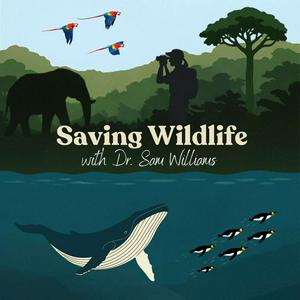
Get to know the extraordinary people who dedicate their lives to save wildlife and the places they call home. We go beyond the headlines to uncover their wildest encounters, toughest challenges, and what keeps them hopeful in the fight for nature.
Podcast websiteListen to Saving Wildlife with Sam, Okay, But... Birds and many other podcasts from around the world with the radio.net app
Get the free radio.net app
- Stations and podcasts to bookmark
- Stream via Wi-Fi or Bluetooth
- Supports Carplay & Android Auto
- Many other app features
Get the free radio.net app
- Stations and podcasts to bookmark
- Stream via Wi-Fi or Bluetooth
- Supports Carplay & Android Auto
- Many other app features

Saving Wildlife with Sam
Scan code,
download the app,
start listening.
download the app,
start listening.
Saving Wildlife with Sam: Podcasts in Family
 South Africa

